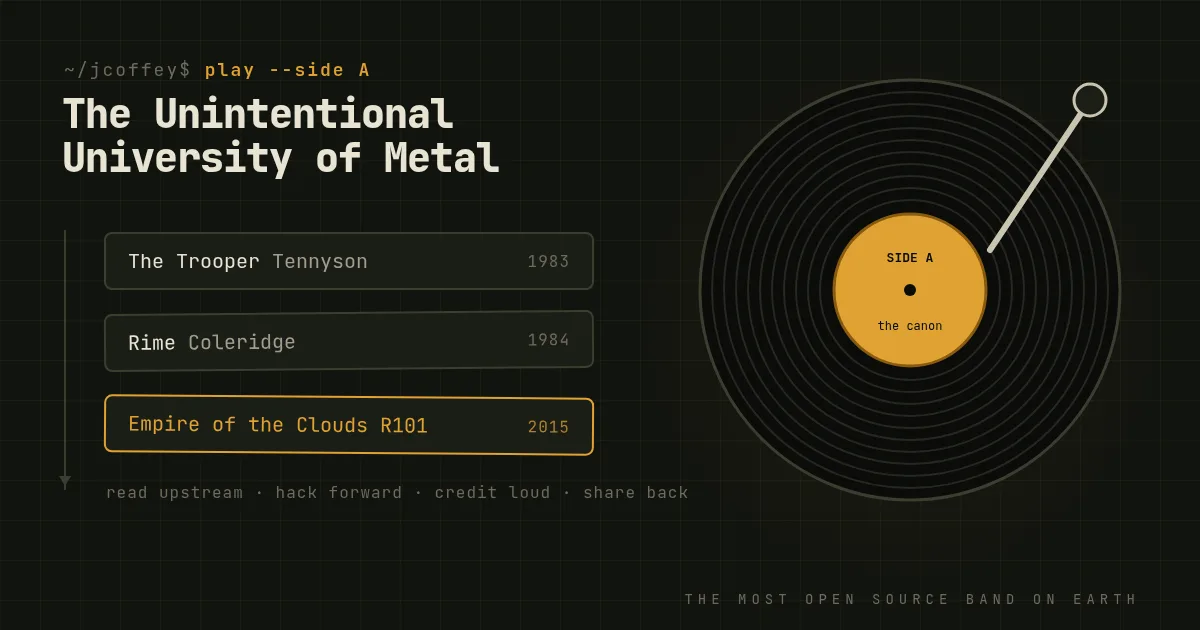
How a kid of the '70s learned to read, hack and share, because the riffs were irresistible.
Here's my argument: Iron Maiden are an open source band. They sit where Eric Raymond's cathedral meets his bazaar. The cathedral is the canon of literature and history. The bazaar is the open, noisy culture of fans, covers, guitar tabs and tours.
Growing up in the '80s, I absorbed Coleridge, Tennyson and whole chapters of military history through Maiden, and later Huxley too. Not because the band set out to teach me, but because their music entertained me so hard that learning was a side effect. The way they show their sources, keep a long-running catalogue in shape, and let their community carry it forward looks a lot like GNU/Linux culture: read upstream, remix with respect, ship improvements, give credit, share back.
The riff that opened a library
I didn't meet the classics in a classroom. I met them on vinyl. Maiden's album sleeves felt like spell books, and their songs were siege engines aimed at history and literature.
On the first day of senior English, when The Rime of the Ancient Mariner came up, I could already explain the albatross as guilt and penance, and recite key lines from memory. Maiden had drilled the poem into me while I thought I was just being entertained.
Open source by method, teaching by accident
- Open source by method. Maiden show their influences, transform them with craft, and release the result back into a culture that studies and builds on it.
- Teaching by accident. The band isn't a classroom. They're chasing a thrill, and in chasing it you chase their references. Curiosity arrives before any lesson does. That produces a self-motivated learner, exactly the kind of person open source depends on.
Cathedral and bazaar, at full volume
The cathedral: Coleridge, Tennyson and Huxley; the mud of Passchendaele, the surf of D-Day, the night sky the R101 airship fell from. Curated, lasting and exacting.
The bazaar: gigs, bootlegs, fanzines, tabs, video lessons, tribute albums and late-night arguments about tempo. Crowded, iterative, many-eyed.
Maiden stand with a foot in each. They pull "upstream code" from the cathedral and release playable builds into the bazaar, where thousands learn from them, fork them and play them, often without realizing they're being educated.
Pull requests from history and literature
- "Rime of the Ancient Mariner", from Coleridge. A faithful port from poem to metal epic: the structure kept, the medium changed.
- "The Trooper", from Tennyson's Charge of the Light Brigade and the Crimean War. The same story, told in the first person, with maximum immediacy.
- "Brave New World", from Huxley. The title, imagery and mood imported, and the dystopia brought into the present tense.
- "Paschendale," "The Longest Day" and "Montségur", from history. War as a system: terrain, logistics, ideology and human cost.
- "Empire of the Clouds", the R101 disaster. An eighteen-minute post-mortem for piano and orchestra: incident analysis as art.
- "To Tame a Land", from Dune. The band wanted to call it "Dune"; Frank Herbert's side said no. So they renamed it and shipped it, inspiration intact.
None of these songs lectures you. They entertain first, and that's what lures you upstream to the poem, the battle and the archive.
The maintainer model
The catalogue feels like a codebase:
- Steve Harris is the lead maintainer. He sets the taste and holds the line. The gallop is a style guide, the twin guitar leads are a convention, and Eddie is the mascot.
- Producers and co-writers are subsystem owners, responsible for tone, dynamics and how it all fits together.
- Albums are major releases, and tours are nightly builds. Setlists get tested on crowds every night, refined, and played again.
It's the same survival logic as GNU/Linux, applied to music: attribution, review, iteration, release.
How entertainment becomes education
Why does Maiden teach without trying?
- The sources are visible. Titles, lyrics and artwork point you upstream. No syllabus needed.
- The stories hook you. High stakes, vivid images and moral weight make you want the backstory.
- You play it again. Repetition makes rhythms and references stick, and curiosity grows in the gaps.
- The community rehearses it. Learning tabs and covers takes close reading, the same discipline as reading code or primary sources.
- They remix with respect. Crediting sources, staying faithful, and renaming when they have to: that's how to build on other people's work ethically.
What metal taught this hacker
- Chase upstream. Liner notes trained me to hunt down the poem, the battle, the design document.
- Don't settle for fragments. Read the whole thing, not just the chorus. Context prevents shallow takes.
- Respect the constraints. Quote where you may, summarize where you must, rename when you're blocked. Ship clean.
- Honor the maintainers. A strong review culture outlasts trends, in a kernel or a back catalogue.
Mini post-mortems
- "Rime": a faithful port, with the risk of melodrama managed by pacing and dynamics. Result: an enduring classic.
- "The Trooper": an interface change to the first person. Adoption exploded, and the riff became a common language for guitarists.
- "Empire of the Clouds": a big scope, accepted. The run time is justified by historical fidelity. Result: their longest track, and all signal.
- "To Tame a Land": a boundary hit, a rename, a release. Inspiration kept, permission respected.
Each one teaches, not as a lesson plan, but as what's left over when great entertainment is made with rigor and respect.
The nave, the market and the prompt
Iron Maiden build like a cathedral, with patient craft and classic sources, and thrive like a bazaar, with open influences and a community that keeps the music moving. Their rare gift is that they entertain so hard you end up educated: curious, well-sourced and ready to contribute.
That's why, to me, they're the most open source band on earth. They turned a boombox into a library, a mosh pit into a seminar, and, in the end, a command prompt into a workshop. The rule they carved into me still holds:
Read upstream. Hack forward. Credit loud. Share back.
And if the soundtrack to that rule is twin guitars and a gallop, so much the better.