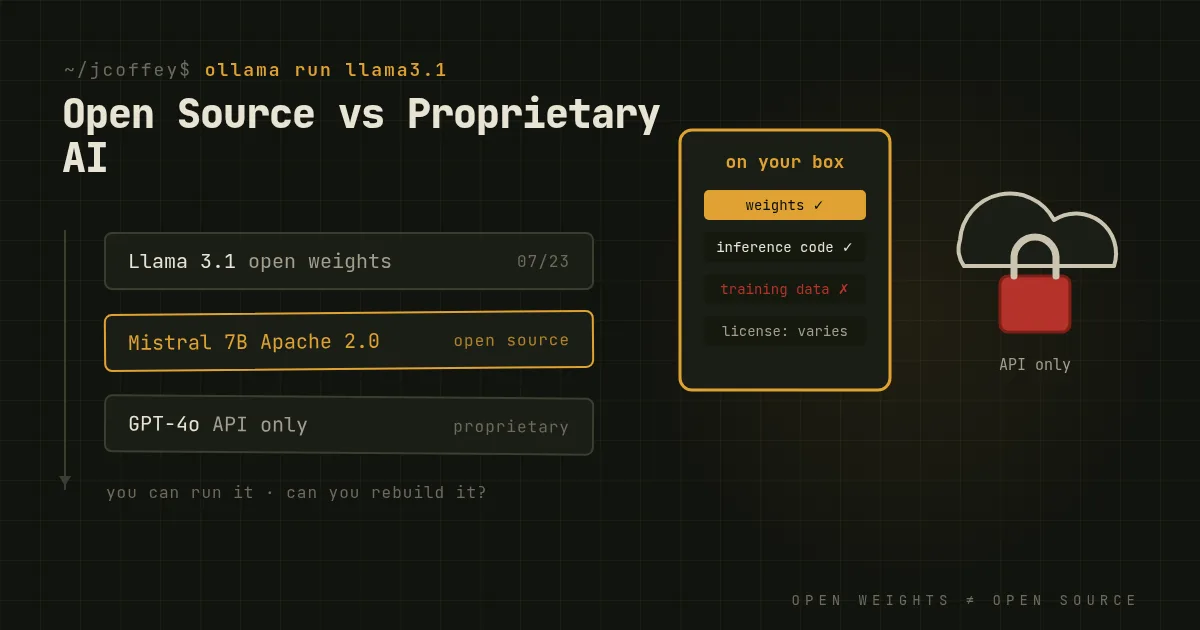
Yesterday, July 23, Meta released Llama 3.1, including a 405-billion-parameter model it says is competitive with the best proprietary models, and Mark Zuckerberg published an essay titled "Open Source AI Is the Path Forward." It's a big moment. A model in roughly the class of GPT-4 is now downloadable by anyone with the hardware to run it.
It also forces a question this field has been dodging: what does "open source" mean for an AI model?
What you actually get
An AI model isn't a program in the usual sense. To recreate one from scratch you'd need several things:
- The weights: billions of numbers learned during training. This is the model.
- The code to run it, which is usually the easy part.
- The training code and recipe: architecture details, hyperparameters, and the steps used.
- The training data: often trillions of words, scraped and filtered.
- A license that says what you may do with all of it.
Most "open" models, including Llama, release the weights and the code to run them, and keep the training data private. The accurate term is open-weight. You can run, fine-tune and inspect the model's behavior, but you can't rebuild it or see what it learned from.
And the licenses vary a lot:
- Llama 3.1 uses Meta's own community license. It's generous, but it isn't an open source license: services with more than 700 million monthly users need Meta's permission, there's an acceptable use policy, and it carries other conditions. The Open Source Initiative doesn't consider it open source.
- Mistral's smaller models, like Mistral 7B and Mixtral, are released under Apache 2.0, a genuine open source license. Its larger models aren't.
- Google's Gemma, Alibaba's Qwen and others each come with their own terms.
- A few projects, like the Allen Institute's OLMo, publish everything: weights, code, training data and logs. That's what open source would look like by the traditional definition.
The OSI is working on a formal Open Source AI Definition right now, and the arguments over it, particularly about whether training data must be released, are heated.
The proprietary side
OpenAI's GPT-4o, Anthropic's Claude 3.5 Sonnet and Google's Gemini 1.5 are available only through APIs and their companies' apps. You send text to their servers and get text back. As of this month, they still lead on the hardest reasoning and coding tasks, although Llama 3.1 405B has narrowed the gap considerably.
What you get: top-tier capability, no infrastructure to run, constant improvements, and contracts with privacy and data-handling terms.
What you give up: your data leaves your control, the model can change or be retired under you, prices and terms can change, and you can't inspect or modify it.
How to choose
Choose a hosted proprietary model when you need the very best capability, your data can leave the building under a suitable agreement, and you'd rather pay per use than run GPUs.
Choose an open-weight model when:
- Data can't leave your environment, because of privacy, regulation or confidentiality. Running a model on your own hardware means nothing goes anywhere.
- You need stability. A model file you downloaded will behave the same way next year. An API model can be updated or deprecated.
- You want to fine-tune on your own data for a narrow task, where a smaller tuned open model often beats a giant general one.
- Cost at scale favors running your own, once usage is high and predictable.
- You want to audit behavior, test for bias, or understand failure modes in ways an API won't let you.
Running them is easier than it used to be. Ollama and llama.cpp run quantized models on a laptop or workstation. vLLM serves them efficiently on GPU servers. An 8-billion-parameter model runs comfortably on a decent consumer GPU, and for summarizing, classifying, extracting and drafting, it's often good enough.
Why openness matters here more than usual
With most software, open source is about freedom and cost. With AI, it's also about power. A few companies controlling the most capable models means a few companies deciding what those models will and won't do, who can use them, and what happens to everything people type into them.
Open-weight models, even with imperfect licenses, keep a second path open: research, local deployment, independent safety testing and competition. That's worth supporting, while still being honest that "open weights" and "open source" aren't the same thing.
Since then
Added October 2026. The OSI published version 1.0 of its Open Source AI Definition in October 2024. In January 2025 DeepSeek's R1, released under the MIT license, showed an open model could match the leading proprietary reasoning models, and in August 2025 even OpenAI released open-weight models under Apache 2.0. In inbuxa, AI is off in a new install, built to use a model you host yourself, and only reaches a third-party service if the operator turns that on. Open-weight models are what make that possible.