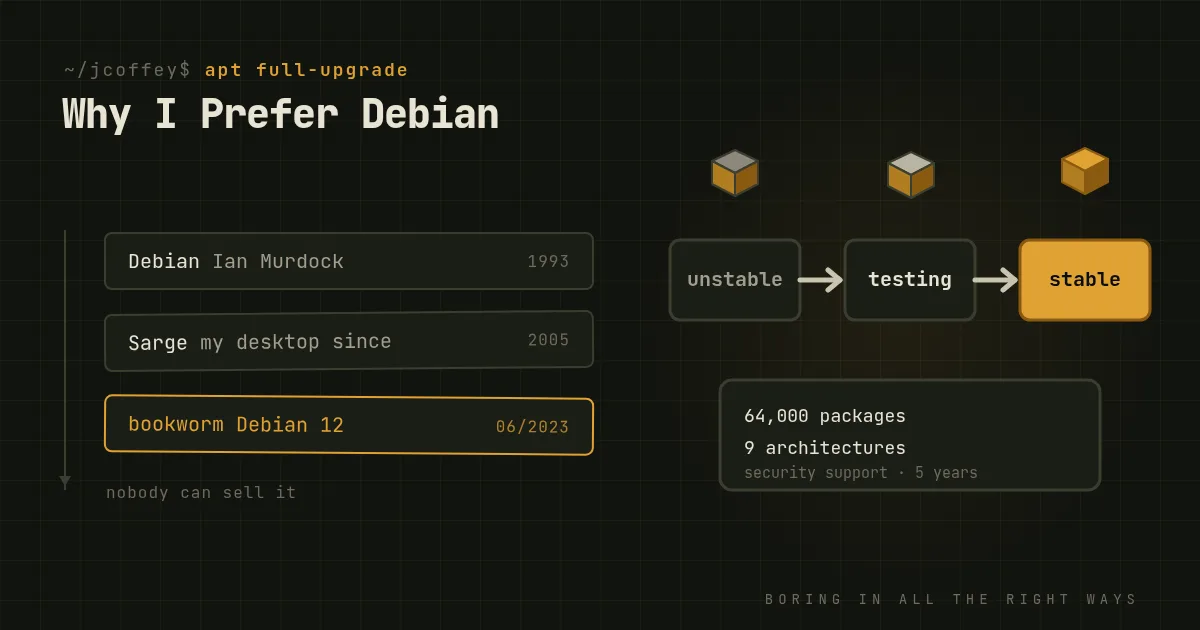
I've worked with most of the major Linux distributions, and I'll happily run any of them when the job calls for it. But when it's my choice, and I'm deploying something I want to forget about for five years, it's Debian. Every time. It's been my desktop, too, since Debian 3.1 "Sarge" in 2005.
Here's why.
Stability that means something
Debian has three branches. Unstable is where new packages land. Testing is where they settle. Stable is what you run in production. A new stable release comes out roughly every two years, when it's ready rather than on a calendar, after the release team has driven the critical bug count down to zero.
Once a release is stable, it doesn't change underneath you. You get security fixes and the occasional important bug fix, backported to the version you already have, and nothing else. The packages on a Debian 12 server today behave the same as the ones you tested when you deployed it. For a server, that's the whole point. Stability isn't "it doesn't crash." Stability is "nothing changes that I didn't decide to change."
The archive
Debian 12 ships about 64,000 packages in its main archive. Whatever you need, there's a good chance it's one apt install away, built from source by Debian, signed, and maintained by someone who cares about it. And the dependency handling in apt and dpkg has been refined for nearly thirty years. Upgrading a Debian system from one stable release to the next, in place, is a routine operation that normally just works. Most distributions can't honestly say that.
Security
The Debian Security Team publishes advisories and patched packages for the stable release quickly, and because those patches are backported to the versions you're running, applying them doesn't drag in new features or behavior. With unattended-upgrades, security fixes can install themselves overnight with very little risk.
Debian also does the unglamorous work: reproducible builds, so anyone can verify that a binary package matches its source, and a long-standing habit of documenting every change in a package's changelog.
Nobody can sell it
This reason gets less attention than it deserves, and it's become more important lately. Debian isn't a company. It's a volunteer project, founded by Ian Murdock in 1993, with an elected project leader, a published constitution, and a Social Contract promising that Debian will remain 100 percent free software and that its priorities are its users and free software.
That means nobody can buy Debian, change its license or decide it's no longer profitable. Look at the past few years. Red Hat ended CentOS Linux as a stable rebuild in 2020, then restricted public access to the RHEL source code last year. Whatever you think of those decisions, they were made for one company's commercial reasons, and the people who'd built on CentOS paid for them. That can't happen to Debian. Its future is decided by the people who build it, in public.
It runs on everything
Debian 12 officially supports nine architectures, from x86 and ARM to IBM's POWER and mainframe s390x. The same distribution, with the same tools and habits, runs on a Raspberry Pi, a cloud VM, a rack server and a mainframe partition. It's also the base of a large family, including Ubuntu, Linux Mint, Raspberry Pi OS, Kali and Proxmox VE. Skills learned on Debian travel well.
Long enough support
Each stable release gets about three years of full security support, then two more years of Debian LTS, maintained by a volunteer team funded by sponsoring companies. That's five years in all. Companies like Freexian sell extended support beyond that for the stragglers. Five years isn't RHEL's ten, but in-place upgrades between Debian releases work well enough that few systems need to stay on one release that long.
Minimal by default
A Debian server install gives you a base system and SSH, and nothing else unless you ask. No snaps, no extra services, no telemetry, no surprise daemons. You know everything that's running because you installed it.
The trade-offs
It wouldn't be honest to stop there.
- Packages get old. By the end of a release cycle, stable's software is two or more years behind. For servers that's usually fine. For a developer desktop it can be frustrating. Backports and containers help.
- New hardware lags. A brand-new laptop may want a newer kernel and firmware than stable has. Debian's backports kernel usually solves it.
- No vendor contract. If your organization needs a support contract with a phone number, Debian alone doesn't give you that. You can buy it from third parties, or use Ubuntu, Debian's commercially supported cousin.
- Certification. Some enterprise software is certified only on RHEL or SUSE. If that's your situation, follow the support matrix.
Where I'd choose something else
Ubuntu LTS when a vendor or a team expects it. RHEL or a rebuild like Rocky or Alma where the software certification requires it. Fedora or Arch on a desktop that wants the newest everything. Everywhere else, Debian.
It isn't the newest, the flashiest or the fastest to adopt anything. It's just the one that's still running, unchanged and patched, years after you've forgotten about it. In this job, that's the highest compliment I know.
Since then
Added October 2026. Debian 13 "trixie" came out in August 2025, and Debian turned 33 this August, which I wrote about in Thirty-Three Years of Debian. After more than twenty years of Debian on the desktop, I also tried an Arch-based distribution there, and wrote about it in A Debian Veteran Tries CachyOS.