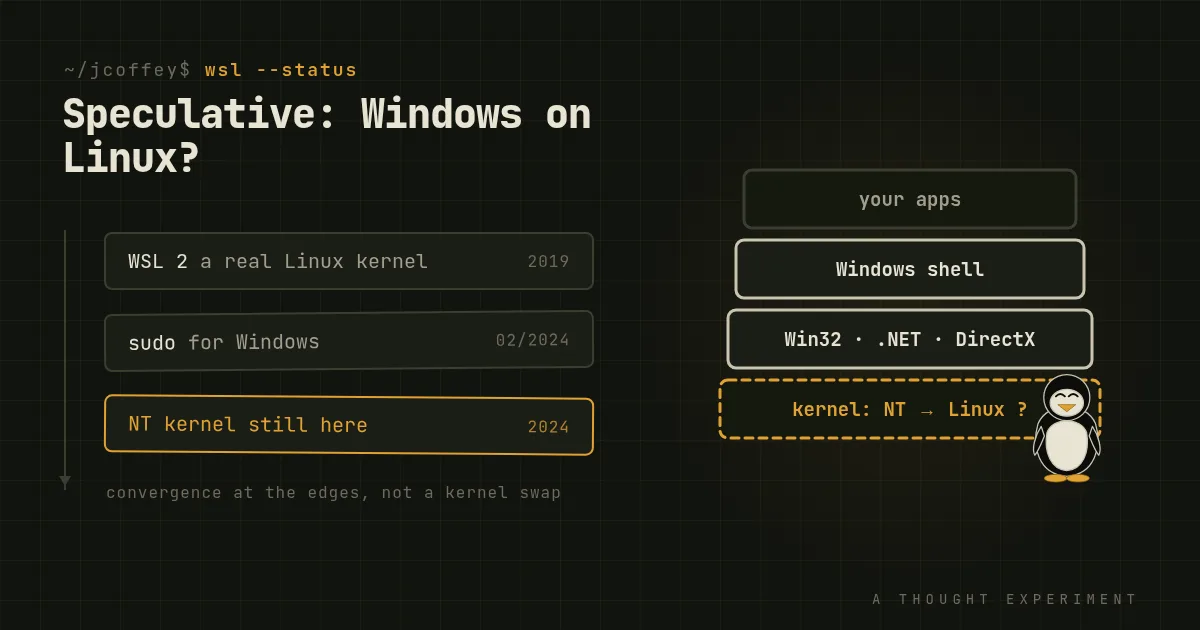
This is speculation. Microsoft has announced nothing of the kind. It's a thought experiment about where things are heading, and the honest answer is less dramatic than the headline.
In 2001 Microsoft's chief executive called Linux "a cancer." Today Microsoft ships a real Linux kernel inside Windows, runs a large share of its own cloud on Linux, and maintains its own Linux distribution. So it's a fair question, asked more often every year: what if the next Windows simply ran on Linux?
How far Microsoft has already come
It's further than most people realize:
- WSL 2 has shipped a full Linux kernel, built and maintained by Microsoft, inside Windows since 2019. Millions of developers use it every day.
- Azure Linux, formerly CBL-Mariner, is Microsoft's own Linux distribution, used across its cloud services and offered as a container host.
- SONiC, the network operating system Microsoft built for Azure's switches, runs on Linux and is now open source under the Linux Foundation.
- Half of Azure runs Linux, by Microsoft's own past statements, along with SQL Server on Linux, .NET on Linux, PowerShell on Linux, and Visual Studio Code everywhere.
- Windows is getting more Unix-like. Microsoft announced
sudofor Windows this February, and Windows Terminal,wingetand OpenSSH are now standard.
At the same time, Microsoft announced this March that it's ending the Windows Subsystem for Android in 2025, a reminder that it retreats as easily as it advances.
The thought experiment
Imagine Microsoft did it the way Apple did. In 2001 Apple replaced classic Mac OS with Mac OS X, which put Apple's own interface and frameworks on top of an open source Unix core, Darwin. Picture the Windows equivalent: the Windows shell, the Win32 and .NET application layers, DirectX and the management stack running on a Linux kernel instead of the NT kernel.
What would be gained:
- One kernel across the cloud and the desktop, for a company whose cloud already leans heavily on Linux.
- Shared driver work. Hardware makers already write Linux drivers for servers, phones and embedded devices.
- Containers, natively. Linux containers without a virtual machine in between.
- Contributions back. Microsoft's engineers improving the Linux kernel for the desktop would help every Linux user.
Why it almost certainly won't happen that way
Compatibility is Windows' whole value. Windows runs software and drivers written decades ago. Most of that compatibility lives in, or depends on, the behavior of the NT kernel and its driver model. Rebuilding it on Linux would mean emulating NT faithfully enough to run everything from kernel-mode anti-cheat to industrial control software. Wine has spent thirty years working on the user-space half of that problem and is impressive, but it isn't perfect.
The NT kernel is good. It's a mature, well-engineered kernel with strengths of its own, in its security model, its I/O architecture and its driver ecosystem. There's no engineering crisis forcing a switch.
The GPL. Linux is licensed under GPL version 2. Microsoft would have to publish its kernel changes and drivers built into the kernel. That's manageable, since Android manages it, but it's a different way of working, and some partners' drivers would be awkward.
The business doesn't need it. Microsoft's money comes from Azure, Microsoft 365 and enterprise contracts, not from the kernel. Windows already runs Linux software through WSL. The kernel is the last place Microsoft needs to spend a decade of disruption.
What's actually likely
The realistic future is convergence at the edges, not a kernel swap:
- WSL keeps getting better, until running Linux software on Windows is indistinguishable from running it natively.
- More of Windows becomes open or cross-platform, the way PowerShell, .NET, Terminal and VS Code did.
- The kernel gets safer instead of replaced. Microsoft has started rewriting parts of Windows in Rust, and there's growing pressure to move third-party code, like security agents, out of the kernel.
- Servers keep moving to Linux wherever customers choose, with Microsoft happy to host them.
That's less exciting than "Windows 12, now with Linux inside." But in a way it's a bigger victory for open source than a kernel swap would be. The company that called Linux a cancer now ships it, contributes to it and builds its cloud on it, by choice.
Since then
Added October 2026. A week before I wrote this, a CrowdStrike update crashed 8.5 million Windows machines, and Microsoft has since begun moving antivirus and endpoint security products out of the Windows kernel, which is one piece of the "safer instead of replaced" path. The Windows Subsystem for Android ended on schedule in March 2025.