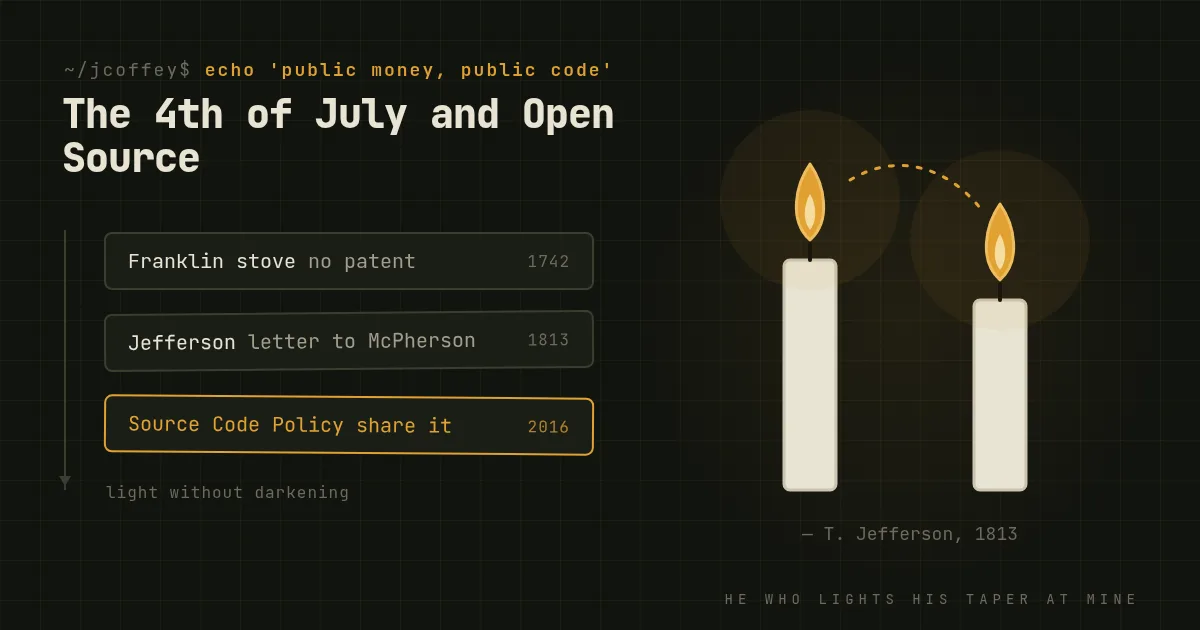
The comparison between Independence Day and open source writes itself, which is usually a sign it shouldn't be written. Freedom, community, throwing off the rule of a distant power that charges whatever it likes. Fine.
But two of the founders actually had something specific to say about ideas and who owns them, and it holds up better than most of what gets said about software today.
Franklin wouldn't take the patent
Benjamin Franklin invented the Franklin stove, bifocals, the lightning rod and the flexible urinary catheter, among other things. He patented none of them. When the governor of Pennsylvania offered him an exclusive patent on the stove, he turned it down, and explained why in his autobiography:
As we enjoy great advantages from the inventions of others, we should be glad of an opportunity to serve others by any invention of ours; and this we should do freely and generously.
That's the open source bargain in one sentence. You build on what others gave away, so you give away what you build. Every Linux distribution, every web server and every programming language you use for free exists because thousands of people made that same choice.
Jefferson and the candle
Thomas Jefferson ran the first US patent board, so he thought about this harder than most. In an 1813 letter to Isaac McPherson, he explained why an idea can't really be owned the way land can:
He who receives an idea from me, receives instruction himself without lessening mine; as he who lights his taper at mine, receives light without darkening me.
It's the clearest statement of why software sharing works that anyone has written. Copying code costs the original author nothing. Jefferson still supported limited patents, as an incentive society chooses to grant for a while. But he was clear that ideas belong naturally to everyone, and that any monopoly on them is a temporary arrangement, not a natural right.
Both quotes are in the public domain, of course. Copyright expires. That was the founders' design, too: the Constitution grants exclusive rights to authors and inventors "for limited Times," to "promote the Progress of Science and useful Arts."
The code you already paid for
There's a more practical side to this, for anyone who pays US taxes.
The federal government spends billions of dollars a year on custom software. Since 2016, under the Federal Source Code Policy, agencies are supposed to release at least 20 percent of their new custom-developed code as open source, and share all of it between agencies, so the public doesn't pay to build the same thing twice. Some agencies take it seriously. NASA, the Digital Service and 18F publish a great deal of their work on GitHub, and code.gov was set up to make it findable.
Many don't. The rule is a memo, not a law, and compliance is patchy. Congress has bills in the works to make code sharing a legal requirement rather than a guideline.
It's worth caring about. Software paid for with public money should be available to the public that paid for it, both because it's ours and because an agency that publishes its code has to write code it isn't embarrassed by. Europe has been running with that idea for years under the slogan "public money, public code."
Independence, the practical kind
For anyone who runs systems, the useful version of today's theme isn't a metaphor. It's a checklist:
- Could you leave your vendor? If your critical software is open source and you have the data in an open format, the answer is yes, and the vendor knows it, which keeps the prices honest.
- Could you keep running it if the company disappeared? With open source code, you or someone you hire can.
- Do you know what's in it? You can audit open source, or pay someone to. You can only trust closed source.
None of that requires everyone to read their source code. It requires the option. That's what Franklin turned down a patent to protect, and what Jefferson was describing when he lit his candle from someone else's.
Happy Fourth.
Since then
Added October 2026. It became law. The SHARE IT Act, signed on December 23, 2024, requires federal agencies to make their custom-developed code available for reuse across government, with exceptions for classified and sensitive code. 18F, one of the teams that had done the most to publish government code in the open, was shut down in March 2025.