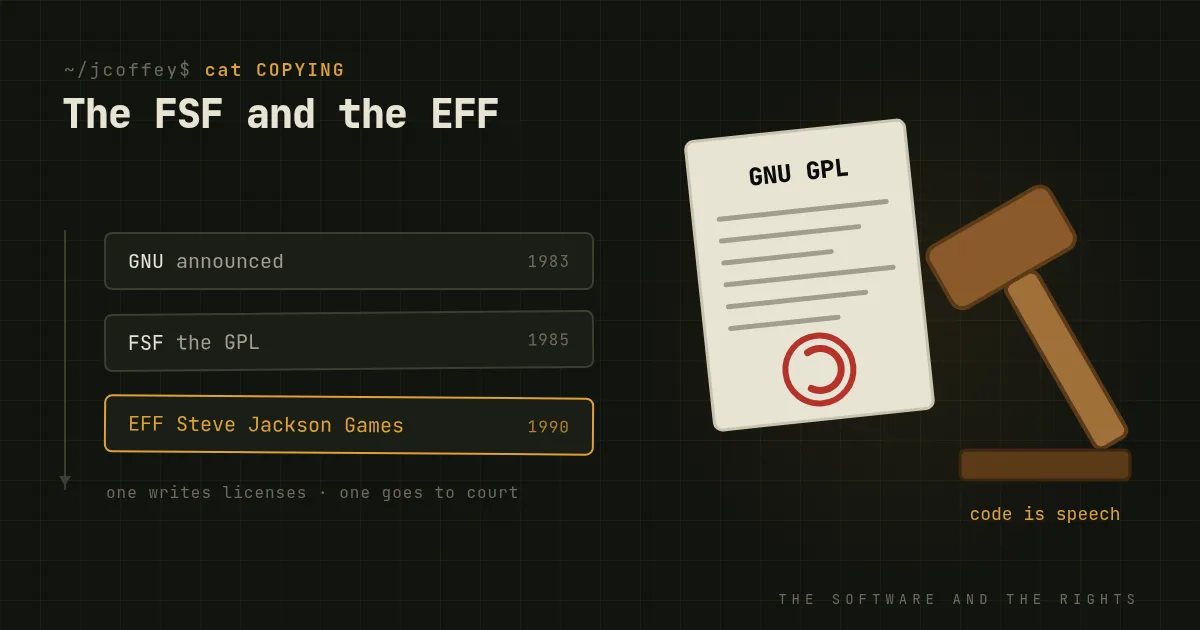
They both have "Foundation" in the name, they were founded five years apart, and anyone who cares about open source has probably donated to one while thinking of the other. They are not the same thing, and they don't do the same job.
The Free Software Foundation is about the software. Can you read it, change it and share it? The Electronic Frontier Foundation is about your rights when you use a computer at all. Can the government search it, can a company sue you over it, can someone stop you from encrypting it? One writes licenses. The other goes to court.
The FSF: a printer and a promise
The usual origin story starts with a printer. Around 1980 the MIT AI Lab got a new Xerox laser printer that jammed often. On the lab's old printer, Richard Stallman had modified the driver to notify users when a job jammed. For the new one, Xerox wouldn't share the source code. A small annoyance, but it crystallized something. Software that you couldn't read or fix wasn't really yours, and the culture of sharing code that he'd grown up in at MIT was being replaced by nondisclosure agreements.
In September 1983 Stallman announced the GNU Project, to build a complete Unix-compatible operating system made entirely of free software. In October 1985 he founded the Free Software Foundation to support it, raise money, and employ programmers.
The FSF defined free software by four freedoms. Run the program for any purpose. Study how it works and change it. Redistribute copies. Distribute your modified versions. "Free as in freedom, not as in beer," as the saying goes. The price was never the point.
Its most consequential invention is a legal one: the GNU General Public License, first published in 1989. The GPL uses copyright to do the opposite of what copyright usually does. Anyone may use, change and share the code, but anyone who distributes a modified version must pass the same freedoms on. It's called copyleft, and it's why the code companies build on top of GPL software comes back to the commons instead of disappearing into a product. Linus Torvalds put Linux under GPL version 2 in 1992. GPLv3 followed in 2007, adding protection against hardware that refuses to run modified software, along with clearer patent terms.
What the FSF does today:
- Stewards the GPL family, including the LGPL for libraries and the AGPL, which extends copyleft to software run as a network service. That one matters a lot for anything self-hosted.
- Holds copyright on much of GNU, which lets it enforce the license as a single party.
- Certifies hardware under its "Respects Your Freedom" program, for devices that run on free software only.
- Runs campaigns against DRM and software patents, and keeps its list of free software licenses.
The FSF is also a famously uncompromising organization, and that has cost it. Stallman resigned in 2019 after remarks he made in a mailing list thread, then returned to the board in 2021, which led many companies and projects to withdraw support. You can believe the FSF's principles are right and still be frustrated with how it's run. A lot of people in this field are in exactly that position.
The EFF: the Secret Service and a game company
The EFF also has an origin story, and it involves a raid. On March 1, 1990, the US Secret Service raided Steve Jackson Games in Austin, Texas, chasing a hacker investigation that had nothing to do with the company. Agents seized its computers, including the one running its bulletin board system, and read and deleted the users' private email. They also took the manuscript of a role-playing book called GURPS Cyberpunk, which one agent described as a "handbook for computer crime."
Mitch Kapor, founder of Lotus, along with lyricist and writer John Perry Barlow and early Sun employee John Gilmore, founded the Electronic Frontier Foundation in July 1990, in part to take that case. They won. In 1993 a federal court found the government had violated the Privacy Protection Act and the laws protecting stored electronic communications. It was one of the first rulings to say that email deserves legal protection.
The EFF has been doing the same thing since: making the case, in court and in public, that rights don't stop at the keyboard.
- Bernstein v. United States. In the 1990s, the US classified strong encryption as a munition, and exporting it required a license. The EFF represented Daniel Bernstein, who wanted to publish his encryption code. The Ninth Circuit agreed in 1999 that source code is speech, and the export rules were relaxed soon after.
- Deep Crack. In 1998 the EFF built a $250,000 machine that broke a DES key in 56 hours, to prove that the government-blessed encryption standard was too weak. DES was replaced.
- Encrypting the web. The EFF built HTTPS Everywhere, co-founded Let's Encrypt, and maintains Certbot, the tool most servers use to get Let's Encrypt certificates.
- Surveillance. Years of litigation against warrantless mass surveillance, and tools like Privacy Badger and Cover Your Tracks that show people how they're being tracked.
- DMCA Section 1201. It keeps fighting the anti-circumvention rules that make it illegal to get around DRM even when you're repairing your own tractor or researching a security bug, and it wins exemptions every three years.
Why you need both
They're often confused because they're allies. Both believe users should control their own technology. But they work at different layers.
The FSF protects your right to have software you can control. The EFF protects your right to use it without being searched, sued or silenced. A free software stack doesn't help much if running it is illegal, and digital rights don't mean much if every device you own runs code you're not allowed to read.
There are others doing related work, and they deserve a mention. The Software Freedom Conservancy does most of today's GPL enforcement and hosts projects like Git and Inkscape. The Open Source Initiative maintains the Open Source Definition and approves licenses. If you value any of this, pick one and give it some money. Each of them runs on donations, and each of them has done more for your rights as a computer user than most of the companies you pay every month.
Since then
Added October 2026. The FSF turned forty in October 2025. One of its licenses is now the backbone of my own work: Coffey Labs releases inbuxa and ihasmail under the AGPL, the copyleft license for network services. It's why anyone who runs a modified copy for others to use has to share the changes back.