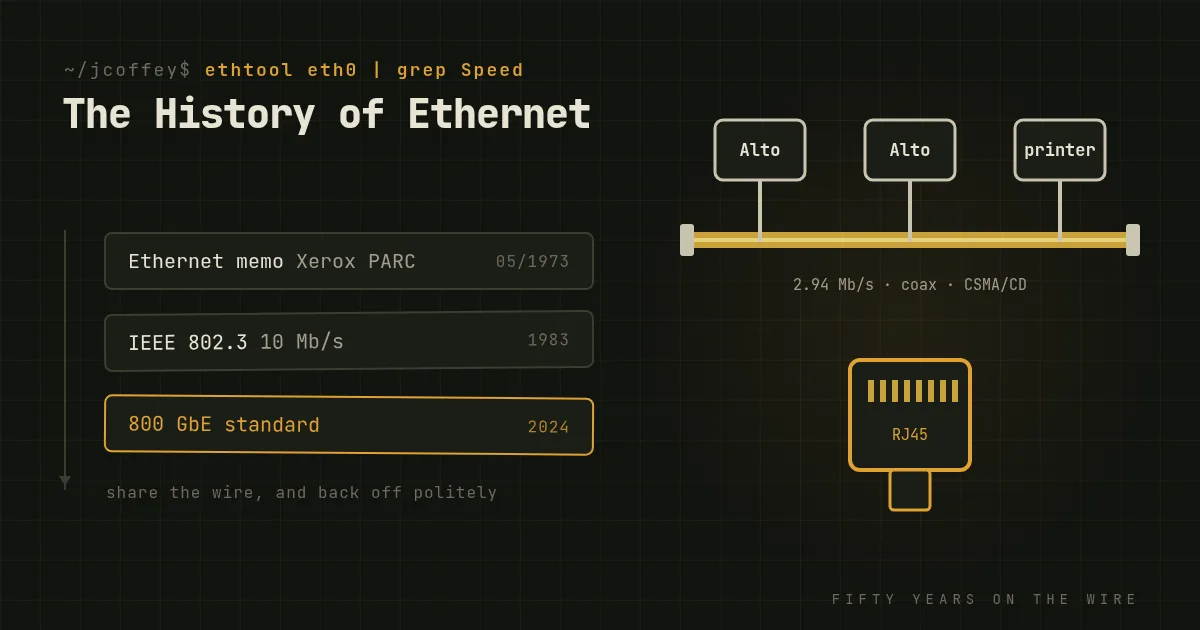
On May 22, 1973, Bob Metcalfe, a young researcher at Xerox's Palo Alto Research Center, wrote a memo describing a way to connect the lab's new Alto personal computers to each other and to a laser printer. He called it Ethernet, after the "luminiferous ether" that nineteenth-century physicists imagined carried light everywhere.
More than fifty years later, it's still how most wired computers connect, at speeds his memo couldn't have imagined. Here's how it got there.
The idea: share the wire, and back off
Metcalfe borrowed a key idea from ALOHAnet, a radio network at the University of Hawaii in which stations simply transmitted whenever they wanted and retransmitted if a collision garbled the message.
Ethernet put that on a cable. Every computer was attached to one shared coaxial cable. Before sending, a station listened to check the wire was quiet. If two stations started at the same moment, they detected the collision, stopped, and each waited a random, increasing amount of time before trying again. The method has a name only an engineer could love: carrier-sense multiple access with collision detection, or CSMA/CD.
The first experimental Ethernet, built by Metcalfe and David Boggs, ran at 2.94 megabits per second. They published the design in 1976 in a paper titled "Ethernet: Distributed Packet Switching for Local Computer Networks."
The standard: DIX and IEEE 802.3
Metcalfe left Xerox in 1979 to found 3Com, to sell Ethernet. Crucially, he persuaded Xerox, DEC and Intel to publish an open specification together. The "DIX" standard of 1980 set Ethernet at 10 megabits per second, and in 1983 it became an IEEE standard, 802.3.
Being an open standard that any company could build to was Ethernet's decisive advantage. Its rivals in the 1980s were serious:
- IBM's Token Ring passed a token around a ring, so only one station transmitted at a time. It was deterministic and performed well under heavy load, but it was IBM's and it was expensive.
- ARCNET was cheap and reliable and popular in small offices.
Ethernet won anyway, because many companies made compatible equipment, competition drove prices down, and each new generation stayed compatible with the last.
The cable changes: from coax to twisted pair
Early Ethernet used thick coaxial cable, nicknamed "frozen yellow garden hose," and later thinner coax, daisy-chained from machine to machine. One bad connector could take down a whole segment.
The big practical change came with 10BASE-T in 1990: ordinary twisted-pair telephone-style cable, run from each computer to a central hub in a star. It was cheaper, easier to install and much easier to troubleshoot. The RJ45 plug on your laptop or desktop descends directly from it.
Switches end the collisions
Hubs still repeated every packet to every port, so the network was still one shared medium. Through the 1990s, switches replaced hubs. A switch learns which device is on which port and forwards each frame only where it needs to go. With full-duplex links, each port sends and receives at once, and collisions simply stop happening.
That quietly retired the CSMA/CD mechanism at the heart of Metcalfe's original design, and nobody minded. Ethernet kept its name, its frame format and its compatibility, and became a switched network underneath.
Faster, and faster
| Year | Standard | Speed |
|---|---|---|
| 1983 | 10BASE5 | 10 Mb/s |
| 1995 | Fast Ethernet | 100 Mb/s |
| 1998–1999 | Gigabit Ethernet | 1 Gb/s |
| 2002 | 10 Gigabit | 10 Gb/s |
| 2010 | 40 and 100 Gigabit | 100 Gb/s |
| 2017 | 200 and 400 Gigabit | 400 Gb/s |
| 2024 | 800 Gigabit | 800 Gb/s |
Along the way it picked up Power over Ethernet, in 2003, which delivers power alongside data to phones, cameras and wireless access points, and single-pair variants built for cars and factories.
Ethernet today
- Data centers. The race to build AI clusters has made networking a bottleneck. Thousands of GPUs must exchange data constantly. NVIDIA's InfiniBand has dominated the largest training clusters, but Ethernet is pushing hard into that space, and the Ultra Ethernet Consortium, formed in 2023 by AMD, Broadcom, Cisco, Intel, Meta, Microsoft and others, is adapting Ethernet specifically for AI and high-performance computing.
- Offices and homes. A gigabit port is standard, and 2.5 and 10 gigabit are increasingly common.
- Not Wi-Fi. Your home wireless network is IEEE 802.11, a different standard. It carries Ethernet-style frames and bridges seamlessly to your wired network, but it's a radio protocol of its own.
Why it lasted
Ethernet's history is a fifty-year lesson in what makes technology endure:
- An open standard many companies could build to.
- Backward compatibility at every step, so new equipment worked with old.
- Willingness to change everything underneath, cable, topology and even the collision mechanism, while keeping the name and the frame format stable.
Metcalfe received the Turing Award, computing's highest honor, in 2023 for inventing Ethernet. David Boggs, his co-inventor, died in 2022. The network they built in a Palo Alto lab is one of the few pieces of 1970s technology that every one of us uses every day.
Since then
Added October 2026. The Ultra Ethernet Consortium published its first specification, Ultra Ethernet 1.0, in June 2025, and work on 1.6-terabit Ethernet is underway.