An open letter to CEOs
Dear CEO,
I've spent more than thirty years in IT, from mainframes to the cloud, and I've watched the way technical work gets done change almost beyond recognition. I'm writing about one decision a lot of you are making right now: ordering technical staff back to the office full time.
Last month Amazon told its corporate employees they'll be in the office five days a week from January. Others are following. I think it's a mistake for technical teams, and I'd like to explain why.
Collaboration doesn't need a room anymore
Early in my career, collaboration meant being physically present: meetings, whiteboards, hashing things out face to face. That was a different time with different tools. Today engineering teams collaborate through version control, code review, chat, video and shared documents, and much of the work of the open source world, including the Linux kernel, has been done this way for decades by people who've never met.
In my experience, deep technical work needs long blocks of uninterrupted time, and the office is often where that time goes to die: drop-by interruptions, meetings that exist because everyone's nearby, noise. Remote work gives engineers back the focus that complex work requires.
The evidence is in
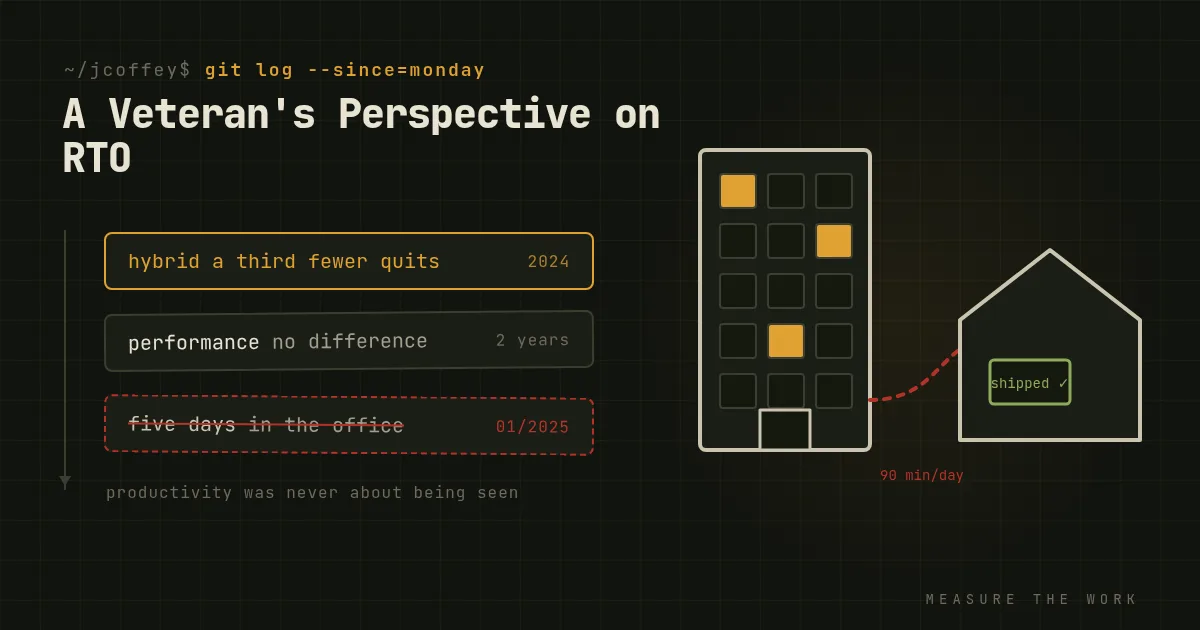
This isn't just opinion. In June the journal Nature published a randomized trial by Stanford economist Nicholas Bloom and colleagues at Trip.com, a large travel company. More than 1,600 employees, including software engineers, were randomly assigned to work from home two days a week or stay in the office full time. Over two years:
- Quit rates fell by a third in the hybrid group.
- Performance and promotions were no different between the groups.
- Managers' own views changed. Before the trial, they expected hybrid work to hurt productivity. Afterward, they thought it helped slightly.
A study that randomly assigns people is about as strong as evidence in management gets. It says hybrid work keeps people without costing output.
Your best people have options
Over thirty years, I've watched the balance of power in the technical job market shift. Experienced engineers, architects and specialists know what they're worth, and many of them now treat flexibility as a basic condition of a job. A full-time mandate doesn't send everyone back to their desks. It sends some of your most experienced people to your competitors, and they're usually the ones you can least afford to lose. You keep the people with fewest options, and you've traded your senior talent for a fuller parking lot.
Productivity was never about being seen
Earlier in my career, productivity was measured by who was at their desk first and left last. After three decades, I've learned that productivity is about results, not presence. Some of the most effective technical people I've worked with weren't the ones you saw in the office first thing in the morning or last thing at night. They were the ones who consistently delivered excellent work, wherever they were.
If you're worried your teams aren't productive, measure the work: what ships, how reliable it is, how fast problems get fixed. If you can't tell whether someone is productive without watching them, the problem isn't where they sit.
The costs you don't see on the spreadsheet
Commuting costs your people hours every week, and costs the environment the emissions of millions of daily trips. Those hours come out of rest, family and the kind of slack that prevents burnout. Your staff will feel the loss immediately, even if your balance sheet doesn't show it for a year.
A better path
I'm not arguing that offices are useless. Some things genuinely go better in person: onboarding, planning, building trust in a new team, the occasional hard conversation. So:
- Make in-person time purposeful. Bring teams together for the things that benefit from it, on a schedule they help set.
- Let teams decide how they work best, within clear expectations about results and responsiveness.
- Measure outcomes, not attendance.
- Invest in the tools and practices that make distributed work good: written decisions, recorded meetings, documentation and asynchronous review.
Your technical staff spent the past few years proving they can do excellent work from anywhere. Trust them, and you'll keep the people who make your organization run.
Sincerely,
John Ellis Coffey
Thirty-year IT veteran and open source advocate
Since then
Added October 2026. Amazon's five-day mandate took effect in January 2025, and several other large employers followed with their own. The debate hasn't gone away, and neither has the evidence: hybrid arrangements remain common across the technical workforce.