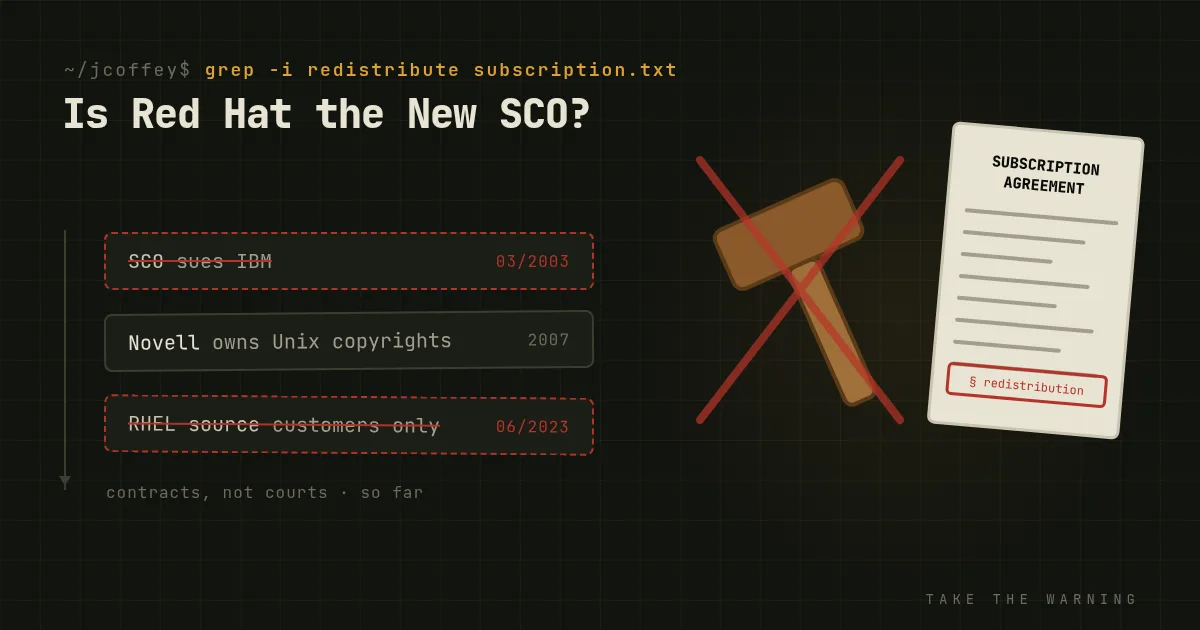
For anyone who was around Linux in the early 2000s, "SCO" is shorthand for the worst kind of corporate behavior toward open source. Comparing Red Hat to SCO is a serious charge, and it deserves a careful look rather than a slogan. So let's look at what SCO actually did, what Red Hat has actually done, and why the comparison keeps coming up.
What SCO did
The SCO Group, the renamed Caldera, which had once sold its own Linux distribution, claimed in 2003 that Linux contained code copied from Unix, which it said it owned.
- It sued IBM in March 2003, eventually seeking billions of dollars, alleging IBM had put Unix code into Linux.
- It sent letters to Linux users at large companies, warning they might be liable, and offered "licenses" to run Linux.
- It sued other companies, including Novell, AutoZone and DaimlerChrysler.
It never showed meaningful infringing code. In 2007 a court ruled that Novell, not SCO, owned the Unix copyrights SCO was suing over, and SCO filed for bankruptcy that year. The litigation dragged on in various forms until 2021. What SCO wanted was to be paid for Linux, which it hadn't written, by claiming to own part of it, and it used the courts and fear to try.
What Red Hat has done
Red Hat's story is different in important ways, and similar in one that matters.
- In December 2020 it ended CentOS Linux as a stable, free rebuild of RHEL, replacing it with CentOS Stream, a preview of future RHEL releases.
- In June 2023 it stopped publishing RHEL's exact source code publicly. Source now goes to customers through the customer portal, under subscription terms that let Red Hat end your subscription if you redistribute it.
- A Red Hat executive described the free rebuilders, Rocky Linux and AlmaLinux, as adding no value, essentially free-riding on Red Hat's engineering.
Red Hat says it fully complies with the GPL, since anyone who receives RHEL binaries can get the source. And it hasn't sued anyone.
Where the comparison is unfair
- Red Hat writes a great deal of Linux. It's one of the largest contributors to the kernel, GCC, glibc, systemd, GNOME and much more. SCO contributed nothing and claimed ownership of others' work. Red Hat is restricting access to a product built in large part from its own engineers' work.
- No lawsuits. Red Hat hasn't taken anyone to court over RHEL rebuilds. SCO sued its way into bankruptcy.
- The source isn't secret. Everything in RHEL is developed in public upstream, and CentOS Stream is public. What's restricted is the exact, matched build that makes a 1:1 clone easy.
Where it holds
- Control over Linux for revenue. Both companies tried to turn shared, freely licensed code into something only paying customers could fully use. SCO did it with lawsuits. Red Hat does it with contracts. The method is gentler, but the goal rhymes.
- Using a contract to limit a freedom the license grants. The GPL says you may not impose "further restrictions" on recipients' exercise of their rights, including the right to redistribute. Red Hat's terms don't stop you redistributing GPL code. They just end your relationship with Red Hat if you do. Whether that's compatible with the GPL is argued by lawyers. That it works against the GPL's purpose is hard to argue with.
- The chilling effect. SCO made companies nervous about Linux. Red Hat's changes made the businesses and communities built on RHEL compatibility nervous about their future, which is why SUSE, CIQ and Oracle formed OpenELA to keep publishing enterprise Linux sources openly.
- The irony. IBM was SCO's main target, and the company that fought hardest to defend Linux. IBM now owns Red Hat.
So, is it?
No, not yet, and not in the same way. Red Hat isn't trying to sue Linux users, and it hasn't claimed to own what others wrote. It's still one of the most important contributors to open source there is.
But SCO's real lesson wasn't about lawsuits. It was that a company can destroy decades of goodwill by deciding the community is a revenue problem to be managed rather than the source of its success. Red Hat has started down that road. Its rebuilders have survived, its community has organized around it, and its reputation has taken a real hit. It should take the warning while the comparison is still unfair.
Since then
Added October 2026. As far as I'm aware, Red Hat still hasn't taken anyone to court over RHEL rebuilds, and AlmaLinux and Rocky have kept shipping, including their version 10 releases in 2025. I wrote about the wider pattern of corporate control over open source in When the Cathedral Ate the Bazaar.