In 1997 Eric S. Raymond presented his essay The Cathedral and the Bazaar. He described two ways to build software:
- The cathedral: closed, hierarchical, built carefully by a small group and released when they decide.
- The bazaar: open and decentralized, where anyone can contribute, and work happens in public, fast.
His argument, summed up as "given enough eyeballs, all bugs are shallow," was that the bazaar would out-build the cathedral. For a long time he was right. Linux, Apache, MySQL and countless other projects showed that communities could match and beat the biggest companies.
Nearly thirty years on, the picture looks different. The cathedral didn't just survive. It adapted, and in many ways it swallowed the bazaar. Open source is everywhere, but the freedom to use it, change it and build on it is more and more constrained by acquisitions, license changes and centralized platforms.
The playbook
It tends to go the same way:
- Acquire an important project, and fold its community into a sales pipeline.
- Restrict it, with license terms that make "free" mean "free unless you compete with us."
- Centralize the platforms open source itself depends on.
- Rebrand community projects as enterprise products.
The result is a paradox: there's more open source than ever, and it's harder than ever to freely fork, remix and redistribute.
Case studies
IBM and Red Hat
In 2019 IBM bought Red Hat for $34 billion, then the largest software acquisition ever. Red Hat had been the proof that you could build a billion-dollar business on open source.
Then came the changes. In December 2020, Red Hat announced that CentOS Linux, the free rebuild of Red Hat Enterprise Linux used by startups, schools and small businesses, would end years early. CentOS Stream, which sits ahead of RHEL rather than matching it, took its place. In 2023, Red Hat stopped publishing RHEL's source publicly, limiting it to customers and making life much harder for rebuilds like Rocky Linux and AlmaLinux.
Free redistribution, a defining feature of the bazaar, was fenced in to protect the enterprise business.
Microsoft and GitHub
Microsoft bought GitHub in 2018. Many expected the old "embrace, extend, extinguish." What came was subtler. GitHub stayed free for individuals and became even more central: the default identity, issue tracker, code review and CI system for open source. Then it was tied into Microsoft's cloud and AI products, Codespaces and Copilot among them.
Open source code still lives on GitHub. But the discovery, the workflow and the infrastructure belong to one company.
Elastic and Amazon
Elastic built Elasticsearch and Kibana under the Apache 2.0 license. Cloud providers, Amazon above all, sold them as hosted services. In 2021, Elastic moved to the Server Side Public License and its own Elastic License, neither of which is open source. Amazon forked the last Apache version as OpenSearch.
Users had to choose sides, and legal teams started reviewing a search engine. In 2024 Elastic added the AGPL back as an option, but by then there were two projects where there had been one.
HashiCorp and Terraform
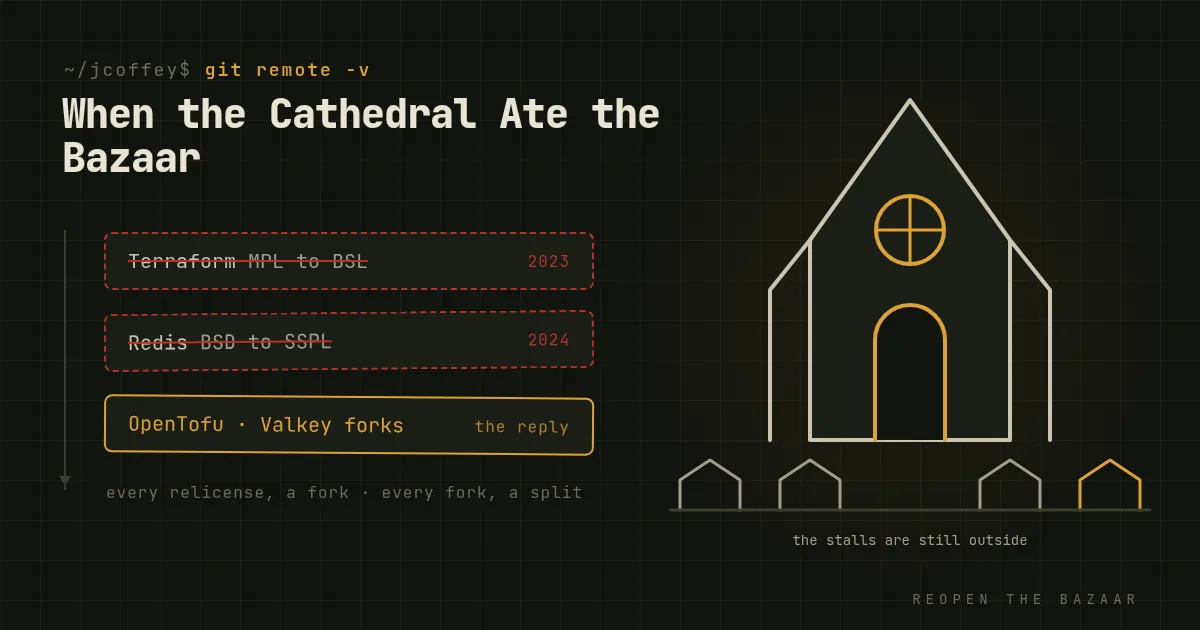
Terraform, Vault and Consul became staples of cloud infrastructure under the Mozilla Public License. In 2023 HashiCorp moved them to the Business Source License, which restricts use by competitors. The community forked Terraform as OpenTofu, now under the Linux Foundation. IBM then bought HashiCorp too, completing the deal in early 2025.
Redis and Valkey
Redis spent most of its life under the permissive BSD license. In 2024, Redis moved to a pair of source-available licenses. Within weeks the Linux Foundation launched Valkey, an open fork, and many Linux distributions and cloud providers moved to it. In 2025 Redis added the AGPL as an option. Again, the fork came first.
NGINX
NGINX started as a lean, fast web server sysadmins loved. Its company had already been selling a commercial NGINX Plus with extra features since 2013, and in 2019 F5 bought it. The open version continues, but the project's energy increasingly feeds an enterprise product line. In 2024, one of its longtime core developers left and started a fork, freenginx.
The cost of forks
Forks keep the bazaar alive, but they're not free.
- MySQL and MariaDB. When Oracle bought Sun, and MySQL with it, MySQL's original creator forked MariaDB. Both live on, but tools, documentation and expertise had to be split.
- OpenOffice and LibreOffice. In 2010, unhappy with Oracle's stewardship, most of the OpenOffice.org community forked LibreOffice. It thrives under The Document Foundation. Apache OpenOffice, where Oracle handed the original, has barely moved.
- OpenSearch, OpenTofu and Valkey. Each one duplicates work, splits communities, and makes adopters pick a side.
Forks show resilience. They also add friction, and they dilute the accessibility that made open source what it was.
Why the cathedral won back ground
- The cloud. Running software at global scale favors the biggest companies.
- Investors. Venture-backed companies need revenue, and see relicensing as protection against the cloud giants.
- Convenience. GitHub, Docker Hub, npm and PyPI aren't just services. They're the bazaar's infrastructure, and whoever owns them has enormous leverage.
- Branding. When the conferences, docs and releases carry a company's logo, a project stops feeling like it belongs to its community, even if the license hasn't changed.
Accessibility lost
For a new developer, open source doesn't feel as open as it did:
- License anxiety. Code you could once just use now needs a legal review first.
- Rebuilds cost more. Restricting RHEL's source raised the price of building a compatible distribution.
- Platform tolls. Docker Desktop started requiring paid subscriptions for larger companies in 2021, even though the code underneath stayed free.
The bazaar still fights back
It isn't dead:
- Foundations like the Linux Foundation, the Apache Software Foundation and the CNCF give projects a neutral home.
- Forks work as an immune response. MariaDB, LibreOffice, OpenTofu and Valkey show that communities can outlast a takeover, and the relicensing climb-downs at Elastic and Redis show the pressure works.
- New funding models, from crowdfunding to collective governance, are being tried.
But without structural protections, the cathedral will keep buying stalls.
How to reopen the bazaar
- Use OSI-approved licenses. Keep the code truly free, and make money above it: support, hosting, training.
- Put governance first. Place trademarks, specifications and decision making with neutral non-profits, not the company that funds the work.
- Don't depend on one platform. Mirror code, docs and releases on infrastructure no single company controls.
- Relicense in the open. If a license must change, give the community a vote, a migration guide and time.
- Change how organizations buy. Prefer projects with neutral governance and real open source licenses.
The future of the bazaar
Raymond expected the bazaar to eclipse the cathedral. He was right, for a while. Then the cathedral adapted. It bought the stalls, rewrote the rules and took over the roads in and out.
The bazaar still exists, but it's fragmented and fenced. If the next generation of developers is going to find open source as free and open as we did, we have to reopen it, with foundations, forks and governance that resist capture.
Open source isn't just code. It's freedom, access and community. If we let the cathedral own the bazaar, we lose more than software. We lose the culture of working together that built the internet.
Since then
Added October 2026. Point 3 stopped being theoretical for me in September 2026, when GitHub suspended my account without notice. Coffey Labs' code now lives mainly on a Gitea server I run, with GitHub as a mirror. I wrote about it in Six Days Without GitHub.