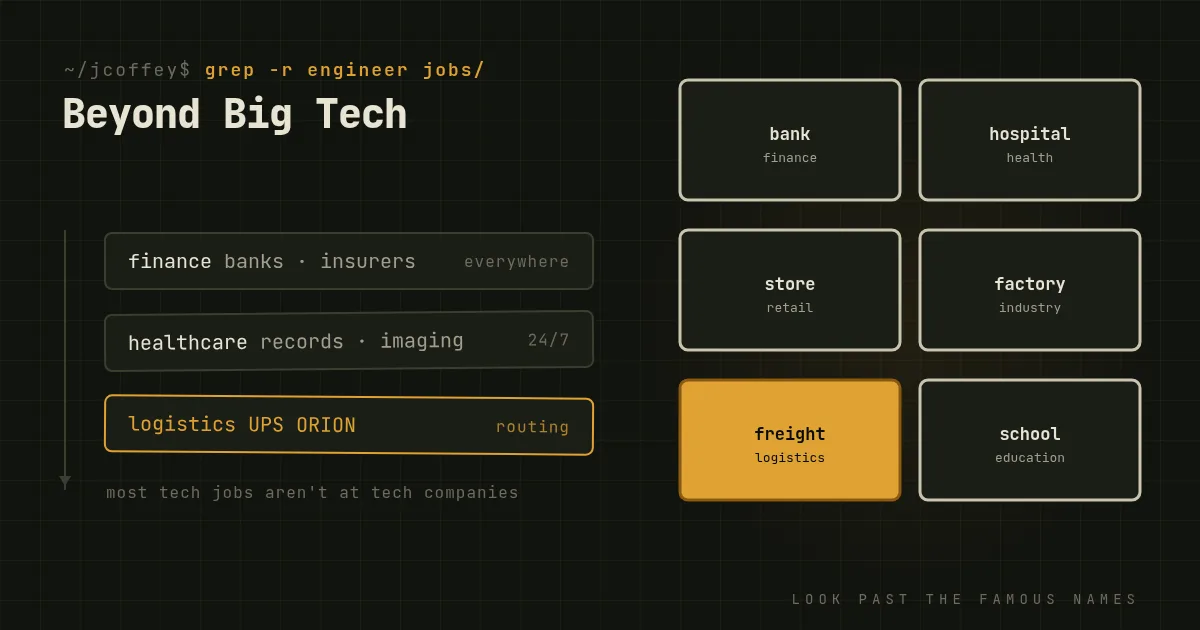
Ask people starting out in tech where they want to work, and you'll hear the same few names: Google, Amazon, Apple, Microsoft. Those companies are famous, they pay well, and they get an avalanche of applications for every opening.
They're also a small part of the picture. Most people who work in technology don't work for a technology company. They work for a bank, a hospital, a retailer, a manufacturer, a shipping company, a school district or a government. Every industry now runs on software, and every one of them needs people to build and run it.
Here's a tour.
Finance
Banks, insurers, investment firms and payment companies are some of the biggest employers of technical people anywhere. The largest US banks count their technologists in the tens of thousands. Customers expect to do everything from their phones, trading runs on software measured in microseconds, and the whole industry is a target for fraud and attack.
The work: core banking and trading systems, fraud detection, mobile apps used by millions, and some of the most demanding security and compliance work there is. Fintech companies like Stripe and Block offer the same problems at startup pace.
Healthcare
Hospitals, insurers, drug makers and health startups all depend on software: electronic health records, telemedicine, imaging, lab systems, wearables and the systems that bill for all of it. Large health insurers run technology divisions the size of a software company.
The work: integrating systems that were never designed to talk to each other, protecting some of the most sensitive data there is, and keeping critical systems up, around the clock. If you want work where the outcome matters, this is it: your code can make a patient's day easier, or help a doctor catch something sooner.
Retail
Retail is a technology business now. Online stores have to survive Black Friday, warehouses run on software, and every price, promotion and delivery slot is calculated. Walmart, the world's largest retailer, runs one of the largest technology organizations anywhere.
The work: e-commerce sites and apps at huge scale, the cloud systems behind them, inventory and demand forecasting, supply chain systems, and payment security.
Manufacturing
Factories are full of computers. Modern cars carry millions of lines of code. John Deere, best known for green tractors, now builds machines that drive themselves and use computer vision to spray individual weeds rather than whole fields.
The work: embedded software for vehicles and machines, programming factory automation, connecting equipment to monitoring systems, and using sensor data to predict when a machine will fail before it does. It's satisfying in a particular way: you can see and touch what your work produced.
Logistics and transportation
Every package that arrives on time is a solved optimization problem. UPS built a routing system called ORION to plan its drivers' routes, and the company has said it saves about 10 million gallons of fuel a year. Airlines run enormous IT departments for reservations, crew scheduling, flight operations and maintenance.
The work: tracking platforms, route and network optimization, forecasting, sensors on trucks and containers, and keeping systems running that simply can't stop.
Education
Schools and universities run large networks, learning platforms and student systems, and they need people to run them. Education companies build the apps and platforms millions of people learn on, from language apps to online courses.
The work: learning platforms, data on what helps students learn, systems for teachers, and a lot of infrastructure that has to work on the first day of term.
It's not all coding
Across all of these, the roles are much the same, and many don't involve writing code all day:
- Software developers build the applications.
- System administrators and cloud engineers keep the infrastructure running.
- Security specialists protect data and systems.
- Data analysts and scientists turn information into decisions.
- UX designers make the systems usable.
- Business analysts, product and project managers connect the technology to what the business needs.
- Support and field engineers keep things working on the ground, sometimes literally on a factory floor or a hospital ward.
In a non-tech company, the tech team is often smaller, which can be a good thing early on. You may get to work across more of the stack, own something bigger sooner, and see directly how your work affects the business.
How to look further
- Look past the obvious names. Many of the best tech jobs are at companies your friends don't think of as tech companies.
- Use what you already know. If you love finance, health or logistics, that knowledge is an advantage. Say so when you apply.
- Expect less competition. A regional insurer or a city IT department will see far fewer applicants for an opening than a famous tech brand.
- Keep learning. Technology moves fast wherever you are, and working outside big tech often exposes you to more of it.
- Think about impact. Products used by billions are one kind of impact. Keeping a hospital's systems running is another.
Technology is the engine inside nearly every industry now. It's fine to aim for the big names. Just don't stop there. Your best tech job may be somewhere you'd never have looked.