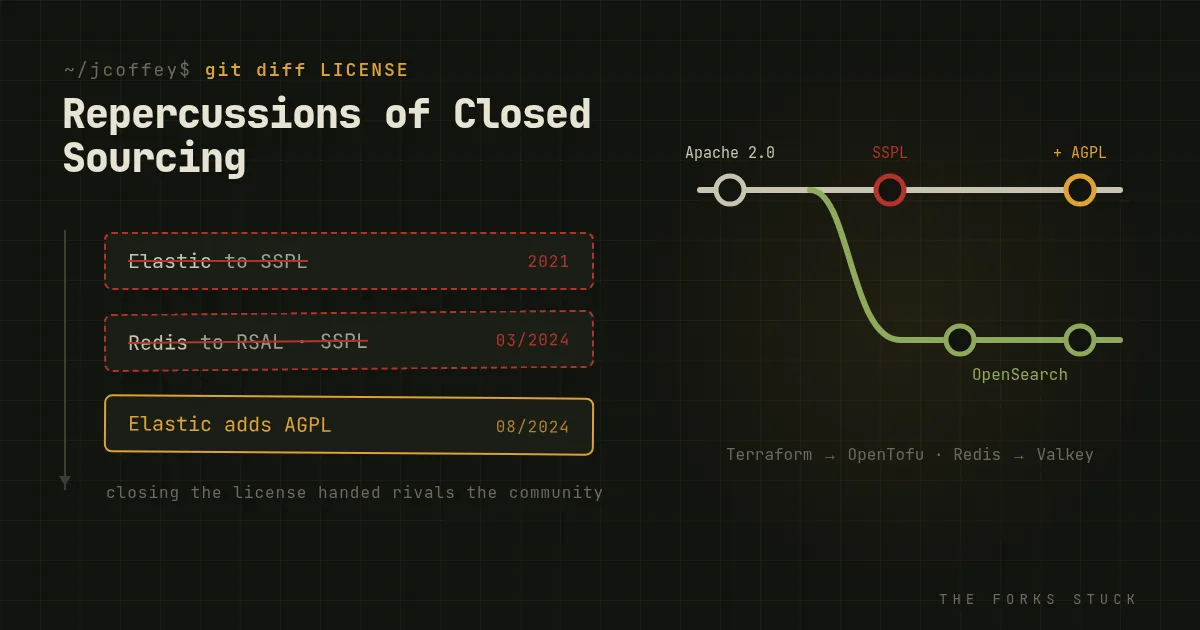
On August 29, Elastic announced that it was adding the AGPL as a licensing option for Elasticsearch and Kibana. Three years after it moved them off Apache 2.0 to a pair of source-available licenses, Elasticsearch is open source again.
That's a remarkable reversal, and a good moment to look at the whole pattern. Since 2018 a series of companies have taken projects they built in the open and closed the license. There's now enough history to see what actually happens next.
The pattern
Each case followed roughly the same arc. A company builds a popular open source project and a business around it. A cloud provider, usually AWS, starts offering it as a hosted service without contributing much back. The company concludes it's subsidizing a competitor, and changes the license so cloud providers can't do that.
- MongoDB, 2018: moved to its new Server Side Public License, which requires anyone offering the software as a service to open source their entire service stack. The OSI declined to approve it as open source.
- Elastic, 2021: moved Elasticsearch and Kibana from Apache 2.0 to the SSPL and its own Elastic License.
- HashiCorp, 2023: moved Terraform, Vault and the rest to the Business Source License, which forbids competing uses until the code converts to open source after four years.
- Redis, March 2024: moved from BSD to a dual SSPL and Redis Source Available License.
- CockroachDB, last month: announced it will retire its free self-hosted Core edition in November in favor of a single enterprise license, free only for small companies.
What happened next
The forks came, fast, and they stuck.
- AWS forked Elasticsearch as OpenSearch in 2021. Three years on, it's a mature project with its own ecosystem, and the default search engine in many places.
- Terraform became OpenTofu within weeks, now at the Linux Foundation and adding features Terraform lacks. I wrote about it in Introduction to OpenTofu.
- Redis became Valkey, also at the Linux Foundation, backed by AWS, Google and Oracle, within a week of the license change.
The biggest irony is that the forks are often led by exactly the cloud providers the relicensing was aimed at. Closing the license didn't stop the competitor. It handed them the community.
Linux distributions dropped the relicensed versions. Distributions only ship open source software in their main archives. Debian and Fedora don't include the source-available Elasticsearch or Redis, so new users meet the forks first.
Trust took a hit that didn't heal. Every company with a single vendor controlling an open source project's copyright now has to answer the question "could you do this too?" Contributors became warier of signing contributor license agreements that make relicensing possible.
And the business results are mixed at best. MongoDB has done well, though it's hard to separate the license from its strong cloud product. HashiCorp agreed to be acquired by IBM this April. Elastic's reversal last week speaks for itself. Its founder's explanation was that the market confusion the change had targeted was now resolved.
Why companies do it anyway
It's worth being fair here. The underlying problem is real: building and maintaining serious infrastructure software costs a fortune, and a hyperscaler can offer your project as a service, with better distribution, and give nothing back. Permissive licenses allow that by design.
But source-available licenses are a blunt fix. They break the promise the community relied on when it contributed, and they punish every user, not just the hyperscaler.
Better answers
- Choose the license deliberately on day one. The AGPL requires anyone offering modified software as a network service to share their changes. That's what Elastic just adopted, and what plenty of projects use from the start. It protects against free-riding without leaving open source.
- Put the project in a foundation if it's critical infrastructure, so no single company can change the terms.
- Sell something the cloud can't copy: a better hosted service, support, expertise, enterprise features built around the open core.
- Avoid copyright assignment through contributor license agreements if you want contributors to trust you.
For users: questions to ask before you depend on something
- Who owns the copyright? One company, or many contributors?
- Is there a CLA that would let one company relicense?
- Is it in a foundation?
- Is there a credible fork or alternative if the license changes?
- What's the vendor's business model, and is it under pressure?
None of these is a reason not to use a company-backed open source project. They're reasons to have a plan if the company changes its mind.
Since then
Added October 2026. Redis followed Elastic's lead and added the AGPL with Redis 8 in May 2025. Amazon moved OpenSearch to a new OpenSearch Software Foundation at the Linux Foundation in September 2024, and IBM completed its HashiCorp acquisition in February 2025. I wrote the larger version of this story in When the Cathedral Ate the Bazaar.