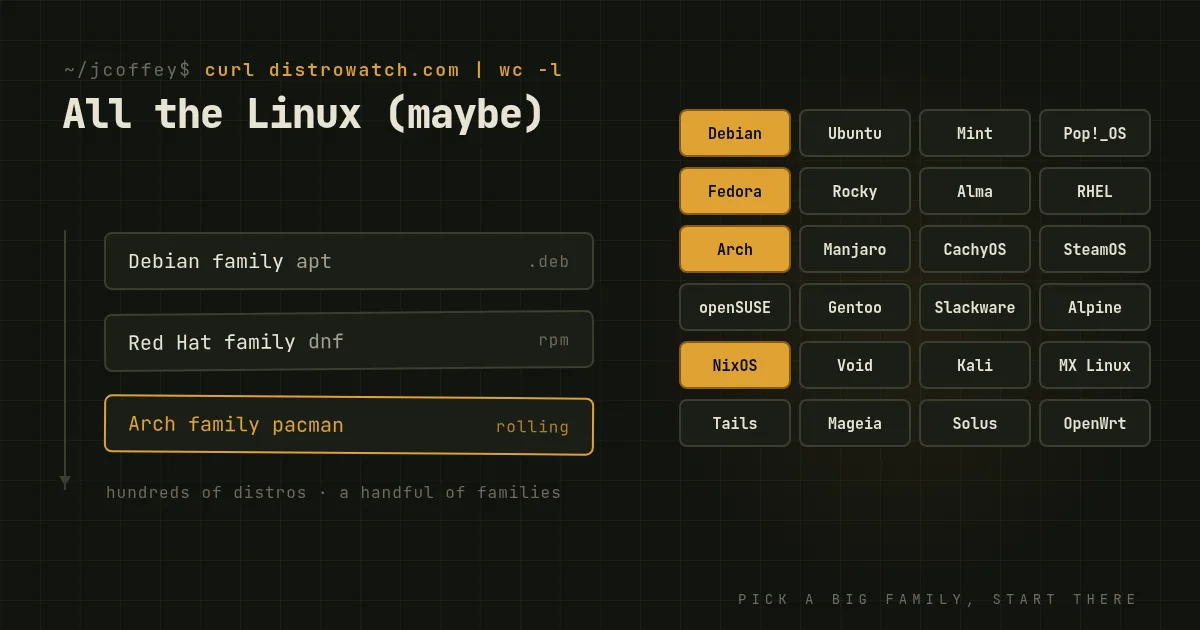
How many Linux distributions are there? DistroWatch tracks several hundred active ones, and that's before counting the in-house builds every large company and appliance maker has. Listing them all is impossible. But nearly all of them belong to a few families, and once you know the families, the rest make sense.
Here's a tour, accurate as of late summer 2024. It's opinionated about what's worth knowing, not exhaustive. Hence the "maybe."
The Debian family
The largest family, built on .deb packages and apt.
- Debian: the community-run parent, famously stable. Version 12, "bookworm," is current.
- Ubuntu: Debian-based, from Canonical, with long-term support releases every two years. 24.04 LTS arrived in April. Its official flavors swap in different desktops: Kubuntu (KDE Plasma), Xubuntu (Xfce), Lubuntu (LXQt), Ubuntu MATE, Ubuntu Budgie, Ubuntu Cinnamon, Ubuntu Unity, Ubuntu Studio for media production, Ubuntu Kylin for Chinese users, and Edubuntu for education, revived as an official flavor in 2023.
- Linux Mint: built on Ubuntu, the friendliest landing spot for people coming from Windows. LMDE is its Debian-based edition.
- Pop!_OS, elementary OS, Zorin OS and KDE neon: Ubuntu-based, each with a strong design point of view.
- MX Linux and antiX: Debian-based, light and fast, with MX near the top of DistroWatch's popularity list for years. Damn Small Linux was revived this year on an antiX base.
- Devuan: Debian without systemd.
- Security and privacy: Kali Linux and Parrot OS for security testing, and Tails, the amnesic live system that routes everything through Tor.
- Raspberry Pi OS: the Pi's default system.
- Special purpose: Proxmox VE for virtualization, TurnKey Linux appliances, VyOS for routing, and grml and Finnix for system rescue.
- Others worth knowing: Deepin, with its own polished desktop, SparkyLinux, and Knoppix, the live CD that showed everyone what a live CD could do.
- National distributions: Astra Linux in Russia, BOSS in India and Canaima in Venezuela, among others.
The Red Hat family
RPM packages and dnf.
- Fedora: the community distribution where new technology lands, sponsored by Red Hat. Its Atomic desktops, like Silverblue and Kinoite, are image-based and nearly unbreakable. Fedora Asahi Remix runs on Apple Silicon Macs.
- CentOS Stream: the preview of the next RHEL minor release.
- Red Hat Enterprise Linux: the commercial product, with ten-year support.
- Rebuilds: Rocky Linux and AlmaLinux, the community successors to CentOS Linux, and Oracle Linux.
- Amazon Linux 2023: AWS's own Fedora-derived distribution for EC2.
- Gaming: Nobara and Bazzite, Fedora-based and tuned for games.
- Qubes OS: security through compartmentalization, every task in its own virtual machine on Xen, with a Fedora-based management domain.
The SUSE family
Also RPM, with zypper.
- openSUSE: Leap, a stable release that tracks SUSE's enterprise base, and Tumbleweed, one of the best-tested rolling releases anywhere. Its YaST configuration tool is a classic.
- SUSE Linux Enterprise: the commercial line.
- GeckoLinux: a friendlier openSUSE spin.
The Arch family
Rolling releases, pacman, and the best wiki in Linux.
- Arch Linux: assemble it yourself, from a minimal base. Its wiki is the reference everyone uses.
- EndeavourOS and Manjaro: Arch with an installer and sensible defaults.
- CachyOS: Arch with performance-tuned kernels and packages built for newer CPUs.
- Garuda Linux: Arch dressed for gaming and looks.
- SteamOS 3: Valve's Arch-based system for the Steam Deck.
- Artix: Arch without systemd.
The Gentoo family
Compile everything, with Portage.
- Gentoo: source-based, now with official binary packages too. I wrote about it in Gentoo Linux.
- Calculate Linux and Pentoo, a security distribution.
- ChromeOS, which surprises people: Google builds it with Gentoo's Portage tools.
The Slackware family
- Slackware: the oldest surviving distribution, since 1993, and still Unix-like and simple.
- Salix and Porteus: Slackware-based, friendlier and portable respectively.
The Mandrake heirs
- Mageia, OpenMandriva and ROSA, descended from Mandrake, the distribution that made Linux friendly in the late 1990s.
Independents
Built from scratch, with their own package managers and ideas.
- Alpine Linux: tiny, musl- and BusyBox-based, the most common base for container images.
- NixOS: the whole system declared in one configuration and rebuilt reproducibly, with atomic upgrades and rollbacks. Its ideas are spreading everywhere. GNU Guix System takes the same approach with GNU's purity.
- Void Linux: independent, rolling, with its own
xbpsand the runit init system. - Solus: an independent desktop distribution, revived in 2023 after a rough patch.
- Clear Linux OS: Intel's performance-tuned distribution.
- Chimera Linux: a newer project combining a FreeBSD userland with the Linux kernel.
- CRUX, GoboLinux, Puppy Linux and Tiny Core Linux: small, unusual or tiny, each with devoted users.
Android and embedded
Linux in its most common forms, where most people never see a shell:
- Android, and its community and privacy-focused versions: LineageOS, GrapheneOS, CalyxOS, /e/OS and the fully free Replicant.
- OpenWrt: Linux for routers.
- And countless embedded systems built with Yocto and Buildroot, which are toolkits for building your own distribution rather than distributions themselves.
Gone, but remembered
- The pioneers: MCC Interim, SLS and Yggdrasil, from 1992, which I covered in The Good, The Bad, and The Ugly.
- CentOS Linux and Scientific Linux, whose last versions reached end of life this June 30.
- Mandriva, Corel Linux, Libranet, Korora, gNewSense, Antergos (succeeded by EndeavourOS) and CrunchBang (succeeded by BunsenLabs).
- Maemo, Nokia's mobile Linux, whose spirit lives on in Sailfish OS.
If you're just starting out, don't let the list overwhelm you. Pick a big name from one of the first few families and start there. You can try the rest later; that's half the fun.
Since then
Added October 2026. Intel discontinued Clear Linux OS in July 2025, so move that one to the "gone" list. Debian 13 and RHEL 10 both arrived in 2025, and Valve began shipping SteamOS on other companies' handhelds.