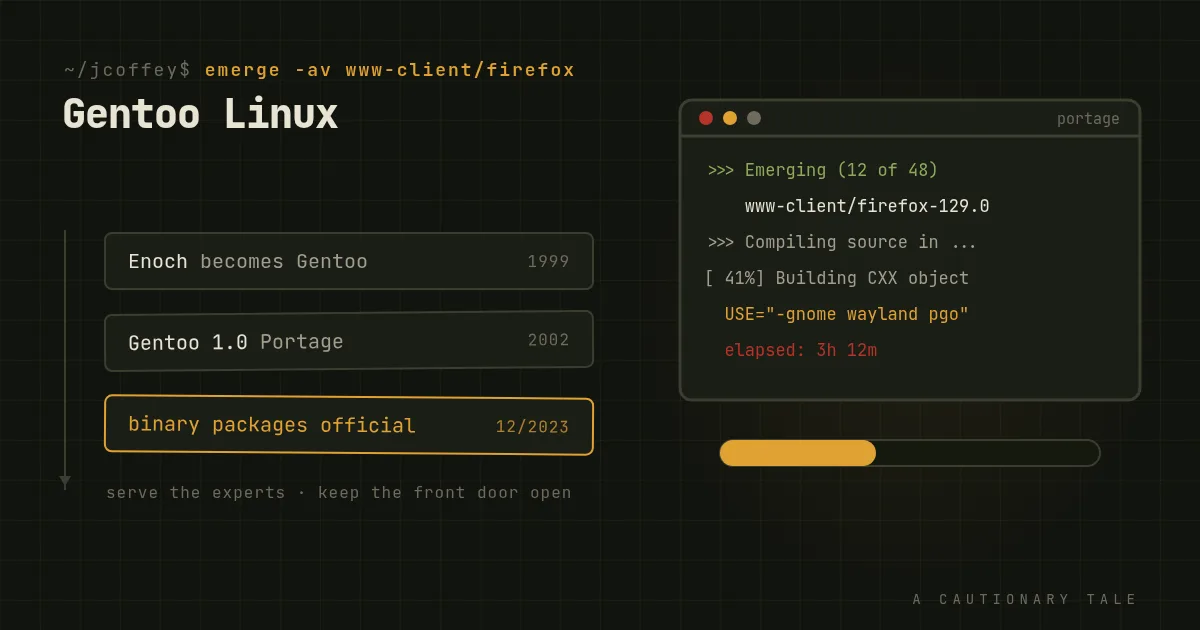
In 2002, if you wanted the most serious-looking Linux setup on your desk, you ran Gentoo. You booted a minimal CD, partitioned your disk by hand, built your own kernel, and then compiled every single package from source with compiler flags tuned for your exact processor. It took days. When it was done, you had a system you understood down to the last library, and you were never going to let anyone forget it.
Gentoo is still here, still maintained by dedicated volunteers, and still excellent at what it does. But it's also one of the clearest examples in open source of how a project's culture can limit its reach.
Where it came from
Daniel Robbins started the project as Enoch Linux in 1999, renamed it Gentoo, after the fastest-swimming penguin, and released Gentoo 1.0 in 2002. Its heart is Portage, a package manager inspired by FreeBSD's ports system. Instead of downloading prebuilt binaries, Portage downloads source code and compiles it on your machine according to recipes called ebuilds.
Two ideas made it special:
- USE flags let you choose which optional features every package is built with, system-wide. Don't want GNOME support compiled into anything? One setting.
- CFLAGS let you compile the whole system for your specific CPU.
For people who wanted total control and to understand everything, nothing else came close.
The golden age, and the reputation
In the early 2000s Gentoo was enormously popular with enthusiasts, and its documentation was some of the best in the Linux world. But it also became known for a culture: the forum threads arguing about obscure compiler flags, the claims of dramatic speedups that rarely survived a benchmark, and a particular attitude toward people who just wanted a working computer. "Install Gentoo" became a meme, and not a flattering one.
Robbins himself stepped back in 2004. The project carried on under a foundation and a council of developers, but the excitement moved elsewhere. In 2004 Ubuntu arrived with a radically different promise: Linux that just works, out of the box, for everyone.
The cautionary tale
Gentoo's technical choices were defensible. Compiling from source gives real control, and for some workloads it matters. The trouble was that the project's center of gravity stayed with the people who enjoyed the hard parts:
- The barrier to entry was the point, for some of its users. A project that treats difficulty as a badge of honor drives away the people who might otherwise grow into contributors.
- The time cost was real. Compiling a web browser or an office suite could take hours, on every update. For most people, the performance gains didn't come close to paying for that.
- Small communities are fragile. A project that relies on a small, specialized group is always one wave of burnout away from trouble.
Meanwhile, distributions that made the first experience easy, Ubuntu above all, captured the next generation of users, and many of those users became the next generation of developers. The lesson for any open source project is simple: you can serve experts brilliantly and still need a door that beginners can walk through.
Where it mattered more than people think
It would be unfair to stop there, because Gentoo's tools mattered far more than its user count suggests.
- ChromeOS is built with Portage. Google's ChromiumOS build system uses Gentoo's package manager and ebuild format. Every Chromebook in a classroom was built with Gentoo's tools.
- Embedded and specialized systems use Gentoo's flexibility to build exactly the system they need and nothing else.
- Gentoo adapts. Last December the project began offering official binary packages, so users can install common software precompiled and build from source only what they want to customize. That's the door for beginners, opened at last.
- Its documentation, like Arch's wiki later, has taught Linux internals to people who never ran the distribution.
Who should use it today
Gentoo is a superb way to learn how a Linux system fits together, and the right tool if you genuinely need to control how every component is built. With binary packages, it's more practical than it has ever been.
But the lesson I take from Gentoo is about community more than code. Exclusivity feels good to the people inside. It limits everything a project could become. If you run an open source project, make the expert path as deep as you like, and keep the front door wide open.
Since then
Added October 2026. After years on Debian, I spent some time with an Arch-based distribution and wrote about it in A Debian Veteran Tries CachyOS, including what I'd always disliked about the elitism around source-based and do-it-yourself distributions, and what changed my mind about Arch.