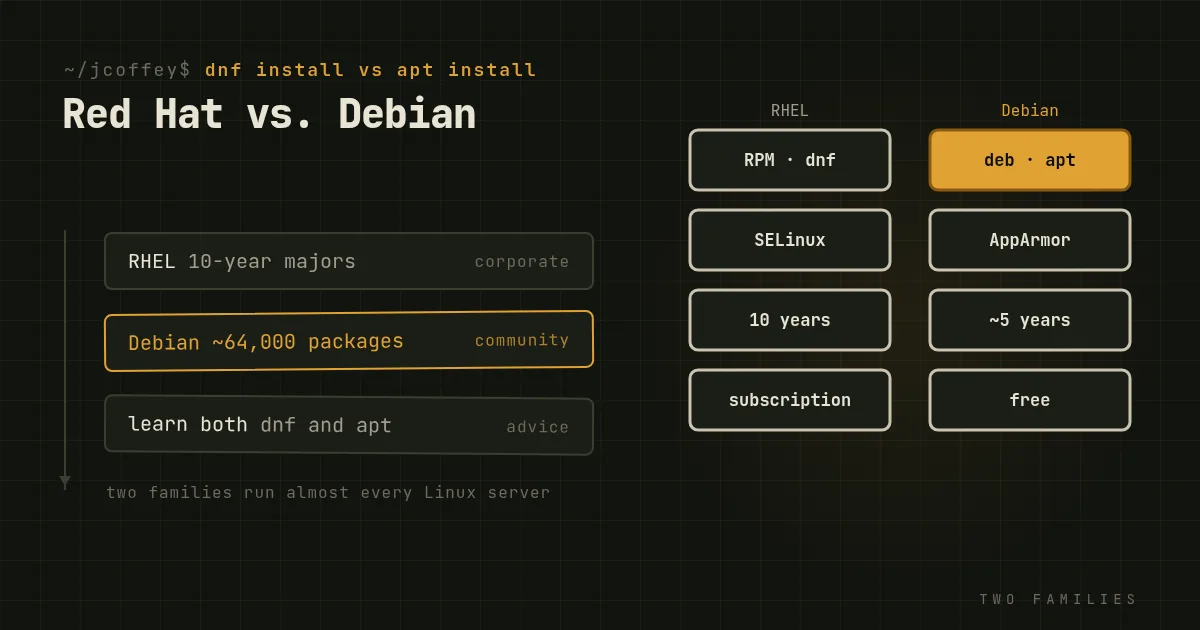
Almost every Linux server in the world belongs to one of two families. One descends from Red Hat: RHEL, Fedora, CentOS Stream, Rocky Linux, AlmaLinux, Oracle Linux and Amazon Linux. The other descends from Debian: Debian itself, Ubuntu, and everything built on them.
My bias first: I prefer Debian, and I've been critical of Red Hat's recent choices. But RHEL is an excellent operating system, and there are plenty of situations where it's the right call. Here's an honest comparison.
Two models
Red Hat is a company, owned by IBM since 2019. Fedora is the fast-moving community distribution where new technology lands. CentOS Stream is the preview of the next RHEL minor release. RHEL is the product: a stable, certified, supported enterprise operating system sold by subscription. Since last year, RHEL's exact source code goes only to customers, and the free rebuilds, Rocky Linux and AlmaLinux, have had to find other routes to stay compatible.
Debian is a volunteer project with an elected leader, a constitution and a social contract committing it to free software. There's no company and no paid product. Commercial support comes from third parties, and from Canonical if you choose Ubuntu.
How they compare
| RHEL | Debian | |
|---|---|---|
| Release cadence | Major release every ~3 years, minor releases every ~6 months | Stable release every ~2 years |
| Support length | 10 years per major, more with paid extensions | ~3 years, plus 2 years LTS (5 total) |
| Packages | RPM, dnf; a curated, smaller set, plus EPEL |
.deb, apt; about 64,000 packages in main |
| Security default | SELinux, enforcing | AppArmor (since Debian 10) |
| Cost | Subscription per system (free developer tier up to 16 systems) | Free |
| Support | Red Hat, by contract | Community, or third parties |
| Certifications | Broad vendor and hardware certification | Fewer formal certifications |
| Governance | Corporate | Elected, constitutional, volunteer |
Where RHEL wins
- Certification. Enterprise software vendors certify on RHEL first, and sometimes only on RHEL: SAP, Oracle Database and many others. If your support contract with a vendor requires RHEL, that settles it.
- Long, predictable lifecycle. Ten years on one major version, with backported fixes, suits environments where changing anything is expensive, like regulated industries or long-lived appliances.
- A throat to choke. A support contract with a company that will take the call at 3 a.m., with engineers who wrote much of the code.
- SELinux enforcing by default, with policies maintained for the whole distribution. It's one of the strongest default security postures of any operating system, if your team learns to work with it instead of disabling it.
- The tooling ecosystem: Satellite for patch management, Insights for proactive issue detection, image builder, and strong integration with Ansible, OpenShift and the IBM portfolio.
Where Debian wins
- Cost and freedom. No subscriptions, no per-system counting, no contract, ever.
- The archive. Vastly more packaged software in the base distribution, so fewer third-party repositories.
- Clean upgrades. In-place upgrades from one stable release to the next are routine and well tested. Major RHEL upgrades are possible with Leapp, but are often done as rebuilds.
- Independence. No company can change the terms, as CentOS users learned the hard way.
- Breadth. Nine official architectures, and the base of Ubuntu, so the skills transfer to the most common Linux in the cloud.
- Minimalism. A Debian server install is lean, with nothing running you didn't choose.
How to choose
- Pick RHEL (or Rocky or Alma, if you don't need Red Hat's support) when vendors certify against it, when you need ten-year lifecycles, when your organization standardizes on Red Hat tooling, or when you want a single vendor accountable for the operating system.
- Pick Debian when you want a free, stable, community-governed platform, need a broad set of packages, run many small systems where per-system subscriptions add up, or value independence from any one company.
- Pick Ubuntu LTS when you want Debian's lineage with a commercial company behind it, especially in the cloud, where it's the most common default.
Mixed environments are normal. Plenty of organizations run RHEL for the database and the certified application, and Debian or Ubuntu everywhere else. Learning both families, dnf and apt, SELinux and AppArmor, is one of the most useful things a Linux engineer can do.
Since then
Added October 2026. RHEL 10 arrived in May 2025 and Debian 13 "trixie" in August 2025, so both families have a fresh major release. The free RHEL rebuilds kept up: AlmaLinux and Rocky shipped their version 10 releases within weeks.