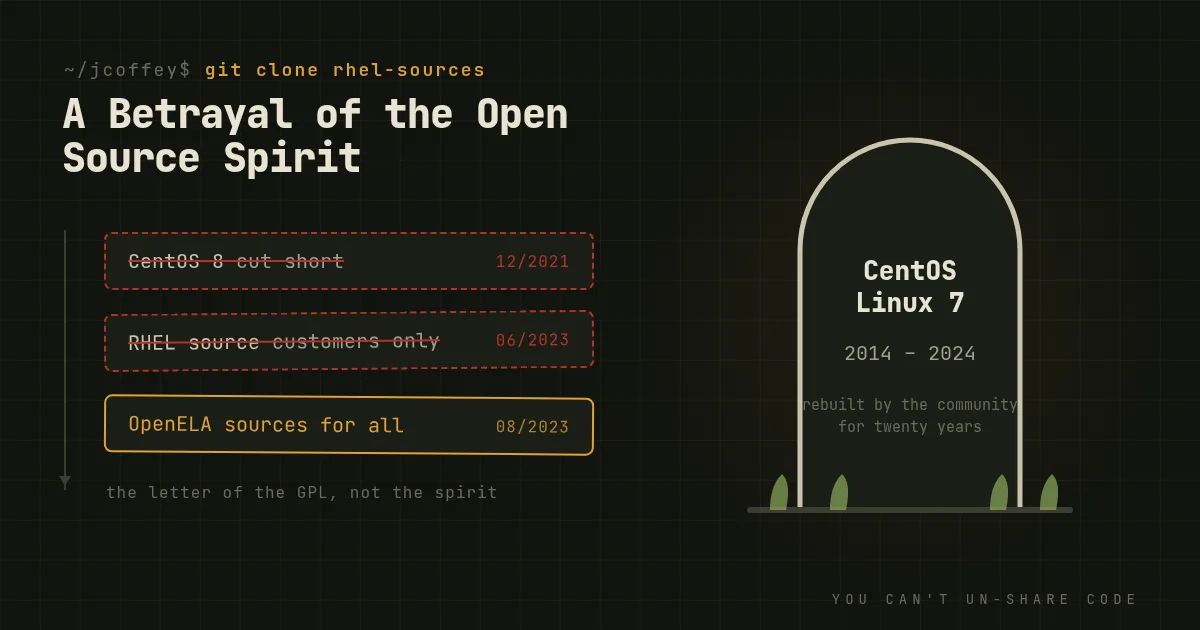
Two weeks ago, on June 30, CentOS Linux 7 reached end of life. That was the last release of the free, community-built rebuild of Red Hat Enterprise Linux that a huge share of the internet's servers ran for two decades. There won't be another one, because Red Hat made sure of it.
I want to lay out what happened, because the details get blurred, and then say plainly why I think it was a betrayal.
What Red Hat built, and on what
Red Hat's story is one of open source's great success stories, and I don't say that lightly. Founded in 1993, it figured out how to make money from free software by selling what companies actually wanted: a stable, certified, supported Linux with someone to call. It went public in 1999 and launched Red Hat Enterprise Linux in 2002. IBM bought it in 2019 for $34 billion.
RHEL is built overwhelmingly from software Red Hat didn't write: the Linux kernel, the GNU tools, and thousands of community projects. Red Hat employs a lot of the people who work on those projects, and it contributes generously upstream. That's real, and it deserves credit.
But the deal that made Red Hat trusted was simple. You could pay Red Hat for RHEL, with support and certification, or you could take the source code Red Hat published and rebuild it yourself, for free. CentOS, started in 2004, did exactly that, and it was where students learned, startups launched and a lot of the cloud ran. Many of those people went on to buy RHEL at work. The free rebuild was part of the funnel and part of the trust.
How it was taken apart
2014. Red Hat "joined forces" with CentOS, hiring its core developers and taking over its governance. At the time, the community was told that nothing would change.
December 2020. Red Hat announced that CentOS Linux 8 would end in December 2021, eight years ahead of its promised 2029 end of life, and that the project would focus on CentOS Stream. Stream isn't a rebuild of RHEL. It's a preview of the next minor release, upstream of it. Organizations that had planned on running CentOS 8 for a decade got a year's notice.
June 2023. Red Hat announced that CentOS Stream would be the only public source for RHEL-related code. The exact source for each RHEL release would go only to customers, through the customer portal, under subscription terms that let Red Hat end your subscription if you redistribute what you got. A Red Hat executive described the rebuilders who simply recompiled RHEL as not adding value.
That last move was aimed directly at Rocky Linux and AlmaLinux, the community projects that had stepped in to replace CentOS.
The letter and the spirit
Red Hat's position is that it complies with the GPL, because customers who receive RHEL binaries receive the source too. Lawyers can argue about whether a contract that punishes you for exercising your rights under the GPL is compatible with the GPL's own ban on "further restrictions." I'm not a lawyer, and that argument isn't the one that matters most.
The spirit is clearer. The GPL was written so that anyone who receives software can study, change and share it. Red Hat built its business on code that thousands of people released under exactly those terms, and then arranged things so that sharing the result costs you your relationship with Red Hat. It follows the letter well enough to survive a lawsuit, and defeats the purpose.
And it breaks a promise people built on. A company that tells you for twenty years "you can always rebuild this yourself," and then makes that as hard as it legally can, has spent the trust it was given.
The community did what the community does
The response was fast, and it's the best part of this story:
- AlmaLinux moved to building from CentOS Stream and other public sources, aiming for compatibility with RHEL rather than bit-for-bit identity.
- Rocky Linux found other legitimate routes to the source and kept rebuilding.
- SUSE announced its own fork with $10 million behind it, and then joined CIQ and Oracle in forming OpenELA, the Open Enterprise Linux Association, to publish enterprise Linux source code for anyone to use.
So the code is still out there. That's the strength of open source working as intended: you can make it inconvenient to share, but you can't make it un-shared.
What I take from it
Don't build your infrastructure on a promise from a company when you could build it on a guarantee from a license or a community. CentOS users trusted Red Hat's goodwill. Debian users never had to, because there's no company there to change its mind, which is a big part of why I prefer Debian.
And to Red Hat, which still employs some of the best engineers in open source and still contributes enormously: the community gave you your business. Treating its members as freeloaders for using what you built from their work is a strange way to say thank you.
Since then
Added October 2026. I followed this up a couple of months later with Is Red Hat the New SCO?, and wrote about the larger pattern in When the Cathedral Ate the Bazaar. AlmaLinux and Rocky both shipped their version 10 releases in 2025.