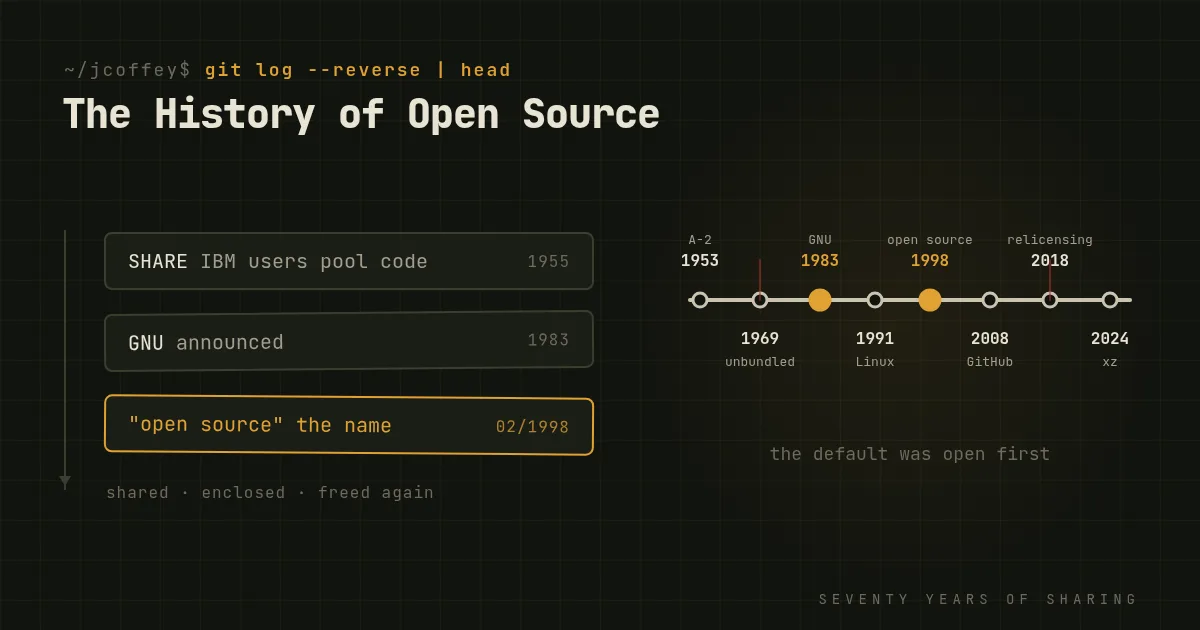
The odd thing about the history of open source is that it begins with the default being open. Closed, proprietary software was the invention. Open source was the counter-revolution.
Here's the story in seven turns.
1. When software came with the machine (1950s–1960s)
In the early days of computing, software wasn't a product. It came with the hardware, as a way to make the hardware useful, and the people who used it shared it freely.
Grace Hopper's team at Remington Rand released the A-2 compiler for the UNIVAC in 1953 with its source code, and asked users to send their improvements back. In 1955 IBM mainframe customers founded SHARE, a user group that pooled programs and libraries so that no company had to write the same routine twice. Universities and research labs passed source tapes around as a matter of course. Nobody called it open source, because nobody had imagined the alternative.
2. Software becomes property (1969–1983)
Three things changed that.
- 1969: under antitrust pressure, IBM unbundled its software and began selling it separately from the hardware. Software was now a product with a price.
- 1976: Bill Gates published his "Open Letter to Hobbyists," accusing home-computer users of stealing Microsoft's BASIC by copying it. The idea that copying software was theft entered the culture.
- 1980–1983: US copyright law was amended to cover computer programs explicitly, and the courts confirmed in Apple v. Franklin that even the machine code in a chip was protected.
By the early 1980s the norm had flipped. Software came as binaries, under license, with the source code locked away.
3. The free software movement (1983–1991)
Richard Stallman, at the MIT AI Lab, watched the lab's sharing culture die as colleagues left for companies that required nondisclosure agreements. In 1983 he announced the GNU Project, a complete Unix-compatible operating system made of free software, and in 1985 he founded the Free Software Foundation. Its masterstroke was the GNU General Public License of 1989, which uses copyright to guarantee that software stays free in every copy and every modified version. I covered the FSF in more depth in The Free Software Foundation and Electronic Frontier Foundation.
Meanwhile, at Berkeley, the BSD project was rewriting AT&T's Unix piece by piece so that it could be distributed freely, under a short, permissive license that let anyone do almost anything. The two great families of open licenses, copyleft and permissive, were born a few miles apart in philosophy and a continent apart in geography.
4. Linux and the internet (1991–1997)
GNU had everything except a working kernel. In 1991 Linus Torvalds supplied one, and put it under the GPL the next year. The combination was a free operating system, and the young internet gave it a way to be developed by people who'd never met.
Debian (1993), Red Hat (1993), Apache (1995), Perl, PHP, MySQL and Python followed. By the late 1990s much of the web ran on free software, mostly without the businesses that depended on it noticing.
5. "Open source" (1998–2007)
In January 1998 Netscape, losing the browser war to Microsoft, announced it would release its browser's source code, inspired in part by Eric Raymond's essay "The Cathedral and the Bazaar." A few weeks later a group including Raymond, Bruce Perens and Christine Peterson, who coined the term, chose "open source" as a name businesses could hear without thinking of politics, or of price. The Open Source Initiative was founded that February.
It worked. IBM announced a billion-dollar investment in Linux in 2000. Microsoft, whose leaked internal "Halloween documents" in 1998 had identified open source as a threat, called Linux "a cancer" in 2001. SCO sued IBM in 2003, claiming Linux contained stolen Unix code, and spent years failing to prove it. Firefox, the descendant of Netscape's code, arrived in 2004 and broke Internet Explorer's monopoly.
6. Open source wins (2008–2018)
Then the fighting mostly stopped, because the outcome was obvious.
- Git (2005) and GitHub (2008) made sharing and forking code effortless, and open source exploded.
- Android (2008) put the Linux kernel in billions of pockets.
- The cloud was built almost entirely on Linux and open source.
- Hardware followed. Arduino (2005) and the Raspberry Pi (2012) opened up electronics for hobbyists and schools, and RISC-V, started at Berkeley in 2010, did the same for the processor instruction set.
- In 2014 Microsoft's new CEO declared that "Microsoft loves Linux" and open sourced .NET. In 2018 Microsoft bought GitHub.
- In 2019 IBM bought Red Hat for $34 billion, the largest software acquisition in history at the time.
Open source had stopped being an alternative. It was simply how infrastructure software was made.
7. The bill comes due (2018–today)
Winning brought new problems, and they're the ones we're living with now.
- Unpaid maintainers. Heartbleed in 2014, Log4Shell in 2021 and the xz backdoor this March all hit critical code maintained by a handful of overstretched volunteers.
- Relicensing. Companies that built businesses on open source projects they controlled started switching to "source available" licenses to keep cloud providers out: MongoDB in 2018, Elastic in 2021, HashiCorp last year and Redis this March. The community forked them, into OpenSearch, OpenTofu and Valkey, as I described in Free as in Freedom.
- Corporate control. Red Hat ended CentOS and restricted RHEL's source, which I think was a betrayal of the open source spirit.
- AI. Models trained on open source code, and companies calling AI models "open" while withholding the data and code to rebuild them, are the newest arguments over what the word means.
What the history teaches
The pattern repeats. Something is shared freely. Someone finds a way to enclose it. Someone else builds a legal or social structure that keeps it open, and that structure turns out to matter more than the code. The GPL, the foundations, the forks: they're how open source survives the people who'd rather own it.
Seventy years after SHARE, most of the world's software runs on code anybody can read. That's an extraordinary result, and it's still not guaranteed.
Since then
Added October 2026. I picked up the thread for Linux's 35th birthday in Just a Hobby, and wrote the darker version of turn seven in When the Cathedral Ate the Bazaar.