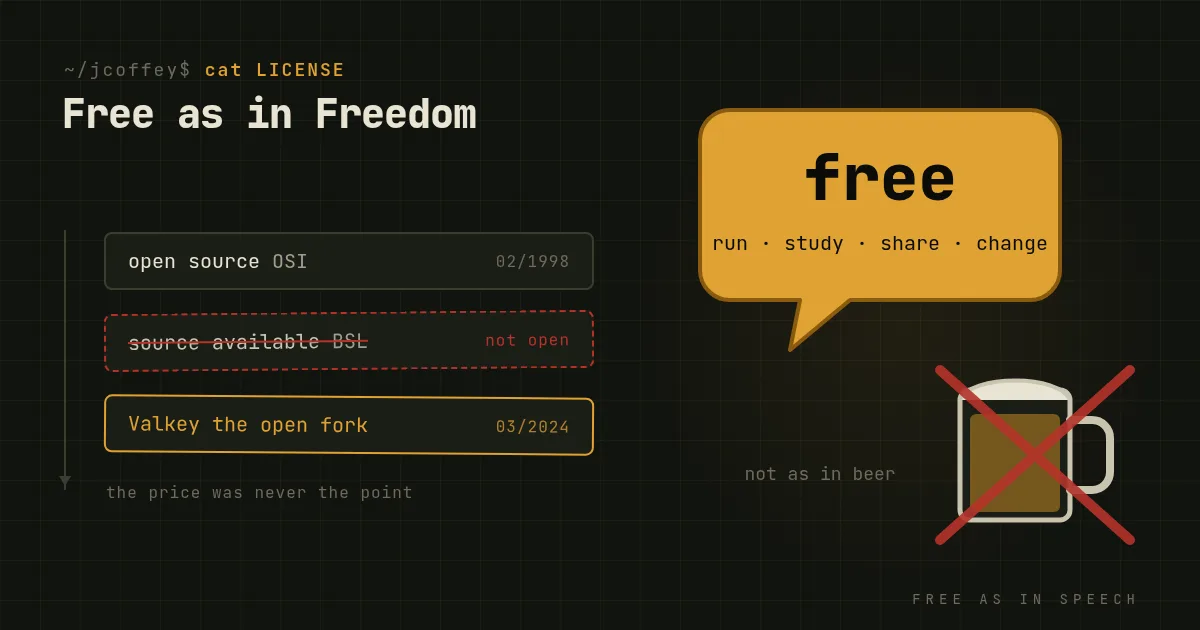
"Free as in free speech, not as in free beer." Richard Stallman has been saying some version of that since the 1980s, and people still get it wrong. Open source software usually costs nothing. That's a side effect. The point is what you're allowed to do with it.
That distinction has stopped being academic. In March, Redis became the latest popular project to swap its open source license for one that looks similar and isn't. If you run software for a living, telling those apart is now part of the job.
The freedoms
The Free Software Foundation puts it as four freedoms, numbered from zero the way programmers count:
- Run the program for any purpose.
- Study how it works and change it, which requires the source code.
- Redistribute copies.
- Distribute your modified versions, so others benefit from your changes.
Take away any one and the rest collapse. Source code you can read but not change is a brochure. Software you can change but not share means every user has to fix the same bug alone. A license that forbids some uses, say commercial hosting, isn't open source, however much of the code you can see.
Free software and open source
The two terms describe almost exactly the same set of licenses, from opposite directions.
Free software is Stallman's term, from the founding of the GNU Project in 1983. It's an ethical position: users ought to control the software they run, and proprietary software is a wrong done to them.
Open source was coined in February 1998 by Christine Peterson, at a meeting called after Netscape announced it would release its browser's source code. The people there, including Eric Raymond and Bruce Perens, wanted a term businesses could hear without flinching, and they made a practical case: open development produces better software. The Open Source Initiative was founded that month. Its Open Source Definition, based on Debian's Free Software Guidelines, lists ten criteria a license must meet. One of them is no discrimination against any field of endeavor.
In practice, nearly every free software license is an open source license and the other way around. The difference is in emphasis, and occasionally in temper. I use "open source" day to day, but the freedoms underneath are the same.
Permissive and copyleft
Open source licenses come in two main families, and the difference matters when you build on them.
- Permissive licenses like MIT, BSD and Apache 2.0 let anyone do almost anything, including folding the code into a proprietary product, as long as the copyright notice survives. Apache 2.0 adds an explicit patent grant.
- Copyleft licenses like the GPL require that if you distribute a modified version, you do it under the same license, with source. The freedoms travel with the code. The AGPL extends that to software offered as a network service, which closes the "we never distribute it, we just run it for you" gap that the cloud opened.
Neither is better in the abstract. Permissive licenses maximize adoption. Copyleft maximizes the chance that improvements come back. For software that's mostly run as a service, copyleft is the only kind that guarantees the users of that service get the freedoms too.
Source available isn't open source
Here's the trend worth watching. A company builds a popular open source project, a cloud provider sells it as a hosted service, and the company decides that's unfair. So it changes the license.
- MongoDB moved to its Server Side Public License in 2018.
- Elastic moved Elasticsearch and Kibana off Apache 2.0 in 2021.
- HashiCorp moved Terraform, Vault and the rest to the Business Source License last August.
- Redis moved to a dual SSPL and Redis Source Available License this March.
You can still read the code for all of them. You can't use it for everything, and that's the line that matters. These are source available licenses, not open source ones, and the OSI hasn't approved any of them.
The pattern that follows is just as predictable. The community forks the last open version. Terraform became OpenTofu and Redis became Valkey, both now at the Linux Foundation, where no single company can change the terms again. The original company keeps the trademark and its paying customers. Everyone else moves to the fork.
To spot the difference before it bites you:
- Check the license, not the marketing. "Open" on a website means nothing. Look up the actual license on the OSI's list.
- Watch for field-of-use limits. "Free unless you compete with us" or "free for non-production use" isn't open source.
- Check who owns the copyright. A project where one company owns all of it through a contributor license agreement can relicense tomorrow. A project with many copyright holders under the GPL effectively can't.
- Prefer foundation-hosted projects for anything you'll depend on for years.
Why the freedoms matter more than the price
You don't need to read every line of code you run. Hardly anyone does. What matters is that you could, or hire someone who can. You can fix it if the vendor won't, keep running it if the vendor disappears, and leave if the vendor changes the deal. Freedom isn't about the price on day one. It's about what happens on day one thousand.
Since then
Added October 2026. The tide partly turned. Elastic added the AGPL as an option for Elasticsearch in August 2024, and Redis did the same with Redis 8 in May 2025. The OSI published its first Open Source AI Definition in October 2024, an attempt to stop "open" from meaning "you can download the weights." I wrote more about renting versus owning software in Software You Rent vs. Software You Own, and it's why Coffey Labs puts its own products under the AGPL.