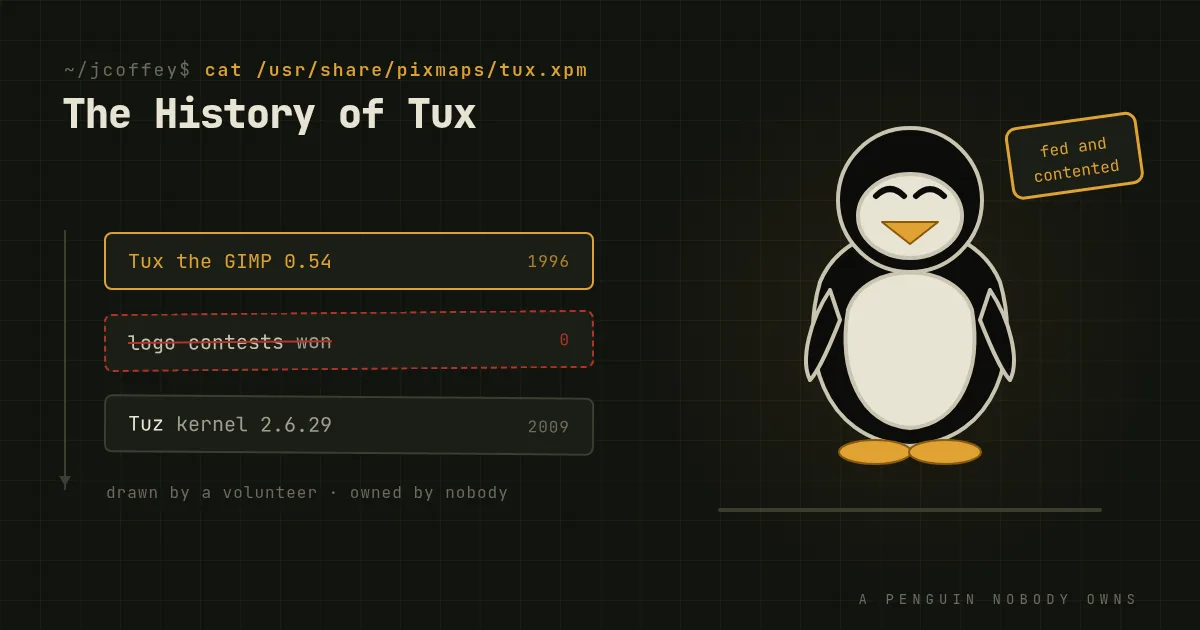
Most operating systems have a logo designed by an agency, approved by a committee and protected by a legal department. Linux has a fat, contented penguin drawn by a volunteer in a beta version of a free paint program, and it never officially won anything.
It's the perfect mascot for the project, and the story of how it happened is better than the version that usually gets told.
The bite
By 1996 Linux was five years old and had no logo. The kernel mailing list was full of suggestions, mostly the kind of sleek, aggressive designs that operating systems in the 1990s went in for: sharks, eagles, stylized letters.
Linus Torvalds wanted a penguin. He had a story to go with it. On a trip to Australia, he said, he'd been nibbled by a little penguin at the National Zoo & Aquarium in Canberra and come down with a case of "penguinitis." He later admitted the bite was a bit of a joke, but also that it really happened.
More important than the bite was what kind of penguin he had in mind. Not a fierce one. He wanted a penguin that looked contented, sitting down after a good meal, maybe a little too pleased with itself. He was thinking of the soft, rounded characters of Aardman Animations, the Bristol studio behind Creature Comforts and Wallace and Gromit, more than of anything heroic.
The drawing
Larry Ewing, then at Texas A&M, took that brief and drew the penguin in 1996 using the GIMP version 0.54, the first public release of what is now one of the best-known free software graphics programs. Getting a smooth, shaded, professional-looking image out of that early a version was a real demonstration of what free software could already do.
His terms for using it were about as open as they come. Anyone could use and modify the image, as long as they credited him and the GIMP if someone asked. That's still the deal.
The name came from James Hughes, who suggested "Tux," for Torvalds UniX. It also happens to be short for tuxedo, which a penguin is always wearing.
The contests it lost
Here's the part the usual telling gets wrong. Tux was entered as a design for an official Linux logo, and there were several logo contests around that time. Tux didn't win any of them.
It didn't matter. Linus liked it, the community liked it, and it appeared with the Linux 2.0 release that summer. Which is why, technically, Tux isn't the Linux logo. It's the Linux mascot. Linux never really got around to having an official logo, and nobody missed one.
Everywhere
Because nobody owned the penguin in any meaningful sense, everyone used it. That turned out to be its superpower.
- Boot screens. For years, the kernel showed one small Tux per CPU at boot. On a big server that meant a whole crowd of penguins.
- Games. Tux Racer in 2000 had him sliding down mountains on his belly, and SuperTux gave him a platformer. Both are still being played in some form.
- Every distribution, conference and user group that wanted a friendly face for Linux put a penguin on it. Plushies, stickers, T-shirts and the occasional tattoo followed.
- Endless variations. Business Tux, pirate Tux, Tux in a lab coat, Tux holding a beer. Projects remix him freely and nobody sends a cease-and-desist.
There was even a brief stand-in. For kernel 2.6.29 in 2009, Linus swapped Tux for Tuz, a Tasmanian devil wearing a cardboard penguin beak, to raise awareness of a disease that was devastating the devil population. Tux came back for the next release.
Why it works
Compare it with the competition. Corporate operating system logos are rebranded every few years and guarded by trademark lawyers. Tux has been the same penguin for nearly three decades, and you're allowed to do almost anything with him.
That's not a coincidence. A mascot that anyone can use matches a kernel that anyone can use. It doesn't say "enterprise grade" or "military strength," which is what everyone else's logos were trying to say in 1996. It says this was made by people who were having a good time, and that you're welcome to join them. Linus wanted a penguin that looked like it had just eaten a good dinner. Almost thirty years later, it still does.
Since then
Added October 2026. Tux turned thirty this year, still under the same terms. The angry pirate waving a flag at the top of Just a Hobby is one more in a long line of variations.