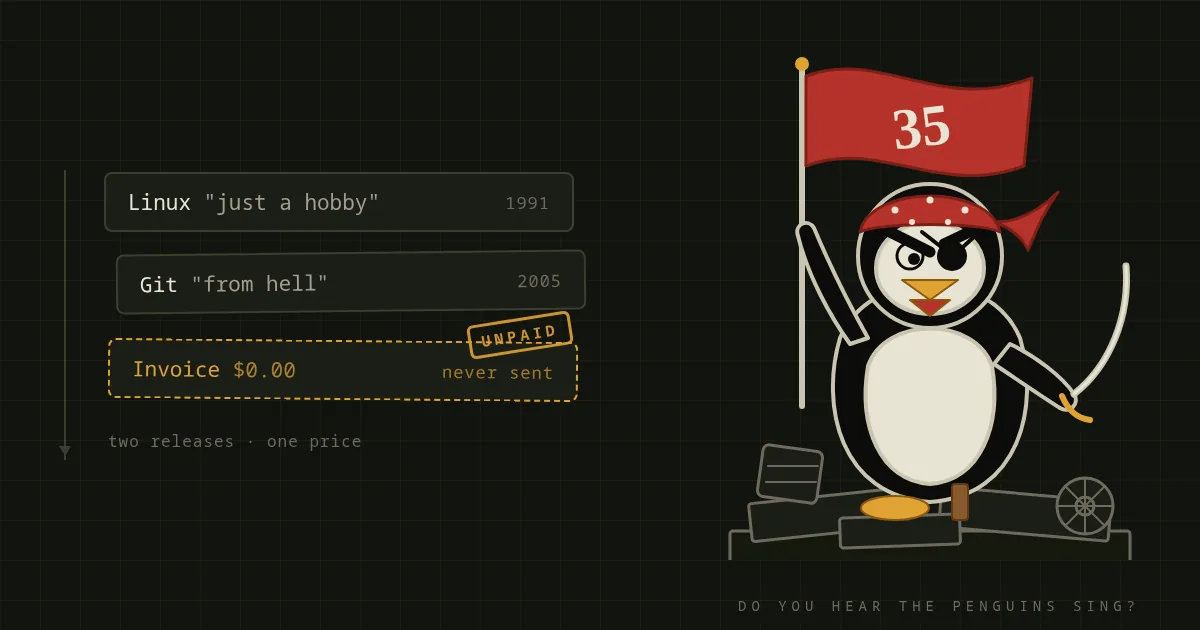
Do you pine for the nice days of minix-1.1, when men were men and wrote their own device drivers?
That is how Linux 0.02 was announced on October 5, 1991, thirty-five years ago this week. The post before it, in August, is the one everybody quotes: a free operating system, "just a hobby, won't be big and professional like gnu." It was a 21-year-old in Helsinki asking comp.os.minix what features people wanted.
The hobby is now the kernel in every Android phone, every one of the five hundred fastest computers on Earth, the New York Stock Exchange, SpaceX's rockets, the laptops on the International Space Station, most of Microsoft's cloud by Microsoft's own count, and a helicopter that flew on Mars. It is in your television, your router, your car and, if you bought the fancy one, your refrigerator.
Then in 2005 he did it again. Angry about a license, he wrote a version control system in about a week and a half, called it Git, and handed it off within four months. Nine developers in ten use it today. Microsoft paid $7.5 billion for a website that wraps it.
Two of the most consequential pieces of software ever written, by the same person, and his monetization strategy for both was the same: none. This week seems like a good time to work out what that cost him, and what it would have cost the rest of us if he'd thought about it differently.
What anyone else would have done
In 1976 Bill Gates wrote an open letter to the hobbyists of the Homebrew Computer Club telling them that most of them were stealing his BASIC and that free software meant nobody would ever write good software. Fifteen years later a hobbyist posted an operating system kernel to Usenet and asked for suggestions. Gates's model was the industry's model: buy it cheap, license it per copy, forever. Microsoft paid about $75,000 for the DOS it licensed to IBM. That is the trade Linus could have made with any of a dozen companies, and the one almost anyone would have made.
He went the other way, and then further. Linux 0.01 came with a license that forbade charging money for it at all. He loosened that to the GPL in early 1992, partly because people wanted to charge for the floppies and partly because he felt he owed the GNU tools he'd built it with. Note the direction: the only change he ever made to the terms was to let other people make money.
The closest he came to cashing in was in 1999, when Red Hat and VA Linux handed him stock before their IPOs, unasked, as a thank-you. It was worth a great deal on paper for a while. He has drawn a salary from Transmeta and then the Linux Foundation ever since, and it's a good one. It is also roughly what a cloud company pays a senior engineer to maintain the logging library. Red Hat alone sold to IBM in 2019 for $34 billion. Linus's share of that was the same as yours.
The one party that did try to monetize Linux through the courts, SCO, spent a decade losing to IBM and went bankrupt doing it. The market has been very clear about who gets to own this.
A world without Linux
So let's take it away. It's August 1991. Linus buys a different book, or the 386 doesn't arrive, or a summer job comes through. No post to comp.os.minix. Where are we?
The honest answer first, because the honest answer is what makes the rest fun. Linus himself said that if 386BSD had been available when he started, Linux probably wouldn't have happened. BSD is the obvious thing that fills the hole. Except in our timeline 386BSD arrived in 1992 under the shadow of AT&T's lawsuit against Berkeley, and the lawyers didn't lift that shadow until 1994. Three years of corporate counsel saying "not that one" is three years of Windows NT getting comfortable. By the time BSD is clean, the decision has been made, and the decision is a license sticker.
With that said, here is the tour.
The server closet. The Unix wars never end, because nothing ends them. Solaris is priced per socket, HP-UX and AIX come with the hardware, and SCO sells Unix for PCs by the seat. The cheap Pentium in the closet runs Windows NT 4 and gets rebooted on a schedule. The web stack that let a kid with a $400 computer run a real server, Linux plus Apache plus MySQL plus PHP, is missing its first letter and most of its reason to exist. The open source databases and languages that grew up on free Unix grow up smaller, on somebody else's terms.
Google. In 1998 two graduate students built a search index on a rack of commodity PCs running Linux, with a cork-board chassis, because that was what they could afford. Take away free Unix on cheap hardware and the price of a search engine is a Sun invoice. Google is a line item in Sun's annual report. Amazon reportedly cut its technology spending by a quarter when it moved from Sun to Linux in 2001, and five years later it rented that same cheap stack to the rest of us and called it AWS. Without the kernel there is no cheap stack to rent. "The cloud" is Sun Grid at a dollar per CPU-hour, which was the actual price in 2006, and it has a sales team.
Your phone. Android is Linux with a phone on top. Apple is fine in this world, because Darwin is BSD and Mach, and Apple would have shipped the iPhone anyway. Everyone who didn't buy an iPhone, which is about three billion people, is carrying a Windows Mobile device with a stylus, or Symbian, or a BlackBerry with the little wheel. They're happy, because they've never seen anything else. Nokia is still the most valuable company in Europe and its flagship ships with a 2-megapixel camera and a ringtone store.
Containers. Docker is a friendly wrapper around two Linux kernel features, namespaces and control groups. Kubernetes is a way to run a lot of Docker. Solaris Zones and FreeBSD jails exist, in fairness, but they don't exist on your laptop for free, so the idea never gets into the water supply. DevOps is a man named Gary with a CD-ROM and a change window. Deployments happen on the third Thursday. Gary is on vacation.
Everything with a plug. The Linksys WRT54G, the TiVo, every smart TV, every car's infotainment, the Starlink dish, the Mars helicopter. Without a free kernel that fits on an embedded board, every one of those devices either pays Microsoft for Windows CE, pays Wind River for VxWorks, or doesn't get made. Your television has a Start button. Your car gets Patch Tuesday. Your toaster has an End User License Agreement and you have, legally, agreed to it.
Supercomputers. All five hundred of the fastest machines in the world have run Linux since 2017. In this world they run AIX, Solaris and Cray's UNICOS, each with a vendor rep, and the national labs spend a measurable fraction of their budgets on operating system licenses for machines they built themselves.
Open source itself. The phrase was coined in 1998, in a meeting called because Netscape had just freed its browser, and Netscape did that because of what Linux had shown was possible. Without the kernel as proof, the GPL is a license for a compiler and a text editor. Stallman is right about everything and ignored by everyone. The free operating system of the future is GNU Hurd, which is to say we are all still waiting. Microsoft never has to say "Linux is a cancer," and never has to walk it back to "Microsoft loves Linux," because there's nothing there to love, and Windows never ends up shipping a Linux kernel inside it, which in our timeline it does.
Me. I have been running Linux since 1994. In the other timeline I am a Windows NT administrator. I have met the man I would have become. He has an MCSE and a reboot schedule.
Then he did it again
In 2002 the kernel moved its development onto BitKeeper, a proprietary tool whose owner let open source projects use it for free, with a clause saying you couldn't work on a competitor while you did. In early 2005 Andrew Tridgell, of Samba, connected to a BitKeeper server and typed help. The server told him its protocol. BitKeeper's owner decided that counted as reverse engineering and pulled the free license, which left the most important open source project in the world with no version control.
Linus started writing a replacement on April 3, 2005. It was hosting its own source code on April 7. The first commit message called it "the information manager from hell." By June the kernel shipped a release from it. On July 26 he handed maintenance to Junio Hamano, who still has it, and went back to his day job. Asked about the name, he said he was an egotistical bastard who named all his projects after himself: first Linux, now Git.
Version control was a real business. IBM had ClearCase, Perforce had a sales force, Microsoft had SourceSafe, and BitKeeper had just demonstrated that a tool the Linux kernel depended on could be rented out on terms. Linus released Git under the GPL and walked away in under four months. BitKeeper itself went open source in 2016, eleven years late, to an empty room.
What grew on top of it: GitHub, founded in 2008 because Git made branching and forking cheap enough that "fork" stopped being a hostile act and became a button. Microsoft bought it in 2018 for $7.5 billion. GitLab went public in 2021 at around $11 billion. The large language models that write code were trained on what sits in those repositories, so the robots owe him too. It is the most valuable fortnight of unpaid labor in the history of the species, and I include the one where somebody invented the wheel.
A world without Git
Honesty again: Mercurial was started the same month, by the same provocation, so the fair counterfactual isn't a world with no distributed version control. It's a world where Mercurial wins. In that world the big code host is Bitbucket, which really did start as Mercurial hosting, it is owned by Atlassian, and every pull request is attached to a Jira ticket. Take a moment with that.
The less fair counterfactual is that none of the 2005 tools catch on and we stay where we were. Subversion. A branch is a copy of the whole tree and everyone is afraid of it. Merging is a quarterly ceremony performed by the one person who understands it, and that person is on vacation with Gary. There is a property called svn:needs-lock and someone has set it on the file you need. The server is down, so nobody can commit, so everybody goes home. Contributing to an open source project means emailing a diff to a man who does not want it.
The kernel, incidentally, still takes patches by email. It is the one place where the counterfactual and the actual are the same, and it works there only because the tool underneath it was built for exactly that.
Without the fork button there is no pull request. Without the pull request, contributing to someone else's software stays a thing you do with a mailing list and a thick skin, and the explosion of open source in the 2010s, the one where a weekend project could pick up a hundred contributors it never met, doesn't happen. Fewer libraries, fewer eyes, fewer projects that start as one person's itch and end up in everyone's dependency tree. Also no left-pad incident. Fine. You can have that one.
The invoice
So what's the number? The Linux Foundation tried in 2008 and came up with about $1.4 billion to recreate the kernel alone, nearly $11 billion for a whole distribution. The kernel is several times larger now. Every estimate since has had more digits, and every estimate is wrong, because a rewrite would have no users.
That is the actual point, and it's the one the "anyone else would have monetized it" framing misses. The value of Linux is not the code. It's that everybody agreed to run the same one, and they agreed because nobody owned it. The minute Linus charges for it, it becomes another Unix with a price list, and we're back in the first half of this article. The zero on the invoice is not what he gave up. It is the feature. Same for Git: a distributed version control system you have to buy a seat for is BitKeeper, and we know how that story ends.
He didn't leave money on the table. He built the table. Everyone else has been eating at it for thirty-five years.
Happy birthday, 0.02
Everything Coffey Labs makes runs on his kernel and lives in his version control. inbuxa, ihasmail and the rest are released under the AGPL, which is the same deal passed along: take it, run it, change it, share it back. I have never paid the man a cent and he has never asked. That's the arrangement, and the arrangement is the whole point.
If you want more of the history, I've written about where Tux came from and about how open source got here. For today, go read the 0.02 announcement. It ends with him asking whether anyone would like a copy. Thirty-five years later, the answer is still yes.