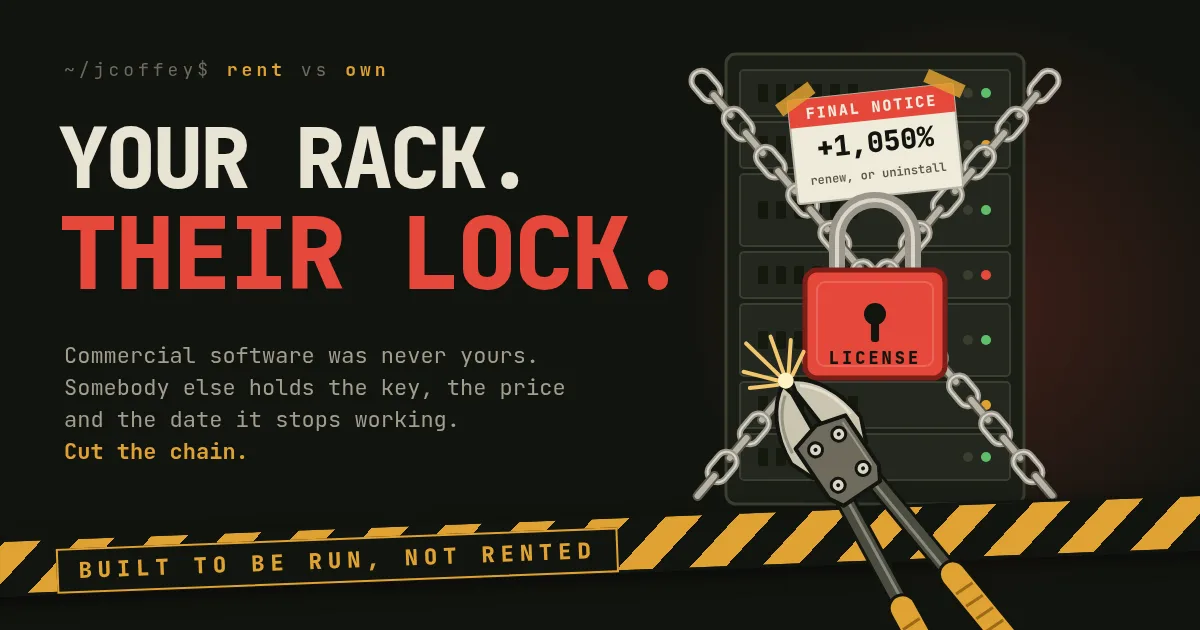
Every piece of commercial software you have ever "bought" came with a document saying you hadn't. You bought a license. A license is permission, and permission is something the other party keeps.
I came up on NetWare and NT 3.51, when that was a technicality. A license was a sticker on a box and a number you typed in once. If the vendor stopped patching it or went under, your copy kept running, and you upgraded when the new version was worth buying.
That deal is ending. First the software moved into someone else's data center and became a monthly bill. Now the monthly bill is coming for the software still running in yours. The vendor decides what version you run, what it costs next year, and whether you can keep using what you already paid for. You are a tenant in your own server room.
Broadcom and the 1,050 percent renewal
Broadcom closed its $69 billion purchase of VMware in November 2023. What it has done to VMware's customers since would fill its own article, and others have documented it well. The highlights, with sources if you want the details:
- Perpetual licenses ended. Within weeks Broadcom stopped selling them and stopped renewing support on most existing ones, folding thousands of SKUs into a few per-core subscription bundles. (Broadcom)
- A 1,050 percent renewal. AT&T sued in August 2024, and its filing called a proposed one-year increase of that size "extreme." They settled. (CIO Dive)
- A 72-core minimum. Resellers reported in 2025 that a small office with one eight-core host pays for 72 cores, and renewing late adds 20 percent. (it-daily)
- Patches you have to give back. Perpetual license holders whose support lapsed got cease-and-desist letters demanding they uninstall every update released after it ended, with an audit threat attached. (Network World)
- Eight to fifteen times the cost. That's how much European cloud providers told regulators their VMware bills had grown. (The Register)
- The smaller bundle withdrawn. vSphere Foundation stopped being sold in parts of EMEA in late 2025. (Techzine)
- Tesco in court. It bought perpetual licenses with support through 2026, says Broadcom won't honor them, and is suing for at least £100 million while it moves 40,000 workloads off VMware. (ITPro)
Customers are leaving, and Gartner expects 55 percent of enterprises to be testing alternatives by 2029. Plenty of those tests are Proxmox, which I compared to VMware back when that was a matter of taste rather than budget.
None of it was illegal, as far as anyone has proven. It is what a license is. VMware customers never owned vSphere. They owned permission to run it, on terms that stayed stable so long everyone forgot they could change.
It isn't just Broadcom
Broadcom is just the loudest. The rest of the industry is doing the same thing at a polite volume.
- Atlassian killed its Server products in 2024, and on March 28, 2029, every Data Center license expires and goes read-only. Your Jira, on your hardware, read-only on a date somebody else picked. (Atlassian)
- Microsoft made on-premises Exchange a subscription in July 2025. It still runs in your rack, but perpetual licenses aren't supported. Microsoft 365 went up again in July 2026, with AI among the reasons. (UC Today)
- Oracle moved Java SE in 2023 from counting machines to counting employees. Fifty developers at a 10,000-person company pay for 10,000.
- Adobe went subscription-only in 2013, and this March agreed to pay $75 million to settle the FTC's case over its cancellation fees. Even the exit costs money. (FOX 10)
The pattern is the same everywhere. Get into the business, make migration expensive, then turn every renewal into a negotiation you can't walk away from.
The landlord has a key
Price is the part you can put in a spreadsheet. The other part is who else can get at what you're renting.
In June 2025, Microsoft France's legal director was asked under oath whether he could guarantee French citizens' data would never reach US authorities without France's approval. "No, I cannot guarantee that." The US CLOUD Act is why. That spring, after the US sanctioned the chief prosecutor of the International Criminal Court, his Microsoft email stopped working. Who flipped the switch is disputed, but the court drew its own lesson and is moving to openDesk, an open source suite. Schleswig-Holstein got there first, moving 40,000 government mailboxes off Exchange last year.
Data sovereignty comes down to two questions: who can turn it off, and who can read it? With rented software, the answer is the landlord, and anyone with leverage over the landlord. It's why I moved my sites and mail out of the United States, and who controls the software matters even more than where it sits.
Open source is not automatically ownership
MongoDB, Elastic, HashiCorp and Redis all built user bases on open source licenses, then changed them. The difference is that they couldn't take back what was already released. The community forked Terraform as OpenTofu, Redis as Valkey and Elasticsearch as OpenSearch. Elastic and Redis have since added the AGPL back, after the forks proved users would leave.
No VMware customer had that option. You can't fork vSphere. That is the whole difference between renting and owning: when the vendor changes the deal, can you keep going without them?
The bait and switch
There's a quieter version of the rug pull, and it's the one I have the least patience for.
A company publishes a project under an open source license and calls itself an open source company. The home page lists clustering, high availability, single sign-on and audit logs. You install it, build on it, put your data in it. Then you go to turn on one of those features and find it needs a license key. The feature grid never said so.
That isn't open source with a business model. It's proprietary software with an open source sample, and the sample is the bait. If you close any part of your software, you are not an open source developer. You're a commercial vendor using the license as marketing.
The polite name is "open core," and its defenders have an argument. Open-Xchange, which owns Dovecot, the IMAP server behind a huge share of the world's mailboxes, wrote last December that open core "is the only sustainable" model. To its credit, it labels what's in Pro. But Dovecot 2.4 removed the director and the replicator, the pieces people used to run more than one server, and the upgrade guide points anyone who needs replication to a Pro-only cluster. People who built two-server setups on a free feature found out the feature was a trial.
It reaches all the way up to the sovereignty projects. openDesk, the suite the ICC is moving to, runs on Open-Xchange and Dovecot, and according to iX high availability comes only with the enterprise edition. You can have a sovereign mail system, so long as it's small or you pay.
Everybody has to eat
None of this is an argument against getting paid. Software costs money to build, developers have rent, and a project nobody is paid to maintain eventually stops being maintained. I don't begrudge anyone earning a living from their work. I'm trying to do it myself.
The argument is about how, and the longest-lived open source projects worked it out long ago. Nobody sells the Linux kernel; the companies that depend on it pay engineers to work on it. PostgreSQL has gone thirty years without an owner while a dozen companies sell support and hosting. Proxmox puts clustering and high availability in the free download and sells the tested update repository and someone to call. Selling support, hosting and expertise is a business model. It just doesn't require lying about what's in the box.
Then there's Debian, the most influential Linux distribution there has ever been. Ian Murdock started it in 1993, and thirty-three years later no company owns it. It runs on volunteers, donated hardware, and donations held by a nonprofit. In 1997 its developers adopted a social contract: Debian will remain 100 percent free, give back to the community, never hide problems, and put its users first. Its guidelines became the Open Source Definition a year later. Whenever someone argues about whether a license is "really" open source, they're using terms Debian wrote.
The contract is also the business model. Debian charges no fees and lets anyone build a distribution on top of it, and more people have taken it up on that than on any other distribution: Ubuntu, Linux Mint, Raspberry Pi OS, Kali, Tails, Proxmox and well over a hundred more. Canonical built a company on Debian's work. Debian didn't send an invoice. It got patches, developers and users back, which is exactly the trade it designed. That's why it's the most forked: forking it is allowed, costs nothing, and the people who build it have promised in writing not to change the rules on you.
What owning costs, and how to tell
Owning your software isn't free. You need hardware, people who can run it or a support contract, and the 2 a.m. phone call is yours. In return, you pick the upgrade date, your data sits in open formats you can copy out, your roadmap is your own, and nobody else holds a key.
Four questions tell you which one you have:
- Is the license on the OSI list? Source-available, BSL and SSPL are not open source, whatever the README says.
- Is every advertised feature in the code you can download? Search for a license key check or a second license file.
- Does one company hold all the copyright? Then that company can relicense the next version on its own.
- If the vendor vanished tomorrow, would it keep running? No phone-home, no license server, no expiring key.
If you don't like the answers, you're renting, even if it's running in your own rack.
Built to be run, not rented
That's the Coffey Labs tagline, and this is why. inbuxa and ihasmail are released under the AGPL, with no paid tier, no enterprise edition and no license key. If it's on the feature list, it's in the code you download. If I ever change that, fork it. Coffey Labs has to pay its way too, and it will, with support, hosting and sponsorship, never with a locked feature.
I've written before about how open source licensing works and what happens when projects close up. The short version: the software you rent will keep getting more expensive, because the people who own it have figured out you can't leave. The software you own costs you time and attention, and then it's yours. Pick which bill you'd rather pay.