For about fifteen years, the honest answer to "VMware or Proxmox?" was short. VMware if you could afford it, Proxmox if you couldn't, and nobody got fired for the first one.
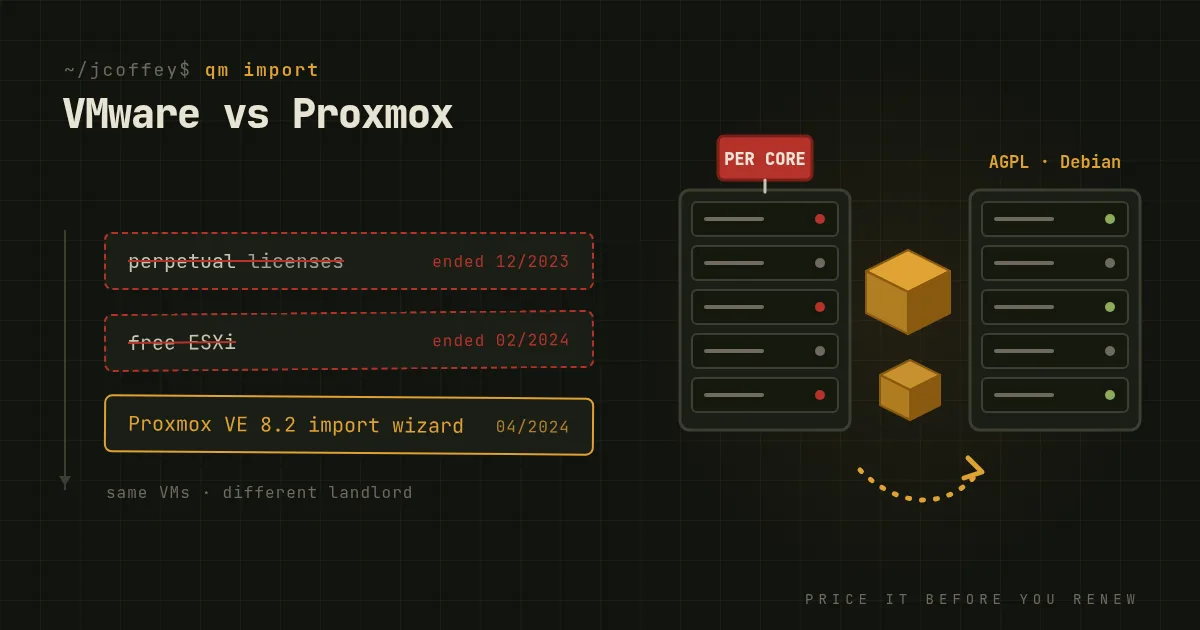
Broadcom finished buying VMware in November 2023. Within weeks it stopped selling perpetual licenses, folded thousands of products into a few per-core subscription bundles, and cut loose a large share of the resellers who used to sell them. In February it ended the free ESXi hypervisor that half the homelabs on earth were built on. So the question has changed. It's no longer which one is better. It's whether what VMware does better is worth what VMware now costs, on terms VMware can change again next year.
That's a real question, and the answer isn't always Proxmox. Here's how they actually compare.
What each one is
VMware vSphere is two products sold as one idea. ESXi is a bare-metal hypervisor with its own small kernel, built for one job. vCenter is the management server on top that turns a pile of ESXi hosts into a cluster, and it's where most of the good features live: vMotion, HA, DRS, distributed switches. Add vSAN for storage and NSX for networking and you have the whole stack, at whole-stack prices.
Proxmox VE is Debian with KVM, LXC containers, a web interface and a clustering layer on top. Every node is a full Linux system, every node can manage the cluster, and there's no separate management server to license, back up or lose. It's AGPL-licensed and free to run. The company behind it, Proxmox Server Solutions in Vienna, sells support subscriptions and access to a more conservative package repository, and that's the whole business model.
Where VMware is still better
I'll start here because the Proxmox crowd tends to skip it.
- DRS. VMware's Distributed Resource Scheduler watches the cluster and moves running VMs to balance load, on its own, all day. Proxmox has live migration and HA, but nothing that rebalances a running cluster automatically. On a big cluster with uneven load, you'll notice.
- The ecosystem. Every backup vendor, storage array, monitoring tool and security product supports vSphere first. Veeam has been the default answer to "how do we back this up" for a decade. On Proxmox there's Proxmox Backup Server, which is good, and a much shorter list after that.
- Certification. Some vendors only support their appliances on ESXi, full stop. If a line-of-business application says "VMware only" in its support contract, that may settle it for you.
- The people. You can hire someone who knows vCenter in any city in the country. Proxmox skills are mostly Linux skills, which helps, but job postings still ask for VCP.
- The mature extras. NSX microsegmentation and vSAN stretched clusters have years of production behind them. Proxmox has software-defined networking and Ceph built in, and both work, but they're younger and you'll be reading forum threads.
Where Proxmox is better
- It's just Linux. When something goes wrong, you SSH in and use the tools you already know:
ip,journalctl,zfs,ceph. There's no proprietary shell, no support bundle to upload and wait on. Anyone who has run Linux servers can run Proxmox. - Containers and VMs side by side. LXC containers run next to KVM virtual machines in the same interface. For lightweight services that don't need a full guest kernel, that's a lot less overhead.
- Storage choice. ZFS on a single node, Ceph across a cluster, plus NFS, iSCSI, LVM and the rest. Replication between nodes is built in.
- No management tier. There's no vCenter appliance to size, patch, back up and license. The cluster manages itself from any node.
- A backup server that does deduplication. Proxmox Backup Server does incremental, deduplicated backups with client-side encryption, and it costs nothing.
- The bill. The software is free. Support subscriptions are priced per CPU socket, not per core, and they're optional.
What it costs in June 2024
The VMware line on the invoice used to be a perpetual license plus about a fifth of that every year for support and upgrades. That's gone. It's now a subscription, priced per core with a 16-core minimum per CPU, and you buy a bundle. vSphere Foundation or VMware Cloud Foundation, whether you wanted the extras in them or not. Customers who already owned perpetual licenses are finding their renewal quotes several times higher than last year's.
Proxmox's subscriptions run from a little over €100 to a little over €1,000 per socket per year, depending on the support level. You can also skip them entirely and use the no-subscription repository. A three-node cluster of two-socket servers on the top support tier costs less per year than many single VMware hosts are now quoted.
Moving over
Proxmox VE 8.2 shipped in April with an import wizard for exactly this moment. You add an ESXi host as a storage source and it pulls the VMs across, translating most of their settings as it goes. You can even boot a guest on Proxmox while its disk is still copying in the background. Two warnings:
- Windows guests need VirtIO drivers for the paravirtualized disk and network devices. Install them before the move, or boot from SATA and IDE first and switch afterward.
- Check your backup story before your hypervisor story. If your recovery plan is built on a VMware-only backup product, that's the hard part of the migration, not the VMs.
Test it on something you can afford to lose first. It's the same advice it's always been.
The way I'd decide
If you're running thousands of VMs across dozens of hosts, rely on DRS and NSX, and have a support contract that requires ESXi, you're probably staying with VMware this cycle. Price it out, push back on the quote, and start a Proxmox lab on the side so the next renewal isn't a negotiation you can't walk away from.
For everyone else, and that's most small and mid-sized shops, Proxmox does what you actually use VMware for. It's a Linux system you can understand, and nobody can reprice it.
The deciding factor isn't any feature. A perpetual license meant the vendor couldn't change the deal after you'd built on it. Broadcom just showed everyone that the protection was never in the license. It was in VMware's good manners, and those were never in writing.
Since then
Added October 2026. The squeeze got harder. AT&T sued over a proposed 1,050 percent renewal in August 2024 and later settled. Holders of lapsed perpetual licenses got letters telling them to uninstall patches. Broadcom raised the core minimum to 72 for some licenses. The free ESXi came back in April 2025, with 8.0 Update 3e, as an unsupported entry-level edition with no vCenter. Proxmox VE 9 moved to Debian 13 in August 2025, and the import tool has had a busy two years. I wrote the longer version in Software You Rent vs. Software You Own.