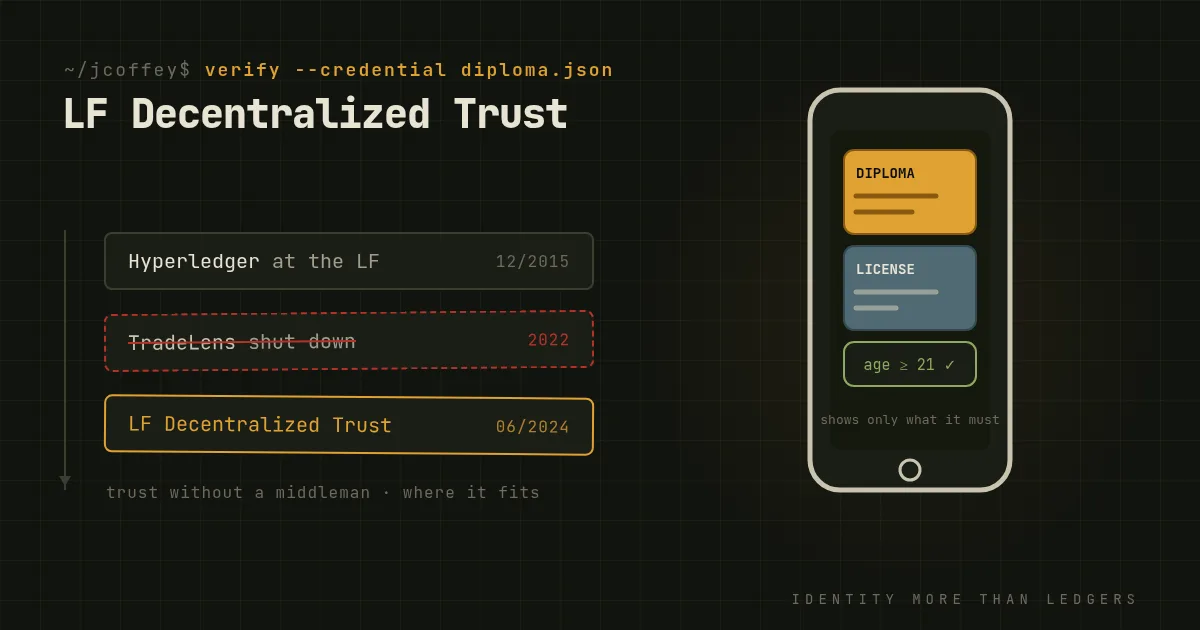
On June 25 the Linux Foundation announced its intent to form LF Decentralized Trust, a new umbrella foundation that will take in the Hyperledger projects and widen their scope to digital identity, cryptography and other technologies for building trust between parties who don't share an owner. It's due to launch properly later this year.
It's worth explaining what that means, because "decentralized trust" is easy to wave around and hard to pin down, and the last eight years of enterprise blockchain have taught some useful lessons.
Where it comes from
Hyperledger started at the Linux Foundation in December 2015, at the height of the blockchain boom, as a home for open source enterprise ledgers. Unlike public cryptocurrencies, these are mostly permissioned: the participants are known organizations, such as banks in a consortium or companies in a supply chain, and only they can write to the ledger. The idea was to get a shared, tamper-evident record without anyone being in charge of it.
Its best-known projects:
- Hyperledger Fabric, originally from IBM, a modular permissioned ledger with "chaincode" smart contracts.
- Hyperledger Besu, an Ethereum client written in Java that can run on the public Ethereum network or in private networks.
- Hyperledger Indy, Aries and AnonCreds, for decentralized digital identity and verifiable credentials.
- Hyperledger Cacti and FireFly, for connecting ledgers to each other and to ordinary applications.
LF Decentralized Trust will put those under one roof with projects beyond ledgers, so "Hyperledger" stops being the name for everything.
What enterprise blockchain didn't deliver
Honesty first, because the hype did real damage.
Around 2016 to 2018, blockchain was going to revolutionize supply chains, trade finance, healthcare records and voting. Most of those projects quietly ended. The best-known example is TradeLens, the shipping platform IBM and Maersk built on Fabric, which they announced in late 2022 they would shut down. It worked technically. It failed because Maersk's competitors didn't want to join a platform run by Maersk.
That's the lesson. A blockchain removes the need for a trusted central party when the participants genuinely don't trust each other and won't accept anyone as the middleman. When there's a party everyone already accepts, like a bank, a regulator or a platform, a normal database run by that party is faster, cheaper and easier to fix. Many enterprise blockchain projects were databases with extra steps.
Where the idea actually helps
That doesn't make the technology useless. The places it fits are more specific than the hype was:
- Digital identity and credentials. This is the most promising area. A university can issue you a digitally signed diploma, a government a driving license, and an employer a credential. You hold them in a wallet on your phone and prove facts about yourself, like "over 21" or "licensed nurse," without the verifier phoning the issuer or seeing more than it needs. The cryptography for that, verifiable credentials and selective disclosure, is exactly what projects like Aries and AnonCreds build. Europe's revised digital identity regulation, eIDAS 2.0, which came into force this May, will give every EU citizen a digital identity wallet, and that's the kind of system this work feeds into.
- Shared records between rivals. Some consortia, in trade finance and in reconciliation between banks, have found cases where no one will let a competitor run the database. Those are narrower than the brochures promised, but real.
- Public Ethereum infrastructure. Besu is one of the clients running the main Ethereum network, which is about as decentralized and adversarial an environment as software gets.
- Central bank experiments. Several central bank digital currency pilots have used Besu or Fabric.
Why a foundation matters here
Trust infrastructure only works if nobody owns it. If one vendor controls the identity wallet or the ledger software, you've just moved the central party. That's exactly the problem open, foundation-hosted projects solve: shared code under an open license, governed in public, that competitors can all run without handing anyone the keys. It's the same reason I think the Linux Foundation is valuable in general, as I wrote in the Linux Foundation.
Whether LF Decentralized Trust becomes important will depend on identity more than ledgers. If the next generation of digital IDs, diplomas and licenses is built on open standards and open source, rather than on a handful of platform companies' wallets, that'll be a real win for everyone who has to carry them.
Since then
Added October 2026. LF Decentralized Trust launched in September 2024 with seventeen projects, including all of Hyperledger, and more than a hundred founding members.