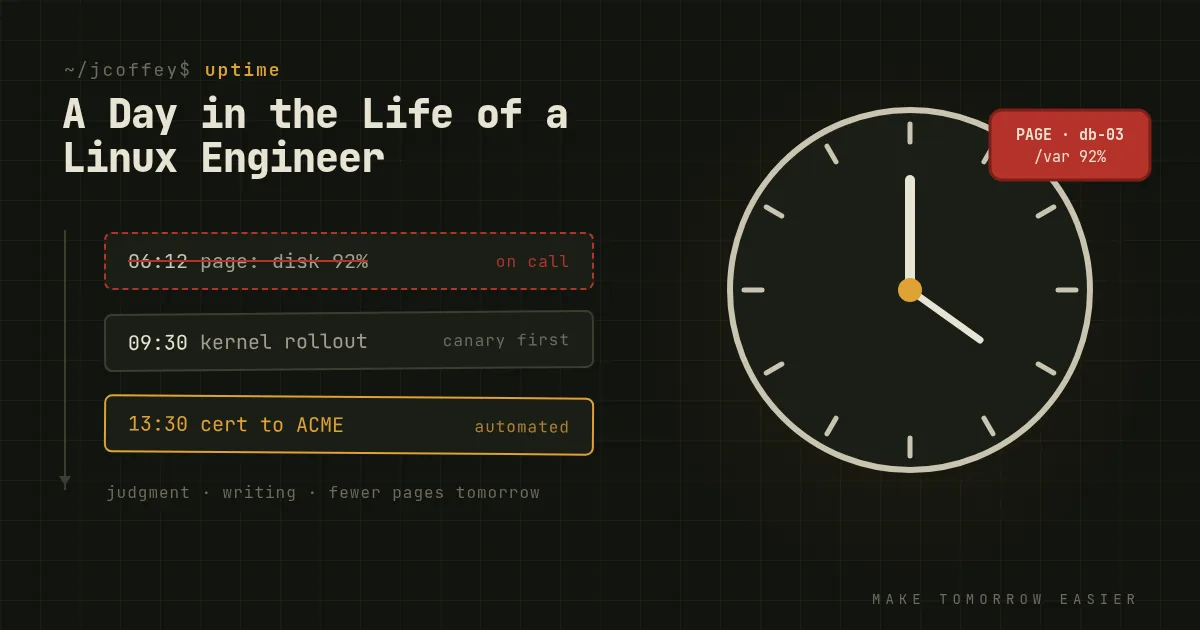
Alex is a composite, a Linux systems engineer at a mid-sized company running a few hundred servers across a data center and a cloud provider. Every part of this day happens to someone in this job every week. The point isn't the schedule. It's what the work actually consists of, which is less heroic and more interesting than people expect.
6:12 a.m. — The page
Alex's phone goes off. It's Alex's on-call week, and the alert says disk usage on a database server is at 92 percent and climbing.
Laptop, coffee, ssh. df -h confirms it. du -xh /var | sort -h | tail finds the culprit: the database's write-ahead logs are piling up because the replica they ship to stopped accepting them overnight. Alex frees space by fixing the replica connection, not by deleting files. Deleting the logs would have broken recovery. The alert clears at 6:40.
What the job description leaves out: most incidents aren't exotic. They're full disks, expired certificates and things that stopped talking to each other. The skill is fixing the cause without breaking something worse in a hurry.
7:00 a.m. — Write it down
Before anything else, Alex writes three lines in the incident channel: what happened, what was done, what's still open. The replica's monitoring didn't catch that it had stopped accepting logs. That goes on the list as a follow-up ticket.
What it says: the incident isn't over when the alert clears. It's over when the next person can understand it, and when it's less likely to happen again.
9:00 a.m. — Stand-up
Fifteen minutes on a video call with the infrastructure team. Alex mentions the morning page, says the follow-up ticket exists, and flags that this week's kernel updates need a maintenance window.
9:30 a.m. — A change, done properly
Today's planned work is rolling out a new kernel across forty web servers, to pick up security fixes. Alex doesn't SSH into forty servers. The change is a pull request against the Ansible repository: a version bump, a playbook that drains each server from the load balancer, updates, reboots, checks that the service is healthy and puts it back, one at a time.
A teammate reviews the pull request. Alex runs it against two canary servers first, watches error rates for twenty minutes, then lets it work through the rest in batches.
What it says: good operations work is mostly preparing the change so the change itself is boring. Review, canary, rollback plan, then go.
11:00 a.m. — "Is the network slow?"
A developer messages: their service's calls to another internal service are timing out, intermittently. They suspect the network. So do they always.
Alex checks both ends. ss -s on the receiving side shows thousands of connections stuck in TIME_WAIT, and the service's logs show it's running out of ephemeral ports under load, because the client opens a new connection for every request instead of reusing them. The fix is in the application: enable connection keep-alive. Alex explains it with the output pasted in, and the developer ships the fix that afternoon.
What it says: "it's the network" and "it's the server" are both just guesses until someone checks. The most useful thing a Linux engineer can do is find out exactly where the problem is, and show the evidence.
12:30 p.m. — Lunch, away from the screen
Actually away. The pager will find Alex if it needs to.
1:30 p.m. — Toil, and what to do about it
A certificate on an internal service will expire in nine days. It's renewed by hand once a year, by whoever remembers. Alex renews it, then spends the next hour moving it to the same automated ACME renewal everything else uses, so nobody has to remember again.
What it says: the real productivity in this job is removing work. Every manual task that happens more than twice is a candidate for automation, and every automation is a task nobody ever has to be paged for.
3:00 p.m. — Planning
A meeting about moving some workloads off the company's VMware cluster, whose renewal quote came in very high this year. Alex's job in the meeting is to ask the unglamorous questions. What backs these VMs up today? Which ones have licenses tied to the hypervisor? What does the network look like on the other side? Who's on call for the new platform at 3 a.m.?
What it says: senior engineers are valuable less for knowing the answers than for knowing which questions will hurt if nobody asks them.
4:00 p.m. — Teaching
Alex pairs with a junior engineer who's been fighting a systemd unit that won't start. Instead of fixing it, Alex shows how to read systemctl status and journalctl -u properly and how to check the unit's environment, and lets them find it. It's a missing environment file. It takes longer than fixing it would have. It's worth it.
5:30 p.m. — Handoff
Alex updates the follow-up ticket from the morning, checks that the kernel rollout finished on all forty servers with no errors, and logs off. The on-call phone stays charged.
9:00 p.m. — On their own time
Alex maintains a small open source tool that a few thousand people use, and reviews a pull request from a stranger in another country. No one pays for this. It's also how Alex learned half of what they know.
What the day shows
Notice what took up the time: one incident, one planned change, one investigation, one automation, one planning meeting, one teaching session and a lot of writing things down. Very little of it was typing commands from memory. The job is judgment, communication and making tomorrow easier than today. The Linux knowledge is what makes the judgment possible.
If that sounds like your kind of work, the skills behind it are in Enterprise Linux Engineer Essentials.