A disclosure first: I've helped write three of the Linux Foundation's certification exams and still sit on the advisory council for one of them. I'm not a neutral observer here. I'll try to be a fair one.
Most people assume the Linux Foundation is the organization that runs Linux. It isn't, quite. Linux is run by Linus Torvalds and a few thousand maintainers on mailing lists, the way it has been since 1991. What the Foundation does is pay some of those people, keep the lights on around them, and increasingly do the same thing for hundreds of other open source projects that have nothing to do with the kernel.
Where it came from
The Linux Foundation formed in 2007 from a merger of two earlier groups:
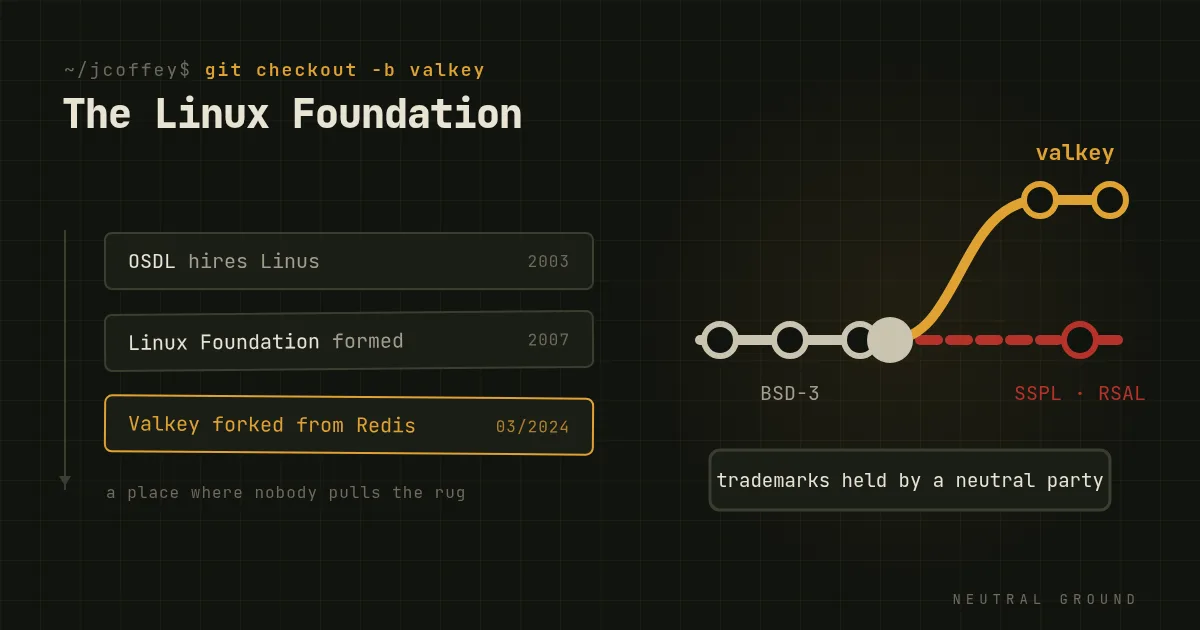
- Open Source Development Labs, founded in 2000 by IBM, HP, Intel and others to help make Linux ready for enterprise use. In 2003 it hired Linus Torvalds, so he could work on the kernel full time without working for any one vendor.
- The Free Standards Group, which maintained the Linux Standard Base, an attempt to make software install the same way on every distribution.
Jim Zemlin, who ran the Free Standards Group, has led the combined foundation ever since. Linus and Greg Kroah-Hartman, who maintains the stable kernel releases, are both Linux Foundation fellows. Their independence was the original point of the organization: the two most important people in Linux aren't on Red Hat's, IBM's or Intel's payroll, so none of those companies can steer the kernel by managing them.
A foundation of foundations
Since around 2015 the Linux Foundation has grown into something much bigger, essentially a service company for open source projects. A project joins, its trademarks and domains are held by a neutral party, and member companies fund it through dues. In return the project gets legal, financial, marketing and event support, without any one of its corporate contributors owning it.
Some of the better-known ones:
- Cloud Native Computing Foundation, founded in 2015 with Kubernetes, which Google donated. It now also covers Prometheus, Envoy, containerd, etcd and many more.
- OpenSSF, the Open Source Security Foundation, working on supply chain security: Sigstore for signing releases, the Scorecard project, and security audits of critical code.
- OpenJS Foundation, which houses Node.js, jQuery and Electron.
- LF AI & Data, LF Networking and LF Energy, for open source in industries that used to buy everything from vendors.
- OpenTofu, the open fork of Terraform, which joined in 2023 after HashiCorp moved Terraform to the Business Source License.
- Valkey, this spring's fork of Redis.
Valkey, and what the Foundation is for
The last two are the most instructive. In March, Redis changed its license from the permissive BSD to a dual "source available" arrangement that cloud providers can't use to offer a hosted Redis. Within about a week, the Linux Foundation announced Valkey: a fork of the last BSD-licensed Redis, backed by AWS, Google Cloud, Oracle, Ericsson and Snap, with several longtime Redis maintainers on board. Fedora has already proposed switching to it.
That's the pattern now. A company that controls a popular open source project changes the license to stop competitors from hosting it, and the community forks it into a vendor-neutral foundation where no single company can do that again. The Linux Foundation is the default destination because it has the legal and organizational machinery ready to go. Whatever else it does, that's its most valuable function. It's a place where nobody gets to pull the rug.
Training and certification
The Foundation also runs one of the largest open source training programs. The ones people most often take:
- LFCS, Linux Foundation Certified System Administrator.
- CKA, CKAD and CKS, the Kubernetes administrator, developer and security exams, run with the CNCF.
- A growing list of others, for things like Prometheus, OpenTofu and cloud native security.
Those are performance-based. There are no multiple-choice questions about which flag does what. You get a live system with a list of tasks, and you have to get the work done, with the documentation open, as you would on the job. Having been on the inside of writing some of them, I'll say the people involved care a great deal about whether passing means you can actually do the work. That's the right question for any certification to obsess over.
The fair criticisms
It wouldn't be honest to leave these out.
- The kernel is a small part of the budget. The Linux Foundation's annual reports show that only a small single-digit share of its spending goes directly to the Linux kernel. Most of its money supports other projects, events and training. That's a defensible choice, since the kernel is well funded by the companies that employ its developers, but it surprises people who think they're donating to Linux.
- It's a trade association. Its members are companies and its board is mostly corporate seats. It serves open source by serving the businesses that depend on it. Most of the time those interests line up. When they don't, you can guess which way it leans.
- Corporate open source. Some of its projects are mostly vehicles for a few large vendors, with little community beyond them. A logo on a foundation's website doesn't make a project healthy.
None of that makes it bad. It makes it what it is: a large, well-run industry body that happens to be the best place we have for keeping important projects out of any one company's hands.
Since then
Added October 2026. The pattern held. In September 2024 the Foundation launched the OpenSearch Software Foundation for Amazon's fork of Elasticsearch, and folded Hyperledger into LF Decentralized Trust, which I wrote about separately. Valkey has replaced Redis in several major Linux distributions. In 2025 Redis added the AGPL as a license option, partly in response.