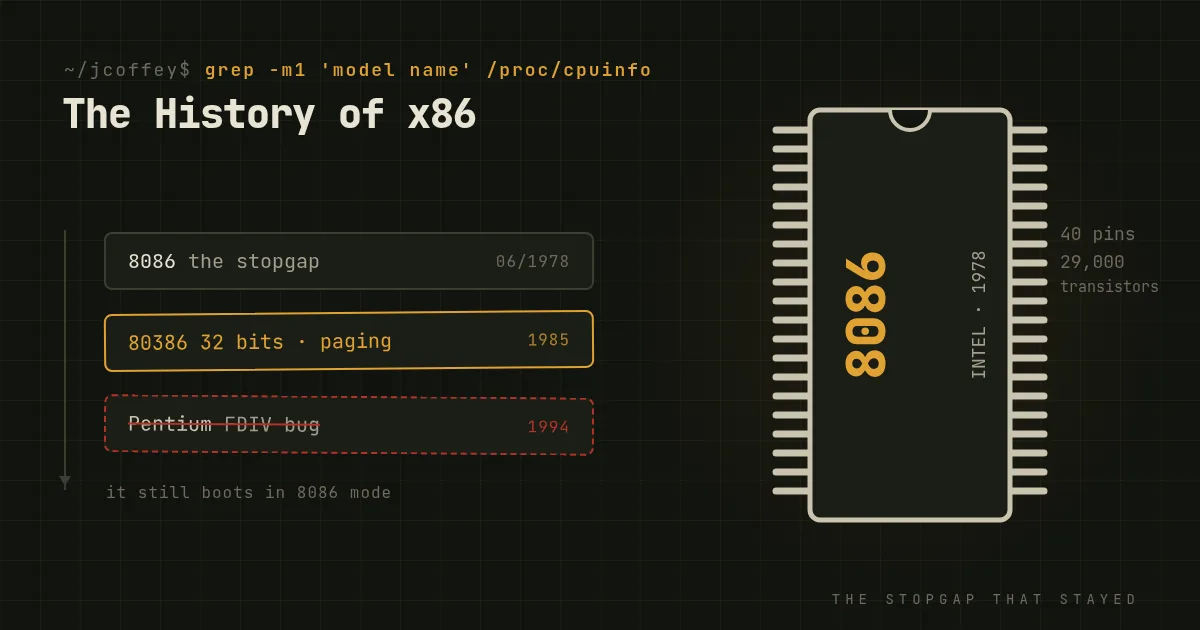
Intel introduced the 8086 on June 8, 1978, forty-six years ago this month. It wasn't supposed to matter much. Intel's real next-generation processor was a far more ambitious design called the iAPX 432, which was running late, and the 8086 was a stopgap thrown together in about eighteen months to keep customers from going to Motorola or Zilog in the meantime.
The iAPX 432 shipped in 1981, ran slowly, and disappeared. The stopgap is the ancestor of the processor in your laptop, and it still boots in 8086 mode every time you turn it on.
The decision that made it
The 8086 was a 16-bit processor with a segmented scheme that let it address 1 MB of memory. Its cheaper sibling, the 8088, had the same instructions on an 8-bit external bus, so it could use cheaper support chips.
In 1981 IBM chose the 8088 for the IBM Personal Computer. That one decision is the reason x86 exists today. IBM's PC was easy to clone, the clones needed the same processor, and software written for one ran on all of them. Within a few years there was a huge installed base of x86 software that nobody wanted to rewrite, and every Intel processor since has been built to run it.
IBM also insisted on a second source, so it wouldn't depend on a single supplier. That's how AMD got a license to make x86 chips in 1982. It's also where four decades of rivalry, cross-licensing and lawsuits began.
The 1980s: protected mode and 32 bits
- 80286 (1982). Added protected mode, with memory protection and access to 16 MB. It also had a famous flaw: once in protected mode, the chip couldn't switch back to the old real mode without being reset. DOS software needed real mode. So most 286 machines spent their lives running DOS as a fast 8086. Bill Gates reportedly called it "brain-dead."
- 80386 (1985). The chip that defined the next twenty years. 32-bit registers, a flat 4 GB address space, paging for virtual memory, and virtual 8086 mode, which could run old DOS programs safely inside a protected-mode operating system. Compaq shipped the first 386 PC in 1986, beating IBM, the moment PC hardware stopped being IBM's to define. Intel also stopped licensing its designs to AMD with the 386, and the companies went to court. AMD shipped its own reverse-engineered 386 in 1991 anyway.
- 80486 (1989). Put the floating-point unit and a cache on the same chip and pipelined execution, so most simple instructions finished in one clock cycle. The ideas were familiar to RISC designers. Bringing them to x86 is what kept x86 competitive.
The 386 is also where Linux comes in. Linus Torvalds wrote it in 1991 specifically to learn and use his new 386's protected mode and paging.
The 1990s: Pentium, and a bug in division
The Pentium arrived in 1993, named that way because a court had ruled that numbers like "586" couldn't be trademarked. It was superscalar, able to issue two instructions per clock cycle.
In 1994 Thomas Nicely, a mathematics professor working on prime numbers, found that it got certain floating-point divisions wrong. A few entries were missing from a lookup table in the division unit. Intel's first response was that the average user would hit the bug once every 27,000 years and only needed a replacement if they could prove they were affected. That went badly. Intel eventually offered replacements to anyone who asked and took a $475 million charge. It's still the industry's best case study in what happens when you argue with customers about a bug.
The quieter revolution was the Pentium Pro in 1995. Inside, it translated x86 instructions into simpler, RISC-like micro-operations and executed them out of order. From then on, x86 was a compatibility layer on top of a core that worked like a RISC chip. That's how an instruction set designed in 1978 kept up with designs that started clean.
The 2000s: the gigahertz wall and 64 bits
The Pentium 4 of 2000 chased clock speed above everything, with a very long pipeline to reach high frequencies. It got there, then ran into heat. The planned 10 GHz chips never arrived. Intel went back to its efficient Pentium M laptop design, descended from the Pentium Pro, and built the Core line on it in 2006. Performance now came from doing more per clock cycle, and from more cores. Dual-core desktop chips arrived from both companies in 2005.
The jump to 64 bits came from AMD, not Intel. It's a story big enough to have its own article.
Today
The last few years have been unusually eventful:
- AMD's comeback. AMD launched its Zen architecture in 2017 after years of falling behind, and it has been competitive or ahead ever since, especially in servers, where EPYC has taken real market share. At Computex this month AMD announced Zen 5 and its Ryzen 9000 chips.
- Spectre and Meltdown. In January 2018 researchers showed that the speculative execution tricks that made modern x86 chips fast could leak data across security boundaries. Years of patches, microcode updates and lost performance followed, and the whole class of attack still hasn't fully gone away.
- Intel's rough patch. Intel has struggled with manufacturing delays, and right now owners of some 13th and 14th-generation Core desktop chips are reporting crashes that Intel is still investigating.
- ARM is coming. Apple left x86 for its own ARM chips in 2020, Amazon's Graviton servers are cheaper per unit of work than x86, and the first Windows laptops built on Qualcomm's ARM chips went on sale this month. The history of ARM covers that side.
x86 has been declared dead about once a decade since the 1980s. Each time, its advantage was the same: a mountain of software that just runs. That advantage is shrinking, as more software is recompiled for ARM and more of it lives in the cloud. It hasn't disappeared, and it's had a longer run than anyone in 1978 would have given it.
Since then
Added October 2026. In July 2024 Intel traced the 13th and 14th-generation crashes to a voltage problem, shipped microcode fixes, and extended the warranty on affected chips. In October 2024 Intel and AMD formed an x86 Ecosystem Advisory Group to steer the instruction set together.