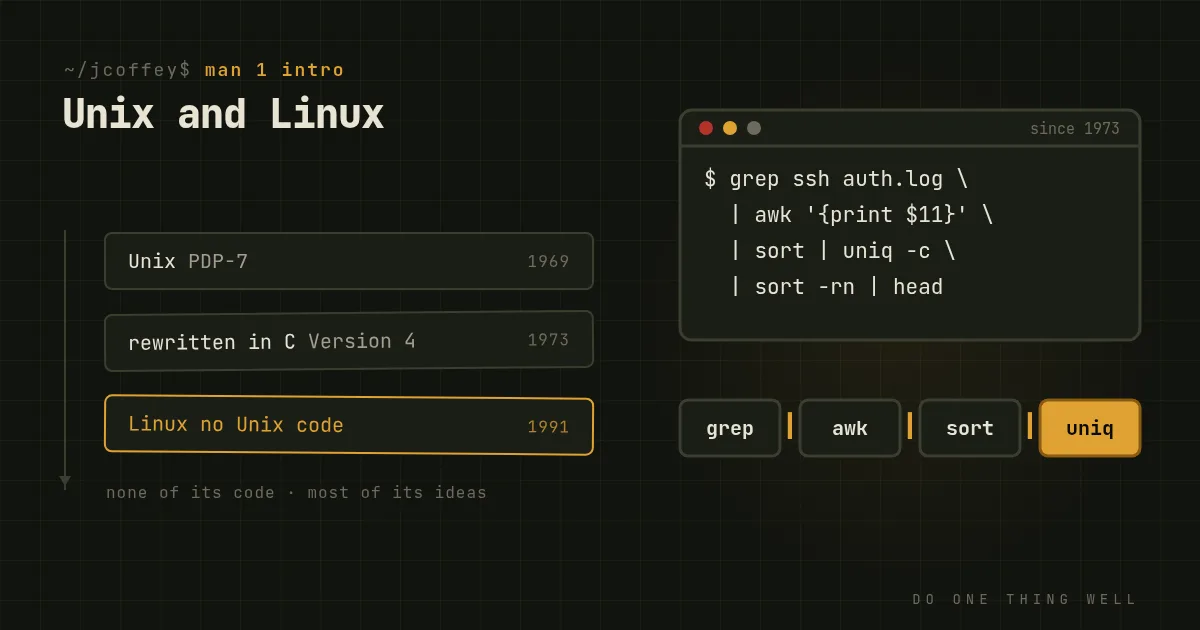
Linux is not Unix. It contains no Unix code, it has never been certified as Unix, and a company spent most of the 2000s losing in court after claiming otherwise. It's also the most successful Unix-like system ever built, and everything about how you use it, from the shell to /etc to pipes, comes from a project at Bell Labs in 1969.
Here's how the one became the other.
A month on a PDP-7
In the mid-1960s, Bell Labs, MIT and General Electric were building Multics, an ambitious time-sharing operating system meant to serve a whole city's computing like a utility. It was late, expensive and complicated, and in 1969 Bell Labs pulled out.
Ken Thompson missed the environment anyway. He found a little-used PDP-7 minicomputer and started writing a small operating system for it. The famous story is that his wife and their young son went to visit family for three weeks that summer. Thompson used the time to write the pieces he was missing, roughly a week each, and by the time they came back he had a kernel, a shell, an editor and an assembler working together.
Brian Kernighan named it Unics, a pun on Multics: one of whatever Multics was many of. The spelling drifted to Unix. To get a better machine, the team pitched it to Bell Labs management as a text-processing system for the patent department, and got a PDP-11 in 1970. The first Unix manual is dated November 1971.
Two ideas from those early years still shape every system you'll log into:
- Everything is a file. Devices, terminals and later processes appear as files in a single directory tree, read and written with the same calls.
- Small tools, joined by pipes. Doug McIlroy pushed for pipes, and they arrived in 1973. Write programs that do one thing well, that work together, and that handle text streams, because text is the universal interface. That's the Unix philosophy, and it's why
grep | sort | uniq -cstill works the way it did fifty years ago.
Rewritten in C, given away by law
In 1973 Dennis Ritchie and Thompson rewrote the Unix kernel in C, the language Ritchie had developed for the purpose. Operating systems were written in assembly language for one machine. Unix was now mostly portable, and could move to new hardware by rewriting a small amount of machine-specific code and recompiling the rest. I've written more about that in the birth of C.
Then the lawyers helped, without meaning to. Under a 1956 antitrust consent decree, AT&T wasn't allowed to go into the computer business. It couldn't sell Unix as a product. So it licensed it, with source code, to universities for little more than the cost of the tapes. A generation of computer science students learned operating systems by reading the Unix source, often from photocopies of John Lions' annotated commentary on Version 6, which AT&T later tried to suppress.
Berkeley
The University of California, Berkeley, took Unix and ran with it. Bill Joy and his colleagues released the first Berkeley Software Distribution in 1978, and BSD went on to add virtual memory, the vi editor, the C shell, and above all the TCP/IP networking stack, funded by DARPA. 4.2BSD in 1983 put the internet's protocols into a widely available operating system. When people say Unix built the internet, this is the Unix they mean. The sockets API you program against today is Berkeley's.
The Unix wars
With the breakup of the Bell System approaching, which took effect in 1984, AT&T was finally free to treat Unix as a product. It released System V in 1983 and sold it commercially, and Unix stopped being something you could study freely. The vendors each licensed it and diverged: Sun's SunOS and later Solaris, HP's HP-UX, IBM's AIX, Digital's Ultrix, Microsoft's Xenix, which became SCO's. Each one added its own extensions, so software written for one didn't build on another.
The industry spent the late 1980s and early 1990s in rival consortiums fighting over whose Unix would be the standard. The POSIX standard, first published in 1988, eventually gave everyone a common interface to write against. Meanwhile AT&T's Unix Systems Laboratories sued Berkeley's spin-off company in 1992, claiming BSD contained AT&T code. The case settled in 1994, with only a few files at issue. By then the damage was done. For two crucial years, nobody was sure the free BSDs were legally safe to use.
Linux arrives in the gap
Meanwhile, two other things were happening. Richard Stallman's GNU Project had spent the 1980s writing free replacements for the Unix tools: a compiler, a shell, an editor, the utilities. It had everything except a working kernel. And in 1987 Andrew Tanenbaum published MINIX, a small Unix-like system for teaching. It was cheap and came with the source code, but its license didn't allow free redistribution.
In 1991 Linus Torvalds, a student who had been using MINIX, wrote a new kernel from scratch for his 386. Combined with the GNU tools, it made a complete, free, Unix-like system, and it did so just as BSD was tied up in court. It wasn't Unix. It was written to POSIX and to how Unix behaved, so Unix software compiled on it, and Unix administrators felt at home.
That's still the relationship. Linux is a reimplementation of Unix ideas, not a descendant of Unix code. When SCO sued IBM in 2003, claiming Linux contained stolen Unix code, it spent years failing to show any meaningful amount of it and went bankrupt.
Who's still Unix
"UNIX" is a trademark owned by The Open Group, and only systems that pass its certification may use it. Today the best-known certified Unix is macOS, whose Darwin core descends from BSD and the Mach kernel. IBM's AIX and Oracle's Solaris are still supported, in shrinking markets. HP-UX is approaching the end of its support. Mainstream Linux distributions have never bothered with certification, and they don't need to.
The irony is that the systems carrying the Unix name are a small corner of the market, and the one that was never allowed to call itself Unix runs nearly everything. Ken Thompson's month on a PDP-7 is still the most consequential vacation anyone has spent at home.
Since then
Added October 2026. HP-UX 11i v3 reached the end of standard support on December 31, 2025, the last of HP's own Unix line. Linux turned 35 this month, which I wrote about in Just a Hobby.