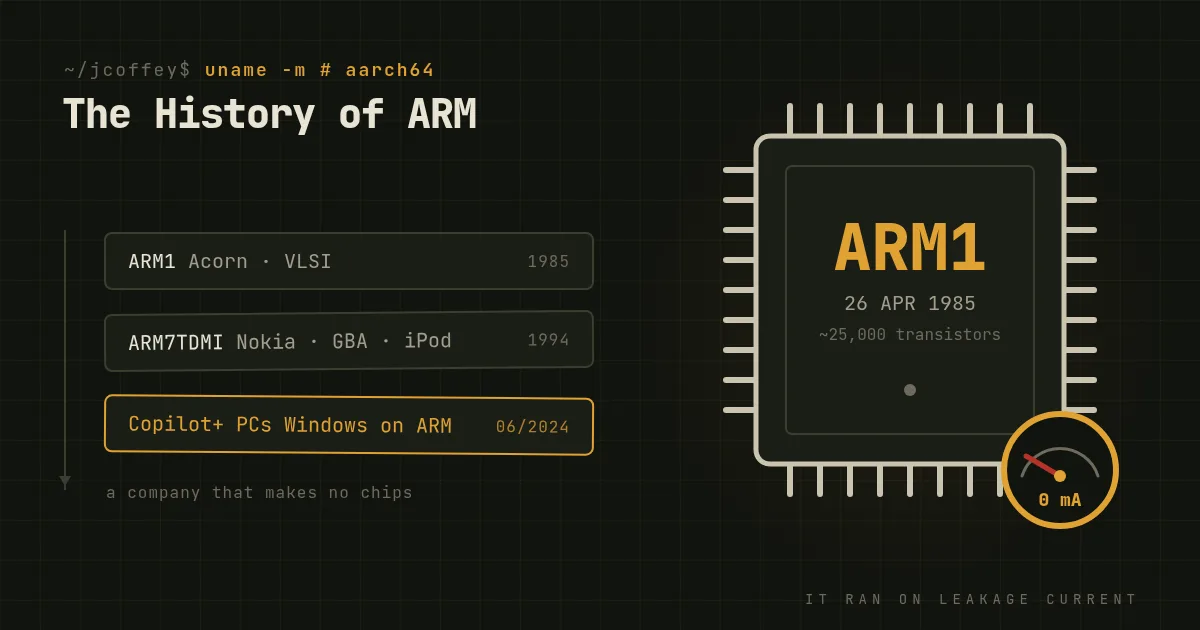
On April 26, 1985, the first ARM processor came back from the fab and ran correctly the first time it was powered up. Then its designers noticed something odd. The ammeter on its power supply read zero. The chip's supply wasn't even connected. It was running on the current leaking in through its input pins.
Nobody had designed it to be low-power. They'd designed it to be simple. That accident is why, forty years later, there's an ARM chip in nearly every phone on Earth.
Acorn and the 6502
In the early 1980s Acorn Computers of Cambridge made the BBC Micro, the computer a generation of British schoolchildren learned on. It ran on a MOS 6502, the same cheap 8-bit chip as the Apple II and the Commodore 64. Acorn needed something faster for its next machine and didn't like any of the 16-bit processors on the market.
Sophie Wilson and Steve Furber had read the Berkeley RISC papers, which argued that a processor with a small set of simple instructions could beat complex ones by doing each step quickly. They also visited the Western Design Center in Arizona, where a handful of people were designing 6502 derivatives in what amounted to a suburban house. If that tiny team could design a processor, so could Acorn. Wilson designed the instruction set and Furber the chip, and VLSI Technology manufactured it. The project was called the Acorn RISC Machine.
The ARM1 was mostly a test chip. The ARM2 shipped in 1987 in the Acorn Archimedes, which was, for a while, the fastest home computer you could buy. It had about 30,000 transistors. Intel's 386, from the same era, had about 275,000.
A company that makes no chips
Acorn's computers were never going to sell in large enough numbers to pay for a processor line. Apple, which wanted a power-efficient chip for a handheld it was planning, provided the way out. In November 1990 Acorn, Apple and VLSI formed a joint venture, Advanced RISC Machines Ltd, with twelve engineers working out of a converted barn outside Cambridge.
The Newton MessagePad of 1993 ran an ARM610. The Newton flopped. The business model it forced on ARM didn't, and it's the most important part of this story.
ARM doesn't make chips. It designs processor cores and instruction sets and licenses them to companies that do. A licensee pays an up-front fee, then a royalty on every chip it ships. Some license ready-made cores. A few, like Apple and Qualcomm, license the instruction set itself and design their own cores to run it. That meant every phone maker, chip designer and appliance company could build an ARM chip tailored to its product, without competing against ARM itself. Intel sold processors. ARM sold the right to make them, to everyone.
The phone in your pocket
ARM's next design to break out was the ARM7TDMI in 1994, which added the compact Thumb instruction set to save memory. It went into the Nokia 6110, the Game Boy Advance and the original iPod, and from there into nearly every mobile phone of the 2000s. When phones became computers, the incumbent was already there.
The first iPhone, in 2007, ran on a Samsung-made ARM11. Android launched on ARM a year later. In 2011 ARM announced ARMv8, its 64-bit architecture, and in 2013 Apple surprised the industry by shipping a 64-bit ARM phone chip years before anyone expected one. By the time Arm went public in 2023, its partners had shipped more than 250 billion Arm-based chips. Phones are where most of them went, but they're also in hard drives, car dashboards, SIM cards, smart speakers and the microcontrollers in your appliances.
The ownership saga
The company has changed hands more than its chips have changed architectures.
- 1998: ARM Holdings listed in London and on the Nasdaq.
- 2016: SoftBank bought it for £24 billion, about $32 billion, and took it private.
- 2020: Nvidia agreed to buy it from SoftBank for $40 billion. Every one of ARM's customers who also competed with Nvidia objected, and regulators in the US, UK and EU lined up against the deal. Nvidia called it off in February 2022.
- 2023: SoftBank took Arm public again on the Nasdaq in September. It was the biggest tech IPO in two years.
It stays independent for a simple reason. Arm is valuable because it's neutral. A licensor owned by one of its licensees' competitors stops being neutral.
Coming for x86's lunch
For decades the line was that ARM was for phones and x86 was for real computers. That line is gone.
- Servers. Amazon launched its first Graviton processor in 2018, and Graviton4 was announced last fall. A large and growing share of new AWS capacity is ARM, sold cheaper per unit of performance than the x86 equivalent. Microsoft has its Cobalt chip, and Ampere sells ARM servers to everyone else. The Fugaku supercomputer in Japan, built on ARM, was the fastest in the world from 2020 to 2022.
- Macs. Apple moved the Mac from Intel to its own ARM-based M1 in November 2020, and the battery life and performance made the case for ARM on the desktop more convincingly than any benchmark.
- Windows. This month, on June 18, the first Copilot+ PCs went on sale, built around Qualcomm's Snapdragon X chips. It's the most serious attempt yet to put Windows on ARM, after several false starts.
Why it matters if you run Linux
Linux got to ARM early and never left. The 64-bit ARM port, arm64 or aarch64, is a first-class architecture in Debian, Ubuntu, Fedora and RHEL. The Raspberry Pi has put cheap ARM Linux boards on millions of desks since 2012. Most open source software builds on it unmodified. In practice, the places you'll hit trouble are proprietary binaries shipped only for x86, and container images that were never built for arm64. Build multi-architecture images, test on both, and an ARM server is usually just a cheaper server.
What's next
The other open question is RISC-V, an open instruction set anyone can implement without paying anyone a royalty. It's already in microcontrollers and storage controllers, and it's ARM's licensing model with the licensing removed. And Arm is in court with Qualcomm, one of its own biggest customers, over the licenses for the Nuvia core designs inside those new Windows laptops. The trial is set for December.
Since then
Added October 2026. In December 2024 a Delaware jury sided with Qualcomm on the main questions in the Nuvia case. Arm-based Windows laptops are a normal purchase now, rather than a curiosity, and the 64-bit ARM server has stopped being news. Arm's partners keep shipping billions of chips a year.