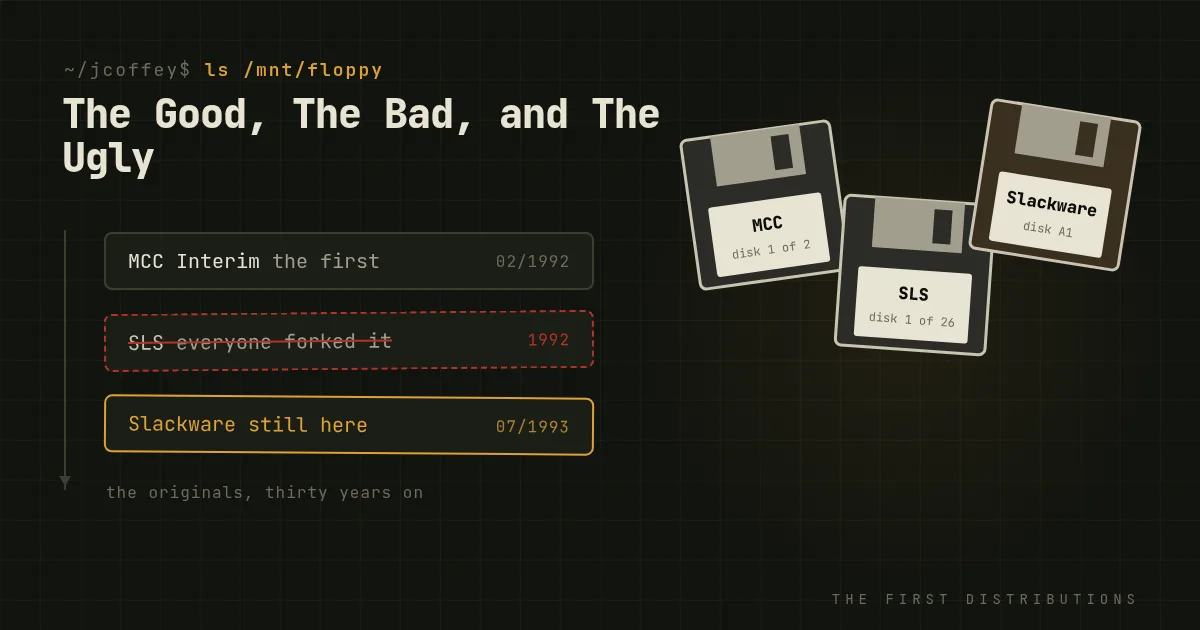
In late 1991, getting Linux running meant downloading a kernel and a pile of separate GNU tools, compiling some of them, and assembling a working system by hand from instructions posted to Usenet. The first distributions appeared in 1992 to do that work for you: a set of floppy disks, an installer of sorts and a system that booted at the end.
Thirty-odd years on, here's what happened to the originals. I've sorted them loosely, with apologies to Sergio Leone.
The Good: still here
Slackware (1993). Patrick Volkerding released Slackware in July 1993, building on SLS, below, after getting frustrated with its bugs. It's the oldest Linux distribution still maintained, and it has stayed true to its original idea: simple, stable and as close to traditional Unix as possible, with no automatic dependency resolution and configuration done by editing text files. Releases are rare, the last major one was 15.0 in 2022, but it's alive and much loved.
Debian (1993). Ian Murdock announced Debian in August 1993, also in reaction to the state of SLS, with the goal of a distribution built openly by a community. It became the foundation of a whole family, including Ubuntu, Mint and Raspberry Pi OS, and its package manager, APT, set the standard for everyone else. I wrote more for its birthday in Debian turns 31.
S.u.S.E. (1994). A German company that began by translating and selling Slackware released its own distribution in 1994. SUSE became the leading Linux in Europe, was bought by Novell in 2004, and today is SUSE Linux Enterprise and the community openSUSE, an independent company once again.
Red Hat Linux (1994). Marc Ewing's Red Hat Linux introduced the RPM package format and became the commercial Linux of the late 1990s. Red Hat ended the consumer product in 2003 and split it into Red Hat Enterprise Linux and the community-driven Fedora. Red Hat itself went on to be bought by IBM, and its later decisions about CentOS and RHEL's source code have been controversial, which I covered in A Betrayal of the Open Source Spirit. But the lineage is alive and enormous.
The Bad: influential, and gone
"Bad" is unfair, but these didn't survive, and their influence outlived them.
SLS, the Softlanding Linux System (1992). Peter MacDonald's SLS was the first distribution to include more than the bare kernel and tools, with networking and the X Window System. For a while it was the way to install Linux. It was also buggy and hard to maintain, and its shortcomings directly inspired both Slackware, which started as a cleaned-up SLS, and Debian, whose founder wanted something better built. Few projects have been so important in losing.
Yggdrasil Linux/GNU/X (1992). Yggdrasil shipped on a CD-ROM at a time when Linux came on dozens of floppies, and it could run directly from the CD, an early live system. It was also one of the first commercial distributions. It faded by the mid-1990s, but bootable live media became how almost everyone tries Linux today.
The Ugly: rough, brave and brief
MCC Interim Linux (1992). Released in February 1992 by Owen Le Blanc at the Manchester Computing Centre, it's generally considered the first Linux distribution. It gave you a boot disk and a root disk with a basic system, and the "Interim" in the name was honest. It was meant to tide people over, and it did.
TAMU Linux (1992). From Texas A&M University, an early distribution notable for shipping with a working X Window System, a big deal when configuring X by hand meant guessing your monitor's timing parameters and hoping it didn't damage the hardware.
They were ugly in the way all early software is: awkward installers, few packages, and documentation in a README. They're also why Linux spread beyond the people who could build it from scratch.
Why the survivors survived
Look at the four still standing and a pattern appears:
- They solved maintenance, not just installation. A distribution isn't a one-time install, it's years of updates. Debian built APT and a release process, and Red Hat built RPM and a business that paid for maintenance. The ones that only solved installation were outpaced.
- They had an institution behind them. Debian has its constitution and community, Red Hat and SUSE had companies, and Slackware has the remarkable dedication of one maintainer and the community around him.
- They had a clear identity. Slackware is Unix-like simplicity, Debian is free software and stability, and the commercial ones are enterprise support. Everyone knows what each one is for.
And every one of them, survivor or not, exists because in 1992 someone decided that installing Linux shouldn't require building it yourself. That decision is the origin of every distribution since, including the one you're probably running.