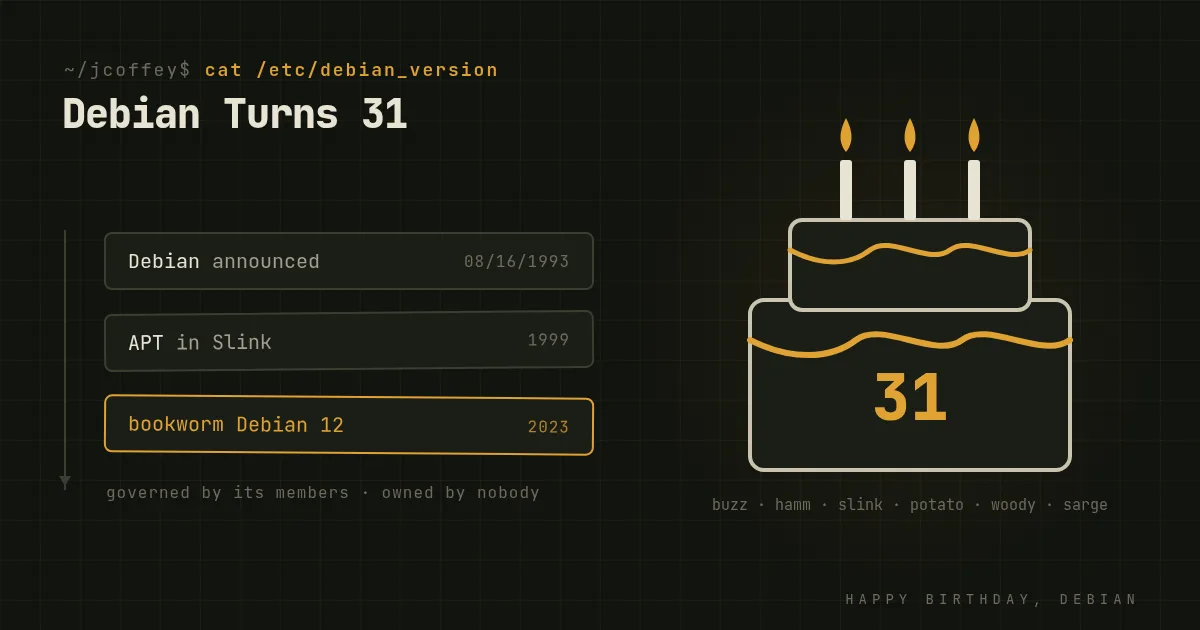
On August 16, 1993, Ian Murdock, a student at Purdue University, posted to the comp.os.linux.development newsgroup announcing a new Linux distribution. Most distributions of the time were put together by one person or one company. His would be different: developed openly, by volunteers, with care and in the spirit of GNU. He named it Debian, after his girlfriend Debra and himself.
Debian turned 31 last Friday. It's been my desktop since Debian 3.1 "Sarge" in 2005, so here's a short history of how it got here.
The early years
- 1993–1994. Murdock published the Debian Manifesto describing the project's goals, and the Free Software Foundation briefly sponsored its development.
- 1996: Debian 1.1 "Buzz." The first release with a codename, starting the tradition of naming releases after Toy Story characters. The project's leader at the time, Bruce Perens, worked at Pixar.
- 1997: The Social Contract and the Debian Free Software Guidelines. Debian committed in writing to remaining 100 percent free software, to giving back to the free software community, and to not hiding problems. The guidelines were so well drafted that the Open Source Initiative adopted them, almost word for word, as the Open Source Definition in 1998.
- 1999: Debian 2.1 "Slink" introduced APT and the
apt-getcommand. Automatic dependency resolution across a huge archive, with whole-system upgrades from one command, was a big leap for the time, and every major distribution has had to match it since.
Growing up
- 2002: Debian 3.0 "Woody" shipped for 11 processor architectures, including the IBM mainframe, confirming Debian's reputation for running on almost anything.
- 2005: Debian 3.1 "Sarge" brought the new modular debian-installer, which made installation far friendlier.
- 2007: Debian 4.0 "Etch" added a graphical installer and official support for 64-bit x86.
- 2011: Debian 6.0 "Squeeze" introduced dependency-based boot ordering and a fully free Linux kernel, with non-free firmware moved out, and added a technology preview of Debian GNU/kFreeBSD, the Debian userland on the FreeBSD kernel.
- 2013: Debian 7 "Wheezy" introduced multiarch, the ability to install packages for several architectures side by side.
- 2015: Debian 8 "Jessie" made systemd the default init system, after one of the most heated debates in the project's history. A group unhappy with the decision forked Devuan, which continues without systemd.
- 2019: Debian 10 "Buster" enabled AppArmor by default and added UEFI Secure Boot support.
- 2023: Debian 12 "Bookworm," the current stable release, created a separate
non-free-firmwaresection and began installing needed firmware by default, a pragmatic change approved by a vote of the project's developers.
Along the way the project lost its founder. Ian Murdock died in December 2015. Debian dedicated its next release to him.
The family tree
Debian's biggest influence may be the distributions built on it:
- Ubuntu, from 2004, which made Linux friendly for millions of desktop users and became the most common Linux in the cloud.
- Linux Mint, built on Ubuntu, and its Debian edition, LMDE, built directly on Debian.
- Raspberry Pi OS, the starting point for a generation of tinkerers and students.
- Kali Linux for security testing, Tails for privacy, Proxmox VE for virtualization, and many more.
Every one of them depends on the work of Debian's volunteers: the packaging, the security team, the release process and the archive.
What Debian is working on now
- The 2038 problem. Debian has spent this year moving its 32-bit architectures to a 64-bit
time_t, a huge transition across thousands of packages so that those systems keep telling the right time after January 19, 2038. - Reproducible builds, so anyone can verify that a binary package was built from the source it claims to come from, a defense against exactly the kind of supply-chain attack that hit xz this spring.
- Debian 13 "trixie," the next stable release, now taking shape in the testing branch.
- A new project leader. Andreas Tille was elected in April.
Why it lasts
Plenty of distributions have come and gone in thirty-one years. Debian lasts for the reasons I gave in why I prefer Debian: it's governed by its members, bound by a social contract, and owned by nobody. That's what lets a project survive its founder, its controversies and every shift in the industry around it.
Happy birthday, Debian.
Since then
Added October 2026. Debian 13 "trixie" was released in August 2025, and Debian turned 33 this August, which I marked in Thirty-Three Years of Debian.