A month ago, on July 19, a CrowdStrike content update crashed about 8.5 million Windows machines. I wrote about it on the day and again after the preliminary review. On August 6 CrowdStrike published its full root cause analysis. It's worth reading in full, but here's what it says, and what it means.
The bug, precisely
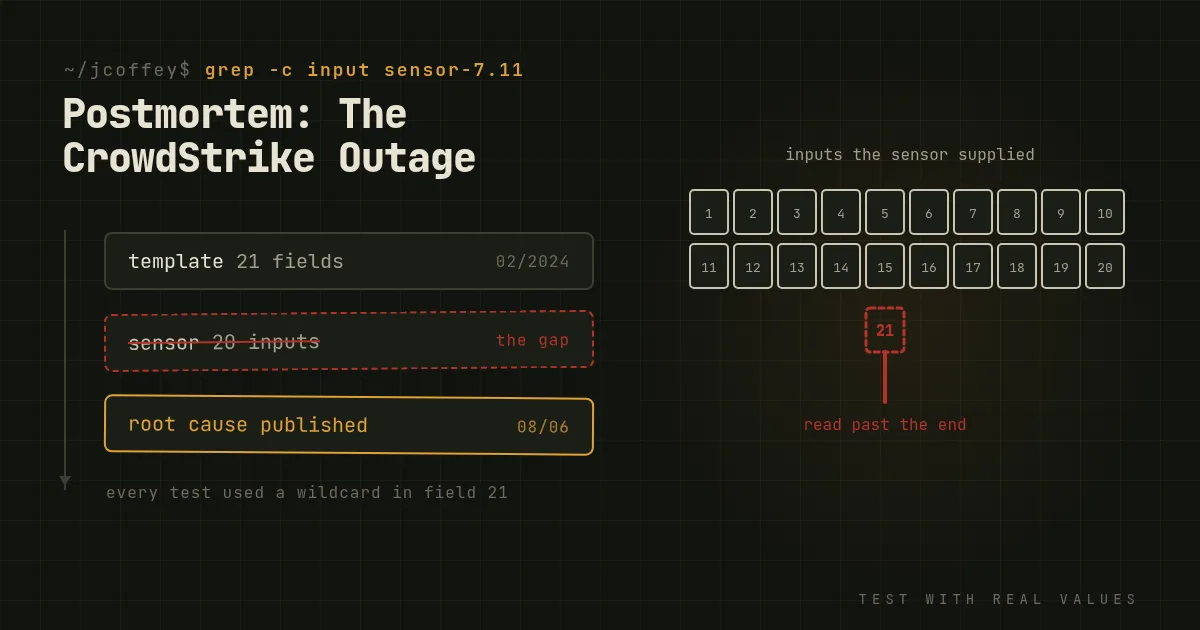
In February, Falcon sensor version 7.11 added a new detection capability for Windows interprocess communication, defined by a template with 21 input fields. The detection rules for it are delivered later as content.
But the sensor code that fed data into those rules only supplied 20 inputs. The 21st field had no data behind it.
That mismatch sat there harmlessly for months, because every rule shipped in the spring used a wildcard in the 21st field, matching anything, so the sensor never tried to read it. On July 19, a new rule was the first to specify a real value for the 21st field. When the sensor's content interpreter tried to read the 21st input, it read past the end of an array of 20, an out-of-bounds read in kernel memory, and Windows crashed.
Why the safety nets missed it
This is the instructive part. CrowdStrike had checks. They all had the same blind spot.
- The tests for the new template type, run in February, used wildcard values in the 21st field, so they never exercised the mismatch.
- The Content Validator, the automated check run on new rules before release, validated rules against the template's definition of 21 fields, not against the 20 inputs the sensor actually provided. The rule looked valid.
- The content interpreter had no runtime bounds check on the number of inputs, so it didn't fail gracefully.
- Deployment sent the content to every Windows sensor worldwide within minutes, with no canary stage.
Any one of those, done differently, would have stopped it. That's the classic shape of a serious incident: not one failure, but several defenses with correlated gaps.
What CrowdStrike is changing
The RCA confirms and extends the promises from July:
- Bounds checking in the content interpreter, and validation that the number of inputs matches at compile time and run time.
- Validator fixes, so it checks rules against what the sensor actually supplies.
- Testing that covers non-wildcard values for every field.
- Staged deployment of rapid response content through canary rings, with customers able to choose how quickly they receive it.
- Two independent third-party reviews of the sensor code and the end-to-end release process.
How the recovery went
The fix was trivial to describe and enormous to apply: boot each machine into Safe Mode or the recovery environment and delete one file. CrowdStrike reported that around 99 percent of Windows sensors were back online by July 29, ten days later.
What slowed people down:
- BitLocker. Encrypted disks needed their 48-digit recovery keys, often stored in systems that were themselves down.
- Physical access. Laptops at home, kiosks in airports and servers in remote sites all needed hands on keyboards.
- Cloud VMs had to have their disks detached and attached to a working machine to be fixed.
- Delta. Most airlines recovered within a day or two. Delta's crew-scheduling system took days to untangle, and it canceled around 7,000 flights over five days.
The fallout so far
- Delta's CEO has put the cost at about $500 million and hired a prominent litigator. CrowdStrike has replied publicly that its liability is contractually limited and that Delta's slow recovery was Delta's own doing. The US Department of Transportation has opened an investigation into Delta's handling of customers.
- CrowdStrike shareholders filed a class action in late July, alleging the company overstated its testing.
- Congress asked CrowdStrike's CEO to testify.
- Microsoft has said it can't simply lock security vendors out of the Windows kernel because of a 2009 agreement with the European Commission, and has said it will work with security vendors on safer approaches.
- Insurers estimate Fortune 500 losses, excluding Microsoft, at around $5.4 billion, with only a fraction insured.
Lessons, in one place
- Data is code. Configuration and detection content can crash systems as surely as binaries. Treat them with the same release discipline.
- Test with real values. Wildcards and defaults make tests pass and hide bugs. Test the edges.
- Validate against reality, not the specification. The validator checked what the rule should match, not what the sensor would provide.
- Fail safe. Code that parses input in privileged contexts must handle bad input without crashing.
- Stage everything. A canary of even a few thousand machines would have turned a global outage into a footnote.
- Rehearse recovery for the case where the machines you need can't boot.
The hardest part of this story to accept is how ordinary the root cause is. An off-by-one, in effect. Almost every team that ships software has had one. What made this one historic was where the code ran and how fast it reached everyone. Those are design choices, and they're the ones to revisit.
Since then
Added October 2026. CrowdStrike's Adam Meyers testified to a House committee in September 2024. Delta sued CrowdStrike in October 2024, and CrowdStrike sued Delta. Microsoft's Windows Resiliency Initiative followed in November, leading to a 2025 preview of a platform that runs security products outside the kernel.