From the Department of Coffee-Fueled Shell Scripting.
So you want to be a Linux sysadmin?
Unless you were raised by daemons in an initrd, you're probably doing it wrong. Don't worry. So are we.
Let's take a walk down the directory tree: the habits, the tools we know are wrong, and the gap between the grizzled veterans and the newcomers who think YAML is a programming language.
Rituals we perform without thinking
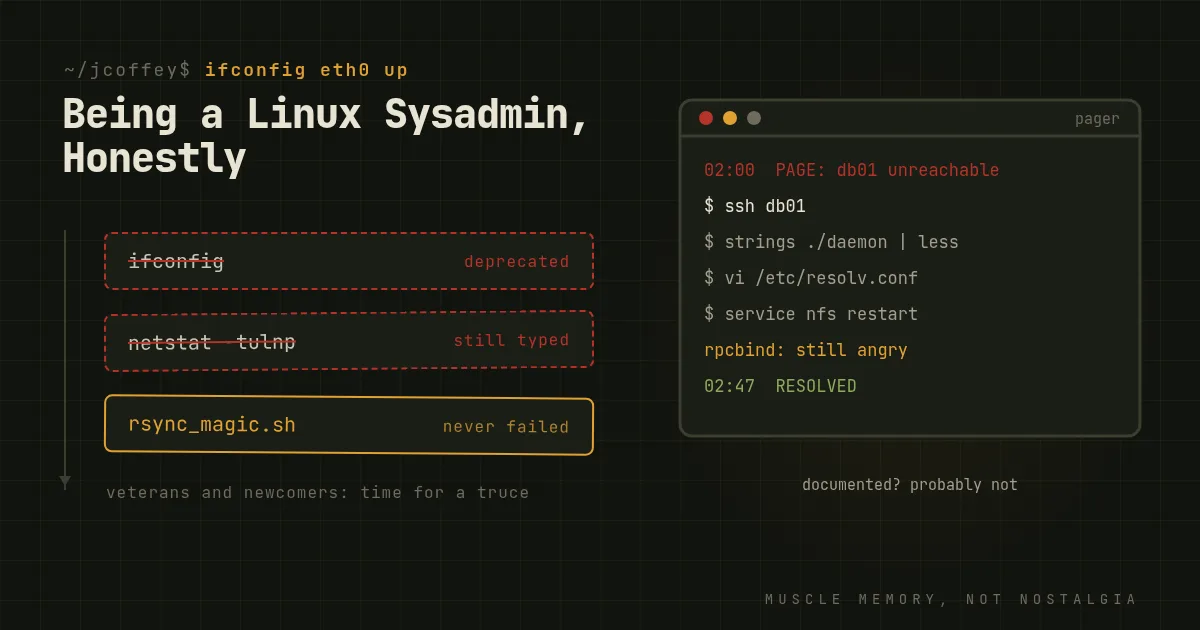
I don't use nmcli. I use ifconfig. Yes, it's deprecated. No, I don't care.
I can type ifconfig eth0 up before your NetworkManager has finished thinking about it. It might not even be installed anymore. That's why I carry a USB stick of static binaries.
I edit /etc/resolv.conf by hand. Fight me.
Testing a connection? I telnet to the port like it's 2004. Is it elegant? No. Does it tell me whether something's listening? Yes.
Debugging a binary? strings binary | less. I reach for strace only when strings fails, which is less often than you'd think.
Tools we know are wrong and use anyway
netstat -tulnp. Yes,ssis the future. My fingers live in the past.serviceandchkconfig.systemctlworks. So do my old habits.rsyncwith flags I can't fully recite. I copy them fromrsync_magic.sh. It has never let me down.- Bash scripts with no error checking. Duct tape and hope. They've outlasted several CIOs.
Why newcomers think we're gatekeeping
New people arrive with shiny laptops, a fresh distro and real enthusiasm for open source. Meanwhile we're nursing a SAN whose drivers were last updated two presidents ago.
They ask which log to check. We say: all of them. /var/log/messages. /var/log/syslog. dmesg. The serial console, if you're brave.
They ask why nothing's in JSON. We ask why their résumé says Kubernetes but they don't know what /etc/fstab does.
From where we sit, that's not elitism. It's survival.
The echo chamber we built
But let's be honest. We did this.
We made IRC hostile. We made mailing lists unreadable. We helped make Stack Overflow sarcastic enough to scare anyone off. We treat man pages as sacred texts, and plenty of them read like they were written by a passive-aggressive robot.
So now we have a reputation as one of two things:
- Dinosaurs, clinging to tools nobody else understands.
- Gatekeepers, scaring off the people who might bring the next good idea.
Meanwhile companies can't find Linux people, newcomers are afraid to ask questions, and the old guard is still trying to get udev to behave.
The right way and the way that works
Yes, Ansible is good. Containers are useful. systemd is here to stay.
But when the server's down and the pager goes off at 2 a.m., I'm SSHing in and fixing it live.
That isn't nostalgia. It's muscle memory, earned through midnight outages, corrupted ext3 partitions and the dark art of sendmail.mc.
A truce
Veterans: stop judging newcomers for not memorizing the Unix philosophy. Let them stumble. We did.
Newcomers: respect the people who built the infrastructure you're stacking abstractions on. Learn why they do what they do, even if you never copy it.
And please: if someone hands you a one-line fix in Bash, don't ask whether there's a GUI for it.
Final thoughts from the command line
Being a sysadmin isn't about perfection. It's about making it work when nothing else will, and maybe documenting it afterwards. Probably not, though.
Whether you're grepping logs like a caveman or deploying microservices from a pipeline a chatbot kicked off, we're all just trying to survive the next outage.
Now, if you'll excuse me, I have an NFS problem to solve by yelling at rpcbind.
Written by a Linux admin with thirty years of mismatched socks, shell scripts and strong opinions.
Since then
Added October 2026. Yes, rsync_magic.sh is real. It now lives with the rest of my admin scripts in SysAdminAutomation, which I wrote about in Supercharge Your Workflow.