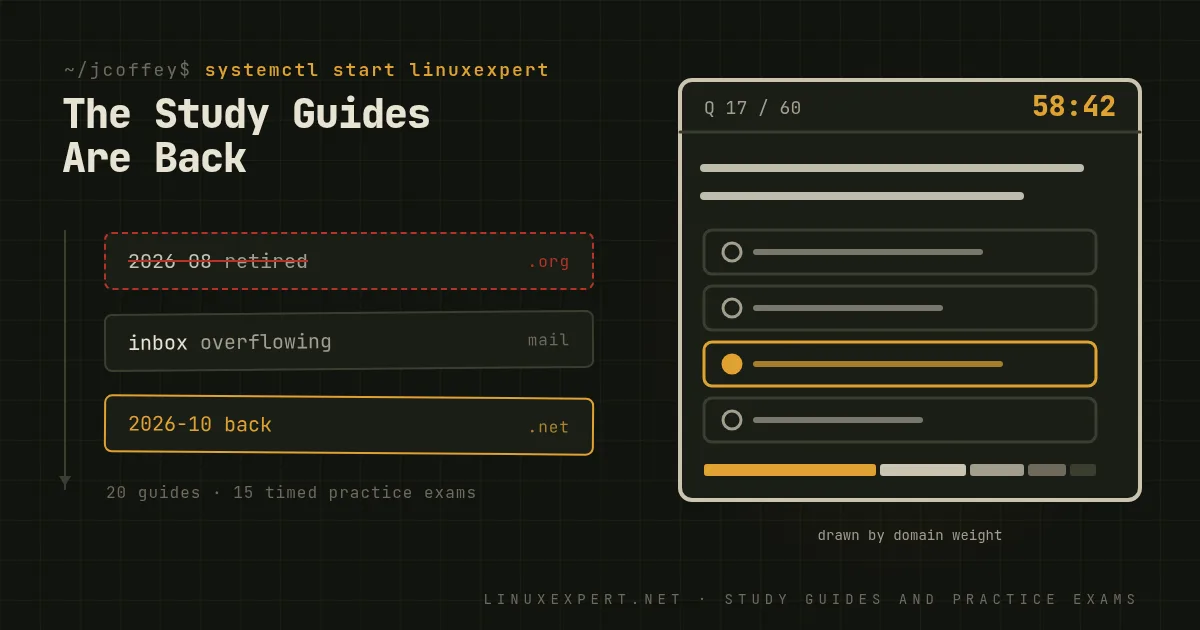
When I retired LINUXexpert.org in August, I said the study guides were going to people who could keep them fresh. What I didn't expect was the mail. The number of you who emailed me directly to say you were actually using those guides has been overwhelming.
That surprised me. Honestly, I wasn't tracking analytics on the guides, so I had no idea how many people were still reading them. And they had been in disarray for a very long time. Objectives had moved under them, commands had changed, and some guides hadn't been touched in years. You used them anyway.
So I changed my mind.
Where they live now
The .org domain already has a new job hosting a community Mastodon server, and that isn't changing. I still had the .net domains, though, so the guides now live at linuxexpert.net.
The content is back, and I've updated it to get it current against each exam's latest objectives. There are twenty guides today:
- Linux Foundation: LFCA, LFCS and CODE, the open source developer exam.
- Kubernetes: KCNA, KCSA, CKA, CKAD, CKS and the Kyverno associate (KCA).
- Cloud native projects: Prometheus (PCA), OpenTelemetry (OTCA), GitOps (CGOA), Argo (CAPA), Cilium (CCA) and Istio (ICA).
- Platform engineering: CNPA, CNPE and Backstage (CBA).
- AI: MCPA, the Model Context Protocol associate.
- And LPIC-1, where the whole thing started.
Every guide opens with an overview of the exam itself: the domains and how much each one weighs, the price, the time limit, the passing score where it's published, and how the guide is laid out to get you there. Every chapter ends with a short self-check quiz. Follow a guide and the site keeps your place, so you can pick up where you left off on any device, and a chapter counts as done once you pass its quiz.
The thing I always meant to build
A guide only gets you so far. Reading about kubectl isn't the same as being asked about it with a clock running. What I always wanted was proper practice exams, and now there are fifteen of them, one for every multiple-choice exam in the library (LPIC-1 is two, 101 and 102).
With the help of HotDog CMS, I built an exam engine that tries hard to feel like test day:
- The right length and the right clock. Each practice exam has the same number of questions and the same time limit as the real one. KCNA, for example, is 60 questions in 90 minutes.
- The timer can't be stopped. It runs on the server, not in your browser, so closing the tab or walking away to make coffee doesn't pause it. Same as the testing center.
- A fresh paper every time. Each exam has a pool of 180 questions, three times the length of a paper, and the questions are drawn from it when your test is generated. No two sittings are the same, and you won't memorize your way through by the third try.
- Accurate domain weights. Each paper is split across the exam's domains by the same weights you'll face when you sit the proctored test. KCNA's 60 questions come out 26, 17, 10 and 7, because that's how the real one is weighted.
- No peeking. Your browser only ever gets the questions. The answers stay on the server until you end the exam, so there's nothing to find in the page source.
While you're in it you can flag questions and come back to them, and there's a review screen before you hand it in, the same as the real thing. When you finish you get your score, how you did in each domain, and every question with the right answer and an explanation. Each one links back to the chapter that covers it, so a miss turns straight into something to read. Your past attempts stay on your profile so you can see whether you're actually getting better.
Lab exams are coming
Some exams are hands-on: LFCS, CKA, CKAD, CKS, Istio and CNPE among them. You get a terminal, a set of tasks and a clock, and you're graded on whether the system ends up the way it should. Practicing for those takes a different engine, one that spins up a secured VM for each test scenario on demand and checks your work when you're done. That's a lot more complicated to build, and it costs real money to run, so I'm still working on it. We'll get there, though some of those lab exams may end up pay to play to help absorb the cost.
The guides for those exams are already up. Only the hands-on practice is still to come.
More exams in the works
Twenty guides isn't the end of the list. The one on the bench right now is Red Hat's.
RHCSA
The RHCSA (EX200) is the exam a lot of Linux careers start with. The guide is written against Red Hat Enterprise Linux 10 and follows Red Hat's own objectives, in Red Hat's own order, across ten domains:
- Essential tools: the shell, redirection, grep, SSH, archives, links, permissions and finding the docs
- Managing software: RPM repositories and packages, plus Flatpak
- Simple shell scripts: conditions, loops, arguments and command output
- Operating running systems: boot targets, breaking into a locked system, processes, tuning profiles and the journal
- Local storage: GPT partitions, LVM, mounting by UUID or label, and adding storage and swap without losing data
- File systems: VFAT, ext4 and XFS, NFS, autofs, growing logical volumes and fixing permission problems
- Deploying, configuring and maintaining systems: at, cron and systemd timers, services at boot, time sync, updates and the boot loader
- Basic networking: IPv4 and IPv6, name resolution, connections at boot and firewalld
- Users and groups: accounts, password aging, groups and sudo
- Security: firewall settings, default permissions, SSH keys, and a lot of SELinux
That comes out to 49 chapters, each one quoting the Red Hat objective it covers word for word, so you always know exactly which line of the exam page you're working on. The outline is done, and the chapters are being written now, domain by domain.
Two things are different about this one. Red Hat doesn't publish domain weights, so the guide won't pretend to know them. And there's no multiple choice at all. Every Red Hat exam is a set of tasks on a live system, so the RHCSA practice exam arrives with the lab engine, not before.
After that
- Ansible (EX294), the other half of the RHCE, is next in line behind RHCSA.
- Canonical's Ubuntu exams and OpenShift (EX280) come after that.
- CKNE gets a guide as soon as it's out of beta. I'd rather not write against objectives that are still moving.
If there's an exam you want that isn't here, email me. That's how this whole thing came back in the first place.
What it costs
All the guides and all the knowledge-based exams will stay free. They sit behind a login, and that's only there to keep AI bots from scraping everything. The first chapter of every guide is open if you want a look before you sign up.
One ask. If you decide to sit a Linux Foundation or CNCF exam, please book it through the affiliate links on linuxexpert.net. We get a small commission on those, and it goes toward the hosting bill. The other exams and the guides earn us nothing.
TEST YOUR MIGHT. Happy learning, nerds.