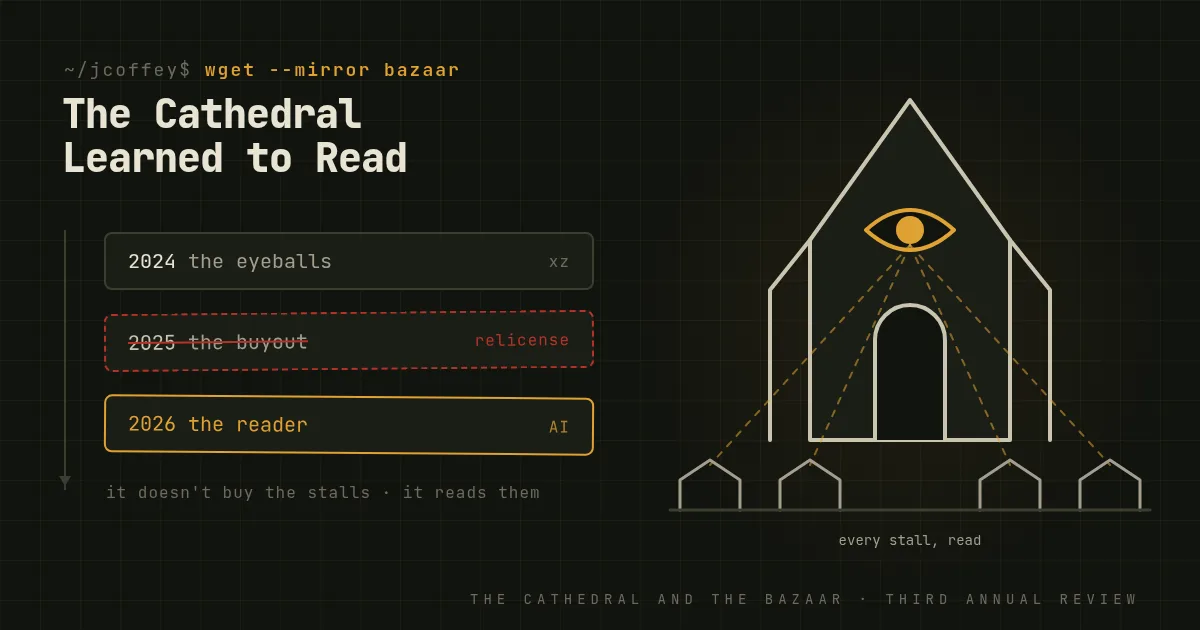
Every year around now I reread The Cathedral and the Bazaar and hold it up against the year we just had. It has become a habit, like changing the smoke detector batteries, except the smoke detector is an essay from 1997.
A quick recap. In 2024 the question was who actually runs the bazaar, and the answer, thanks to xz, was a handful of tired people. In 2025 I argued that the cathedral had eaten the bazaar: companies bought the important stalls, changed the licenses and took over the roads in and out.
This year the story changed shape. The old cathedral mostly stopped buying. A new one turned up that doesn't need to buy anything at all.
The old cathedral calmed down
Start with last year's scorecard, because some of it is good news.
- The forks won the argument. Redis added the AGPL back in May 2025, a year after leaving open source, and Valkey kept going anyway, with distributions and cloud providers behind it. OpenTofu and OpenSearch are established projects now. A relicense reliably gets you forked within weeks, and companies have noticed.
- MinIO walked out instead. It took the admin console out of the community edition in 2025, stopped publishing community binaries and images that October, went into maintenance mode in December, and archived the repository in early 2026. No license change needed. Community forks picked it up, and a company now sells security patches for the old releases, which is the bazaar doing what it does.
- Some stalls just closed. Kubernetes retired Ingress NGINX in March 2026, one of the most widely deployed pieces of the whole ecosystem, because nobody could be found to keep it safe. That's the 2024 problem, still unsolved.
- The roads changed hands again. In August 2025, GitHub's CEO announced he was leaving, and GitHub was folded into Microsoft's CoreAI group. The place where most of open source lives is now, on the org chart, part of an AI division. I found out what depending on it costs this September, when my account was suspended without notice.
The new cathedral doesn't buy. It reads.
Raymond's cathedral was a way of building software: a small group, behind closed doors, releasing when they decide it's ready. The big AI labs fit that description better than anyone ever has. Their models are built by a small group, behind closed doors, and released when they're ready, if at all. And a good share of their raw material is the bazaar.
They consume it in four ways, and this year each one got a clear example.
They read it. Open source code is training data, and whether its licenses have any say in that is still an open question. On September 16 the Ninth Circuit ruled in the Copilot case, Doe v. GitHub, that Copilot's output is new work, not a copy with the attribution stripped off, so that theory is gone. The argument about training itself never got a hearing, because the court found it hadn't been raised properly in the first place. The claims that Copilot breaks the open source licenses are still waiting in the district court. Five years after Copilot launched, nobody can tell you whether "keep this notice" means anything to a model.
They crawl it. Reading takes bandwidth, and the bazaar pays for it. Through 2025, GNOME, KDE, Fedora and SourceHut all reported AI crawlers knocking their servers over. SourceHut's Drew DeVault said he was spending between a fifth and all of his week fending them off. The fix that spread fastest was Anubis, a small open source tool that makes a visitor's browser solve a puzzle before it gets a page. It now sits in front of GNOME's GitLab, the Linux kernel's mailing list archives and FFmpeg. The bazaar built a gate to keep out the cathedral's readers.
They answer for it. In January, Tailwind Labs laid off three-quarters of its engineers. Tailwind is more popular than ever, but its documentation traffic had fallen about 40% since early 2023 and its revenue about 80%. People ask an assistant instead of reading the docs, and the docs were how anyone found the paid products. Sponsors rushed in within days, which was decent of them, and which also proves the point: the project now leans on the goodwill of the companies whose tools caused the problem. The bazaar's business model was always "come to my stall." Answers skip the stall.
They talk back. The bazaar's front door was that anyone could send a patch or a bug report. This year that door got jammed. In January, curl ended its bug bounty after six years, because AI-generated reports were burying the real ones. Daniel Stenberg's reasoning was that you can't stop the slop, but you can stop paying for it. In February, GitHub added settings to turn off pull requests entirely or limit them to collaborators, and in June it did the same for issues. Read that twice. The platform that made "treat your users as co-developers" one click away now ships a switch to stop them.
The eyeballs showed up. They belong to someone.
Now for the part that complicates my own argument.
"Given enough eyeballs, all bugs are shallow" was always the essay's most famous line and its weakest. xz showed that the eyeballs don't come for boring code. In April, Anthropic announced Project Glasswing: a model it doesn't plan to release publicly, used with a group of large companies and open source organizations to find holes in critical software. It reported thousands of high-severity vulnerabilities, including one that had sat in OpenBSD for 27 years and one in FFmpeg for 16, and put up $100 million in usage credits and $4 million for open source security groups.
That's Linus's Law at last, with machine eyeballs. The catch is whose eyeballs. A bug found by a model nobody outside can run is found on somebody else's terms. Defense depends on whoever holds the model sharing what it sees, and attackers will build their own.
You can see how unsettling this is in the reactions. In May, NHS England moved to make its public code repositories private, citing what new AI models might find in them. The same month, the UK's Government Digital Service published guidance saying publicly funded code should stay open by default, and that hiding it is no substitute for security. GDS is right. Hiding source never stopped a determined attacker. It only stops the defenders who might have helped. But the urge to close the door is new, and it came from the eyeballs, not from a license.
Open weights are the cathedral's free download
What about open models? There are more than ever. DeepSeek publishes its models under the MIT license, much of Qwen is Apache 2.0, and OpenAI released gpt-oss under Apache 2.0 in August 2025. Meta's Llama comes under its own community license with restrictions on who may use it, which is why neither the OSI nor the FSF calls it open source.
They're genuinely useful, and running one yourself beats renting an API. But be clear about what they are. Open weights are the build, not the source. You can run them, tune them and pass them on, but you can't rebuild them, because the training data and most of the process stay inside. In Raymond's terms, that's a cathedral handing out free copies of the finished building. The rare exceptions, like Switzerland's Apertus, published down to its training data and code, show it can be done.
How AI is at play for me
I'd be a hypocrite to write all this without saying it: I use AI tools every day, and I've said so before. My own projects ship machine translations, labeled as such. I don't think the answer is refusing the tools, any more than refusing search engines was the answer in 1998.
The question the essay keeps raising isn't which tools you use. It's who holds the keys. A model running on my own hardware is a tool I own. A model behind someone else's API is a service I rent, and renting has its costs. That's why the AI features in inbuxa are off until you turn them on, and run on a model you host.
Where it stands, 2026
- The bazaar: more open source code than ever, and fewer open doors. Maintainers are adding gates, puzzles and kill switches, for good reasons.
- The old cathedral: quieter. Relicensing reliably gets you forked, so companies walk away from projects instead, like MinIO, or let them retire, like Ingress NGINX.
- The new cathedral: the AI labs. They consume the bazaar by reading it, crawling it, answering for it and flooding it, and now they also offer it the machine eyeballs to fix itself, on their terms.
Last year I said the cathedral bought the stalls. This year it didn't need to. It learned to read.
What I'd do about it
- Own your front door. Run your own forge, or at least mirror to one. I run Gitea now, and GitHub is the mirror. If crawlers hurt, put Anubis or rate limits in front.
- Write down your policy on AI contributions. It can be short: AI-assisted work is welcome if the person sending it understands and owns every line, and drive-by agent pull requests get closed.
- Pay the maintainers. I said it in 2024, and it's still true. Find the boring stalls your business runs on and fund them.
- Prefer models you can run. Open weights over APIs, and truly open models when they exist.
See you next October.