It's been a strange few weeks to be a Windows user.
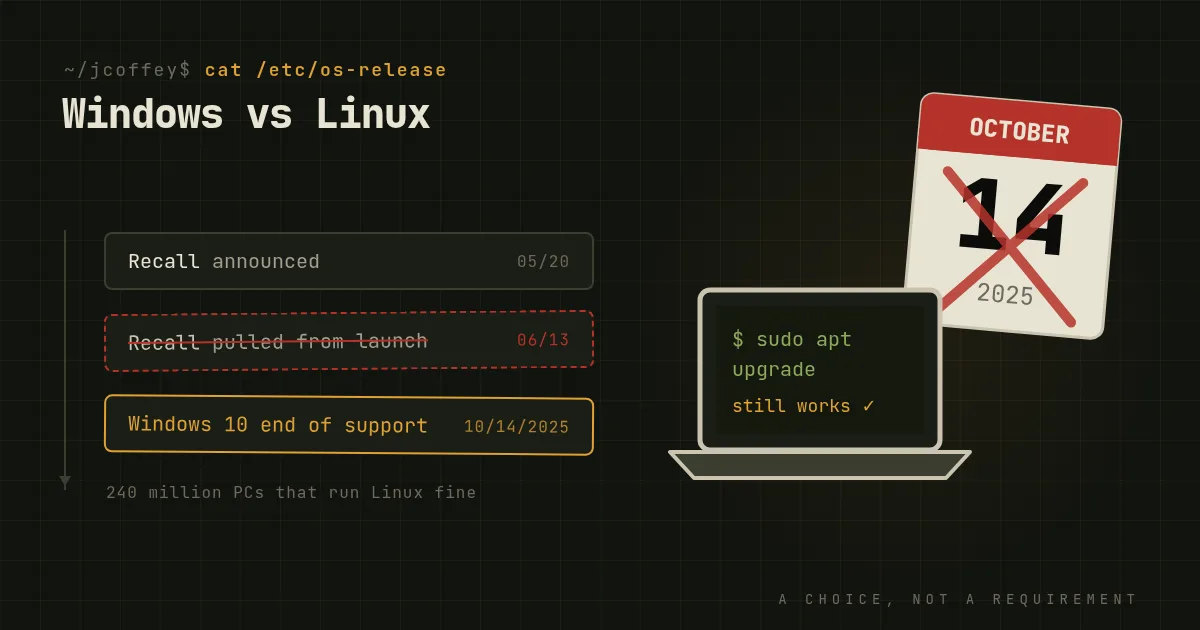
On May 20 Microsoft announced Recall, a feature for its new Copilot+ PCs that takes a screenshot every few seconds, runs text recognition on it, and keeps a searchable history of everything you've seen and done. Security researchers quickly showed that the history was stored in a database any program running as the user could read. On June 7 Microsoft made Recall opt-in. On June 13, days before the laptops shipped, it pulled the feature from the launch entirely.
That's the backdrop for this comparison. The question isn't really whether Linux is ready for the desktop. Plenty of people have been running it there for decades. The question is whether Windows is still the safe default it used to be, and for a growing number of people the answer is changing.
The Windows 10 cliff
Windows 10 reaches end of support on October 14, 2025. After that there are no security updates unless you pay. Businesses can buy Extended Security Updates, starting at $61 per device for the first year and doubling each year after that.
The catch is Windows 11's hardware requirements: TPM 2.0 and, roughly, an Intel 8th-generation or AMD Ryzen 2000-series processor or newer. Plenty of perfectly good machines from 2016 and 2017 don't qualify. Canalys estimated in December that about 240 million PCs could end up as e-waste because of it.
Every one of those machines runs Linux fine.
Where Windows still wins
Let's be honest about this, because Linux advocates often aren't.
- Commercial software. Adobe Creative Cloud, AutoCAD, desktop Microsoft Office with all its macros and add-ins, a long tail of tax, accounting and industry tools, and anything with a hardware dongle. Some of it works in Wine or a virtual machine. A lot of it doesn't, or not well enough to bet your income on.
- Some games. Valve's Proton has made most Steam games playable on Linux, which would have sounded absurd in 2017. The exceptions are mostly multiplayer games whose anti-cheat software either doesn't support Linux or whose developers haven't turned that support on. If your main game is one of them, that settles it.
- Enterprise management. Active Directory, Group Policy, Intune and the whole Microsoft 365 ecosystem assume Windows. Managing a fleet of Linux laptops is perfectly doable, but it's a different skill set, and most IT departments don't have it.
- Hardware support on the newest machines. A brand-new laptop's fingerprint reader, webcam or Wi-Fi chip may lag behind on Linux. Hardware from the past couple of years, and anything sold with Linux preinstalled by vendors like System76, Framework or Dell, is generally fine.
- Familiarity. It's the system most people have used at work for thirty years. That counts for a lot, and it's not a character flaw.
Where Linux wins
- It's yours. No account required to set it up, no ads in the Start menu, no feature that screenshots your screen, nothing that changes your settings after an update. What you install is what runs.
- Old hardware is fine. A 2015 laptop with an SSD and a lightweight desktop like Xfce feels quick. You can keep good machines out of landfills.
- Updates you control. One package manager updates everything, from the kernel to the browser, when you choose. Nothing reboots in the middle of a presentation.
- Security by design. A real user and permission separation, software installed from signed distribution repositories rather than random downloads, and far less malware written for it. It isn't immune, but the everyday risk is much lower.
- Development. For anything that runs on a server, which is most software now, Linux is the native environment. Microsoft knows it, which is why it ships a real Linux kernel inside Windows as WSL 2.
- Cost. Free, and it stays free.
What's really changed: the apps moved
The biggest change isn't in either operating system. It's that most of what people do on a computer now happens in a browser. Email, documents, chat, banking, streaming and most business software run in Chrome or Firefox, and they run the same on Linux. The share of people for whom the operating system genuinely matters is shrinking every year.
That's also why Linux on the desktop is growing in ways that don't always show up as "Linux":
- ChromeOS runs on the Linux kernel, and it's what a large share of American schoolchildren learn on.
- The Steam Deck runs SteamOS, a Linux distribution, and has put Linux in several million homes as a game console that also happens to be a PC.
- Desktop share. StatCounter's count of traditional Linux desktops crossed 4 percent worldwide this year, a record, and that's before counting ChromeOS.
Who should switch
Switch now if you mostly live in a browser, you're a developer, you play mainly single-player or Proton-friendly games, or you have a Windows 10 machine that can't run Windows 11. Start with Linux Mint or Ubuntu, try it from a USB stick first, and keep a Windows install around for the one app you might still need.
Wait, or dual-boot, if your work depends on Adobe, CAD, or desktop Office macros, or your main game uses anti-cheat that blocks Linux.
Stay if your employer manages your machine. That decision isn't yours to make, and that's fine too.
For the future, I don't think one of them will "win" the desktop. Windows will remain dominant at work for years. But the share of people for whom Windows is a choice rather than a requirement keeps growing, and Microsoft keeps giving them reasons to choose something else.
Since then
Added October 2026. Windows 10 support ended on schedule in October 2025. Microsoft offered consumers a year of free extended updates with conditions attached, and the Linux desktop got a noticeable wave of newcomers. Recall eventually shipped as an opt-in feature. I wrote about where the Linux desktop stood at the start of this year in 2026 Won't Be "The Year of the Linux Desktop".