Every few weeks another mail server announces ActiveSync. Or Exchange Web Services, or MAPI so classic Outlook can connect. Big projects and one-person projects, many of them in the JMAP world, which is the part that gets me. JMAP is the open, modern answer to how a mail app talks to a server, and its own builders are busy rebuilding Microsoft's.
Someone moving off Zimbra asked on our forum this week whether inbuxa would add ActiveSync and MAPI. I said no. Here's the longer answer.
What Microsoft is actually doing
I started out thinking Microsoft was killing all of it. The truth is more telling.
- Exchange Web Services is dying. Exchange Online began switching it off on 1 October 2026, and it's gone for good on 1 April 2027. The replacement is Microsoft Graph, Microsoft's own API. (Microsoft Learn)
- ActiveSync is frozen. The current version, 16.1, dates from 2016. Exchange Online stopped accepting older ones in March, and no newer version has been announced. Microsoft's own Outlook app for phones doesn't use it at all. (Microsoft)
- Classic Outlook lives on, for now. It's supported until at least 2029. The new Outlook for Windows can't connect to Exchange Server on your own hardware, and syncs IMAP accounts through Microsoft's cloud.
Microsoft hasn't buried these protocols. It stopped needing them. Its apps talk to its cloud over its API, and ActiveSync is what's left for everyone else.
"The patents were never enforced"
I believed that too. It's wrong.
In 2012 the US International Trade Commission found that Motorola's Android phones infringed an ActiveSync-related Microsoft patent, for creating meeting requests from a phone, and banned imports of the phones that used it. (Bloomberg) Seven months later, without saying why, Google dropped ActiveSync for free Gmail accounts and pointed people to IMAP, CalDAV and CardDAV. (Computerworld)
That patent may well have run out by now. But Microsoft's ActiveSync specs still open with a patent notice, and there's no public licence. If Google decided it wasn't worth it for free users, a one-person project should think hard first.
Who gets it
The IETF and IANA. JMAP is an open standard, written in the open. The IETF published core and mail in 2019 and contacts in December 2024, and calendars is in the last stages. IANA keeps JMAP's registries of capabilities and data types, so anyone can extend it without asking a vendor. (RFC 8620, RFC 9610, IANA) ActiveSync gets a new version when Microsoft writes one, and it hasn't since 2016.
Fastmail. Fastmail helped write JMAP. Its Neil Jenkins is an author of both the core spec and the contacts spec, and according to the JMAP project its web, desktop and phone apps all run on it. (JMAP) Its setup guides don't mention ActiveSync at all. Phones and Outlook get IMAP, CalDAV and CardDAV, and Fastmail is honest about what that costs: Android users are told to install DAVx⁵ for calendars and contacts, and Outlook users need a plugin. (Android, Outlook)
Fastmail has never said why it skipped ActiveSync. What it did instead was build its own JMAP apps, and that closed the one-login gap for its customers the way I'm arguing for. The catch is that those apps only work with Fastmail.
inbuxa. The mail server I build is JMAP first. That's why my answer on the forum this week was no. (forum)
Stalwart, until last week. A disclosure first: inbuxa started as a fork of Stalwart, so I'm not a neutral party, and I follow it closely. In May 2025 its maintainer closed the request for ActiveSync with: "ActiveSync support will not be implemented in Stalwart Mail Server." The reasons were the ones I'm giving here. It's a proprietary protocol, and supporting it only entrenches Microsoft. On 23 November 2026, Stalwart 1.2.0 shipped MAPI, Exchange Web Services and ActiveSync, in its free AGPL edition. (GitHub, Stalwart)
Their reason deserves a fair hearing. Organizations that can't put their mail in a US cloud can't move to Exchange Online, and they need Outlook and their phones to keep working while the server changes underneath. Stalwart calls it a bridge, with people moving to JMAP clients later.
I hope it works out that way. My worry is that bridges turn into places people live. Once Outlook works, nobody has a reason to leave it. The server has then signed up to track Microsoft's protocols for as long as those users stay.
So why does everyone build it?
Not for Outlook. For the phone.
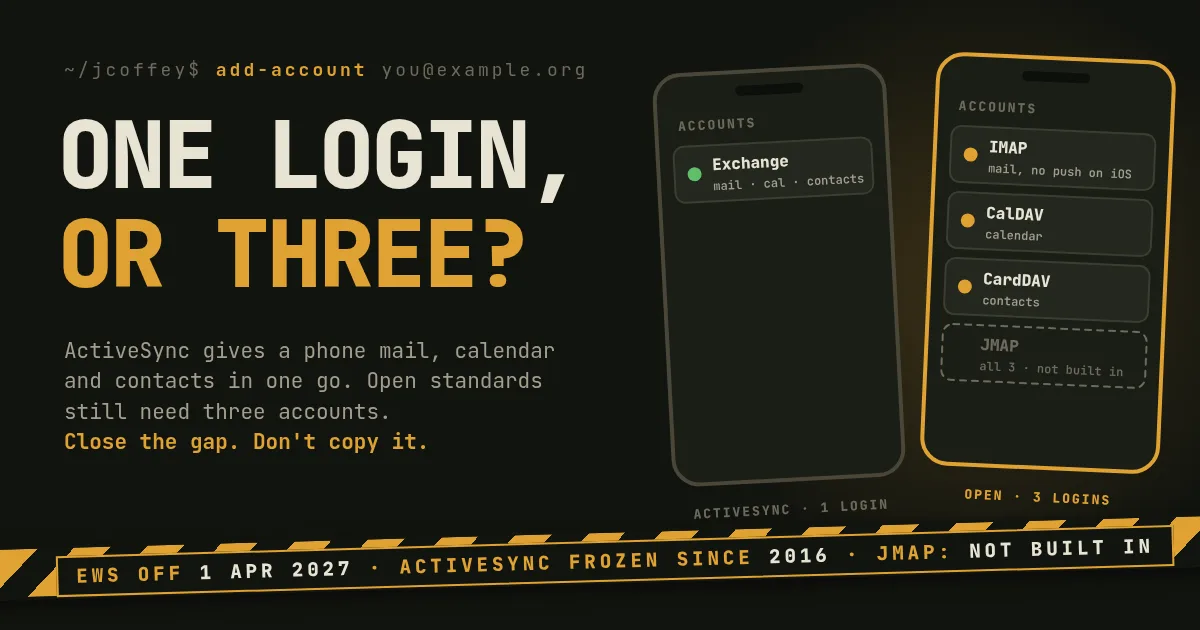
With ActiveSync you type an address and a password once, and you get mail, calendar and contacts with push. It's built into the iPhone, the Gmail app and Samsung Mail.
The open-standard version of that phone:
- IMAP for mail, with no real push on an iPhone unless the server speaks Apple's private extension
- CalDAV for the calendar, as a second account
- CardDAV for contacts, a third
- on Android, an extra app like DAVx5 for those two
- JMAP, which does all of it in one protocol, with no built-in client on either phone
Nobody is nostalgic. They're tired of explaining three accounts to their users. The desktop has the same gap: classic Outlook can't do CalDAV or CardDAV, so a company leaving Exchange asks its new server for MAPI.
What it costs
- A frozen, closed target. You build to one company's spec, can't propose changes, and that company has moved on.
- A big attack surface. ProxyShell, the 2021 chain that took over Exchange servers worldwide, got in through Autodiscover. Every one of these protocols is a large parser facing the internet, built to match someone else's behavior, bugs included.
- Less pressure where it counts. Every server that fakes ActiveSync gives Apple and Google one less reason to ship JMAP.
Where the effort should go
Stop building a dozen copies of Microsoft's protocols. Put that effort into open JMAP apps instead.
The goal is an open-source app for iOS and Android that works with any JMAP server. You give it an email address and a password, it sets itself up, and you get mail, calendar and contacts with real push. That's everything people want from ActiveSync, on a standard nobody owns.
The standards side is mostly done. JMAP has covered mail since 2019 and contacts since 2024, and calendars are close. A client finds a server's JMAP settings at a well-known address, and push is part of the core spec. (RFC 8620, RFC 8621, RFC 9610)
Fastmail has shown it works for one provider. When I started writing this, I thought nobody was building the version for everyone. I was wrong, and I'm glad:
- Allodia Mail & Calendar is GPL and on the App Store and Google Play, and one JMAP sign-in brings in mail and calendars. It's young: version 0.19, started in August. (GitHub)
- Flectar Mail is AGPL and runs on Android and iOS. It uses JMAP for mail, and CalDAV and CardDAV for calendars and contacts. It's an alpha, and on an iPhone you have to sideload it. (GitHub)
- Ltt.rs is a JMAP mail app for Android that calls itself a proof of concept. (Codeberg)
They need what the ActiveSync layers are getting now: server teams testing against them, bug reports, translations and money. That time gets everyone closer to one login than another copy of Exchange does.
Until they're ready:
- Fix the open stack we have. Real push for IMAP on iPhones, and setup that finds the server from your address, so three accounts at least feel like one.
- Leave classic Outlook to an add-in. The open-source CalDav Synchronizer already gives Outlook calendars and contacts over CalDAV and CardDAV. That's a smaller, safer job than a server speaking MAPI.
- Ask for it. The iPhone already ships IMAP, CalDAV and CardDAV. File the feature request with Apple and Google, and say JMAP.
If your server already speaks ActiveSync, keep it. Your users need their phones working today. I'm asking the next project to put that time into these apps instead.
Microsoft has moved on from these protocols. We can too.
What would it take for you to drop ActiveSync on your phone?