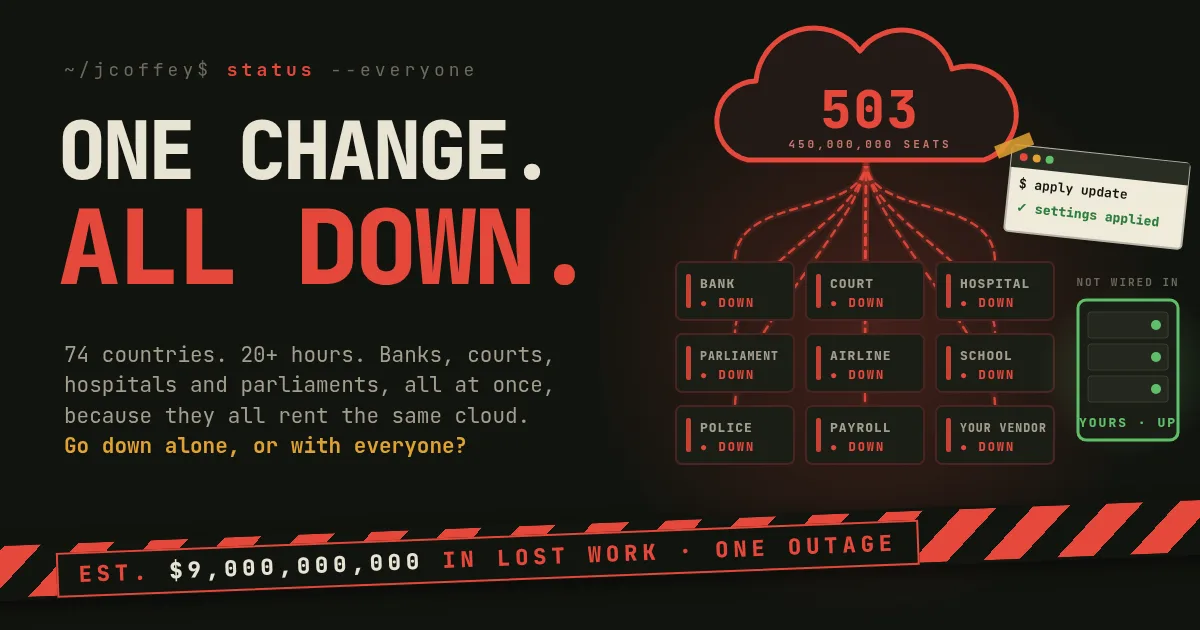
As I write this on Friday morning, Microsoft 365 still isn't right.
It broke around 11 a.m. Arizona time on Thursday, 18:00 UTC. Outlook stopped, then Teams, SharePoint and Copilot. By Thursday evening, 140,000 people in 74 countries had reported problems on Downdetector. More than twenty hours later, Microsoft says email queues are "approaching normal levels." It has stretched the timeout on delayed mail to 48 hours, which tells you how long it expects some of that mail to sit. (Wikipedia, CNBC)
Look at who went down with it. Government departments in Australia, Japan, the Philippines, Singapore and the United States. The Philippine Supreme Court warned that replies and transactions might be delayed. US House staff told Politico they lost a day of legislative work. A Canadian hospital network declared a code grey, and the NHS cancelled some operations. At least two public companies delayed their results. Australia's cyber security minister said Microsoft thought it was dealing with something like CrowdStrike.
It wasn't an attack. Microsoft says it was settings applied to servers after an update. Someone changed a configuration, and a process that handles secure connections got overwhelmed.
One change, at one company, and a good chunk of the world's offices stopped at the same time.
I've been saying this for a while
I've been running my own mail since 1997, and I've been arguing against putting everything in one place for most of that time. In July 2024 I wrote about CrowdStrike and the Azure outage the night before, and about how much we'd concentrated. Not much has changed since, except the size of the blast.
None of this is a new idea. In 1964, Paul Baran at RAND argued that a communications network should be distributed so it could lose pieces and keep working. That idea became packet switching, and packet switching became the internet. Email was built the same way: thousands of independent servers, any of which can fail without stopping the others.
In 2003, Dan Geer and a group of security researchers published a paper warning that a monoculture of Microsoft software was a risk to national security. One bug, everywhere at once. Geer lost his job over it. Twenty-three years later, he's been right so often it's boring.
We built the most fault-tolerant communication system in history, then moved 450 million paid seats onto one vendor's servers. (Office 365 for IT Pros)
It keeps happening
Here are the big ones from the last 28 months. This isn't every incident, just the ones that made the evening news.
| When | Who | How long | What happened |
|---|---|---|---|
| 19 July 2024 | CrowdStrike on Windows | Days for many | A bad content update crashed about 8.5 million Windows machines |
| 12 June 2025 | Google Cloud | About 3 hours | A bad policy change crashed a core control service, and services built on it went with it |
| 20 October 2025 | AWS us-east-1 | About 15 hours | A DNS race condition in DynamoDB's automation |
| 29 October 2025 | Azure Front Door | About 8 hours | A configuration change, the second Front Door failure that month |
| 18 November 2025 | Cloudflare | About 3 hours, 6 to full recovery | A database permission change doubled a config file past a hard limit |
| 22 January 2026 | Microsoft 365 | Nearly 10 hours | Infrastructure in North America "not processing traffic as expected" |
| 12 November 2026 | Microsoft 365 | 20+ hours and counting | Server settings after an update |
Sources: my CrowdStrike postmortem, Parametrix on AWS, ThousandEyes on Azure Front Door, Cloudflare, The Register on January.
Look at the last column. Not one of these was an attack. Every one was a routine change: an update, a config push, a permission tweak, an automation bug. That isn't bad luck. When millions of customers share one control plane, every change to it is a change to all of them. The provider is careful, and it's still one typo away.
And these failures stack. When Google Cloud went down in June 2025, parts of Cloudflare went with it, because Cloudflare ran a piece of its own platform on Google. You can pick two vendors and still discover they were one vendor underneath.
What it costs
People ask me to put a number on it. Honest answer first: nobody measures this well. The published figures come from insurers, and they count what insurers care about.
What has been published:
- CrowdStrike, 2024: $5.4 billion in lost revenue and gross profit, for the US Fortune 500 alone, according to Parametrix. Healthcare took $1.94 billion and banking $1.15 billion. (ITPro)
- AWS, October 2025: $500 million to $650 million in losses for US companies, also Parametrix. (Insurance Edge)
- Microsoft 365, this week: RSM Australia's Ashwin Pal told the ABC it would cost Australia alone "billions," and professional services firms hundreds of thousands of dollars an hour. One small business owner in Queensland put a lost day at $30,000 at least. (ABC News)
Nobody has published a global figure for this week yet, so here's my own napkin math. Treat it as exactly that.
Microsoft has over 450 million paid commercial seats. Say a third of them were working and hit during the worst of it: 150 million people. Say each lost an hour and a half of useful work. People still have local files and phones, so that's not a high guess. Use $40 an hour as a blended loaded cost, worldwide.
150 million × 1.5 hours × $40 = $9 billion.
Change the guesses and you get anywhere from $3 billion (100 million people, one hour, $30) to $30 billion (200 million, three hours, $50). That's only lost work. It doesn't count cancelled operations, delayed earnings, missed court deadlines, or the bail payments police couldn't process.
Add the two published totals to the low end of mine and you're near $9 billion in under three years. Most of the events in that table have no published figure at all.
Now make it yours. Take a 1,000-person company at $60 an hour, loaded. An hour and a half each this week is $90,000. If January cost half that, Microsoft outages cost that company about $135,000 this year. Its Microsoft 365 E3 bill is $468,000 a year. The outages added almost 30 percent to the price.
ITIC's 2024 survey asked over 1,000 companies what an hour of downtime costs them. Over 90 percent of mid-size and large enterprises said more than $300,000. Forty-one percent said $1 million or more. (ITIC) Those are self-reported, but they're the numbers people put in their own risk registers.
The SLA won't cover it. A financially backed SLA pays you service credits, a share of that month's fee for the affected service, and you have to claim them. It doesn't pay for the day.
The landlord can turn it off
Downtime is the cost you can count. The other one is control.
I wrote about this last month in Software You Rent vs. Software You Own. Microsoft France's legal director told a French Senate inquiry, under oath, that he couldn't guarantee French data would stay out of US hands. The US CLOUD Act is why. The International Criminal Court's chief prosecutor lost his Microsoft email after US sanctions. Who flipped the switch is disputed. The court's lesson wasn't, and it's moving off Microsoft. It's also why I moved my own sites and mail out of the United States.
Data sovereignty and outages are the same question asked two ways. Who can turn it off? This week, the answer was "a configuration change." Next time it might be a court order, a sanctions list, or a price you can't pay.
And the house rules change while you live there. Microsoft 365 went up again in July: E3 from $36 to $39 a seat, Office 365 E3 from $23 to $26, and frontline plans by up to a third. Office 365 E3 was $20 until 2022. That's 30 percent in four years. (UC Today) Exchange Online is also retiring EWS, the protocol a lot of tools use to read your mailbox. It's blocked from October 2026 unless an admin allows it, and gone in April 2027. Your mail, their schedule.
What the cloud really saves
I'm not going to pretend renting has no upside. It does.
You don't buy hardware. Nobody on your staff gets paged at 2 a.m. when a disk dies. The provider buys the compliance certifications, absorbs DDoS attacks you couldn't, and scales when you need it. For a small business with no IT person, those are real.
So let's do it honestly. Here's a 1,000-seat company running mail, calendars, files, chat, video, office documents, single sign-on and VPN. On the rented side I'm using Office 365 E3 at $26, not Microsoft 365 E3. That leaves out Windows Enterprise, Intune and Defender, which you'd still need to replace or buy separately, and it keeps the comparison fair.
| Per year, 1,000 seats | Rented | Owned |
|---|---|---|
| Licenses | $312,000 | $0 |
| Hardware (3 nodes + backup, $45,000 over 5 years) | $9,000 | |
| Rack space, power, bandwidth | $12,000 | |
| One more full-time admin than the rented side needs | $150,000 | |
| Support contracts, for the pieces you want a phone number for | $25,000 | |
| Encrypted off-site backups | $3,000 | |
| Total | $312,000 | $199,000 |
That's about $113,000 a year less, or 36 percent. Budget $100,000 once for migration and training, and it pays back in under a year. Then add the outages: $135,000 this year on the rented side. And the next price increase, which history says is coming.
These are my numbers, and yours will differ. The salary line matters most. The rented side isn't free of admins either: someone runs your tenant, licensing, retention policies and conditional access today. I've only counted the extra person.
Now do it at 50 seats. Licenses are $15,600 a year. You can't hire a tenth of a good sysadmin, so the owned side is a managed service provider at about $1,000 a month, plus a couple of rented servers and backups. That's roughly $16,000. It's a wash, and renting is simpler.
On the invoice alone, my break-even lands somewhere between 400 and 650 seats, depending on which Microsoft plan you'd otherwise buy. Add downtime and price rises, and it moves lower. 37signals took this to its conclusion. After leaving AWS, it expects its yearly infrastructure bill to drop from $3.2 million to well under $1 million. (The Register)
Your own servers will go down too
They will. I run a three-node cluster for my mail and the people I host, and I've had bad nights.
But it's a different kind of down.
- The blast radius is you. When my mail server is down, my bank isn't, my suppliers aren't, and the courts aren't. The rest of the world keeps working and routes around me. Mail queues and retries for days, by design.
- You choose when things change. Nobody pushes a config change to your servers in the middle of your quarter close.
- You can see the problem. You read your own logs, not a status page that says "some users may experience."
- You're the only customer. Nobody's deciding which of several million tenants to bring back first.
Self-hosting doesn't promise more uptime. It promises that your failures are your own, at a time that's usually yours, and that they don't line up with everyone else's.
A sane mix
I don't think the answer is "own everything." I think it's this: own the core, rent the edges, and keep the exits open.
Own these. These are the things that, when they stop, everything stops, or that hold your organization's memory:
- Identity. If your single sign-on lives in someone else's tenant, their outage locks you out of everything, including your own servers. Keycloak and Authentik both do this well.
- Mail, calendars and contacts. Your records, your legal hold, your institutional memory.
- Files of record. Contracts, HR, finance, engineering.
- Internal chat, or at least a fallback for it.
- Your backups, and the keys to them.
- Your DNS zone data, served by at least two providers.
Rent these, with a way out:
- CDN and DDoS protection, as long as you can drop to DNS-only and serve without it.
- Off-site backup storage, encrypted before it leaves your network.
- Burst compute you don't need every day.
- Payroll, HR and CRM software, as long as you can export everything in a format something else reads.
Do these whatever you choose:
- Have a second channel that doesn't share fate with the first. If you live in Teams, keep a Matrix room or a Signal group for when Teams is down. If you self-host chat, keep a hosted fallback. Thursday, a lot of people found out their incident channel was in the incident.
- Keep your status page on a different provider from the thing it reports on.
- Test the exit once a year. Export a real mailbox and a real file share, and import them somewhere else. If you can't, you've found out who owns your data.
If you're staying on Microsoft 365, and plenty of you will, at least do the last three. Keep your domain's DNS outside your tenant. Keep a journal or archive copy of your mail somewhere Microsoft doesn't run. It costs little, and it's the difference between "email is down" and "we've lost the record."
What to run instead
You don't have to build any of this from scratch. Most of it exists, it's mature, and it's open source.
From Coffey Labs, the company I started to look after my projects. Our tagline is "built to be run, not rented," and these are the reason:
- inbuxa, a self-hosted mail server: mail, calendars, contacts and files, with the console and webmail included. AGPL, with no paid tier and no license key. Clustering, multi-tenancy, audit logs and legal holds are in the same download as everything else. My own mail runs on a three-node inbuxa cluster, and releases roll out one node at a time while the others carry the mail. The 27.1 release is in release candidates now and ships in January 2027. It includes a relay for networks that can't open mail ports. You can try the demo without installing anything.
- inbuxa-migrate, to get your mail out. It reads Exchange Online through Microsoft Graph and on-premises Exchange through EWS, as well as IMAP, CalDAV, CardDAV, Google Takeout and more. It also writes the open account export layout, so leaving inbuxa is just as easy.
- ihasvpn, a self-hosted WireGuard VPN with its console in one container, and sign-in through your own identity provider.
- ihasmail, a JMAP webmail, if you already run a Stalwart mail server.
- HotDog CMS, for your website. This site runs on it.
From everyone else, the tools I'd shortlist:
- Nextcloud for files, sharing and sync.
- LibreOffice on the desktop, and Collabora Online for editing in the browser.
- Matrix, with Element, for chat. It's federated, the way email is. I wrote about federation on the Fediverse a while back, and the same idea applies.
- Jitsi Meet for video calls.
- Keycloak or Authentik for identity.
- Proxmox to run it all on.
- Mailcow, if you'd rather have a Postfix and Dovecot stack. It's a good project with a long track record.
Governments are already doing the math. Schleswig-Holstein moved 40,000 mailboxes off Exchange. Denmark's digital ministry and Austria's armed forces have swapped Microsoft Office for LibreOffice. They're not doing it to save money, though they will. They're doing it so the next outage, or the next sanctions list, isn't someone else's decision.
So, is it worth it?
Is the cost saving from centralizing worth the outages, the price rises, and the loss of control? For a 20-person office with no IT staff, maybe it is, as long as you keep the exits open. For anyone with a few hundred seats, a regulator, or data that matters, I don't think the math holds anymore. It mostly holds because nobody puts the outages on the same spreadsheet as the licenses.
Put them on the same spreadsheet. Then ask the question that matters: when it goes down, and it will, do you want to go down alone, or with everyone else?
- inbuxa: inbuxa.org, and the demo
- The forum: community.coffeylabs.org
- Me: @jcoffey@linuxexpert.org, or the feed
Figures for the November 2026 outage are from reporting on 12 and 13 November while it was still going on, and may change. The cost estimates are mine unless a source is named. inbuxa and ihasmail are not affiliated with or endorsed by Microsoft or Stalwart Labs. Stalwart is a trademark of Stalwart Labs LLC.