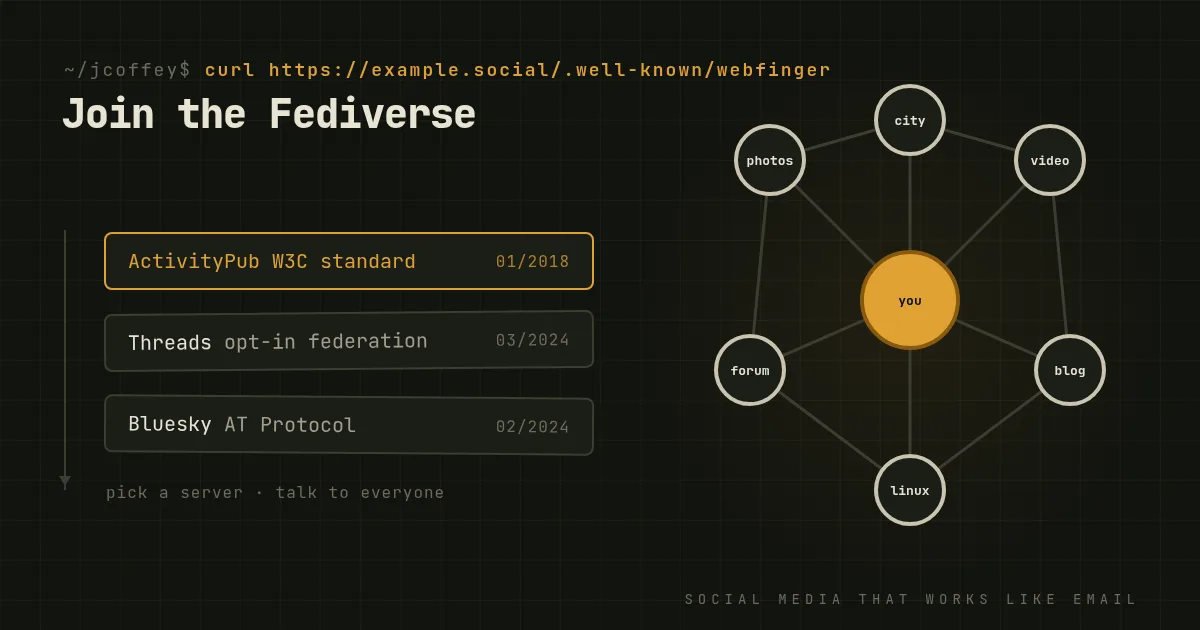
The easiest way to understand the fediverse is to think about email. You might use Gmail, your friend uses Outlook and your company runs its own mail server, and you can all email each other anyway, because email is a standard, not a company.
The fediverse does the same for social media. Thousands of independent servers, run by individuals, communities, non-profits and companies, talk to each other using an open protocol called ActivityPub, published as a W3C standard in 2018. You join one server, and you can follow and reply to people on any of them.
Why it exists
The short history of centralized social media is a history of being at the mercy of one company's decisions: algorithm changes that decide what you see, policy reversals, API shutdowns that kill the apps you use, and, in Twitter's case after October 2022, an ownership change that sent hundreds of thousands of people looking for an exit in a matter of weeks. Many of them landed on Mastodon.
The fediverse's answer is structural:
- No single owner. No company can change the rules for everyone, sell everyone's data or shut it all down.
- No algorithmic feed by default. On Mastodon your home timeline shows posts from people you follow, in order. Nobody is optimizing it for engagement.
- No ads, unless your server chooses them, and almost none do.
- You can leave without losing your audience. Mastodon lets you move your account to another server and bring your followers with you.
- Communities set their own rules. A server for scientists, one for a city, one for queer artists and one for Linux users can each moderate their own way, and block servers that don't meet their standards.
The platforms
ActivityPub is a protocol, so there are many different apps that speak it:
- Mastodon: microblogging, the closest thing to Twitter, and the largest part of the fediverse.
- Pixelfed: photo sharing, in the style of Instagram.
- PeerTube: video hosting, in the style of YouTube.
- Lemmy: link aggregation and forums, in the style of Reddit.
- Friendica and Misskey: other social platforms with different feature sets. Friendica can also talk to Diaspora, an older decentralized network that uses its own protocol.
- WordPress, via the ActivityPub plugin, lets a blog be followed from Mastodon directly.
They all interoperate to varying degrees. You can follow a PeerTube channel or a WordPress blog from your Mastodon account.
Where Threads and Bluesky fit
Two newer names come up in every conversation about this, and they're different from each other.
Threads, Meta's Twitter-like app, has started joining the fediverse. Since March, Threads users can opt in to have their posts shared over ActivityPub, so people on Mastodon can follow them. Many Mastodon servers have blocked Threads pre-emptively, out of distrust of Meta, and others have welcomed it. Either way, it's the biggest test so far of whether a giant platform and the open network can coexist.
Bluesky, which opened to the public in February, is decentralized too, but it uses a different protocol, the AT Protocol, and isn't part of the fediverse. Bridges such as Bridgy Fed can connect the two networks if both sides opt in.
Joining without overthinking it
The thing that stops most people is choosing a server. Here's how to do it quickly:
- Pick a server that fits you, or just a big general one. Joinmastodon.org lists servers by topic and language. A general server like mastodon.social is fine to start with, and you can move later. A topic server, for Linux, science or your city, gives you a better local timeline.
- Check its rules and who runs it. A server is a small institution. Look for clear rules, active moderation and some sign it's funded and maintained.
- Sign up on the website or in an app. The official Mastodon app is fine, and third-party apps like Ivory, Ice Cubes, Tusky and Phanpy are often better.
- Fill out your profile and post an #introduction. Hashtags are how people find each other here, since full-text search across the network is limited by design.
- Follow people actively. There's no algorithm to fill your feed, so for the first week, follow generously: people you knew from elsewhere, hashtags you care about, and whoever the people you follow keep boosting.
Etiquette worth knowing
- Content warnings are used to hide spoilers and sensitive topics behind a click. Many servers expect them for certain subjects.
- Alt text on images is expected, not optional. It's how blind and low-vision users read your posts.
- Boosts are the retweet; there's no quote post on Mastodon, deliberately, to discourage dunking.
- Verification is do-it-yourself. Link your website in your profile and add a
rel="me"link back to your profile on the site, and Mastodon shows a green check.
The trade-offs
It's honest to say it can feel quieter than the big platforms, discovery takes more work, and your experience depends a lot on the people who run your server. In exchange, nobody is selling your attention, and nobody can take the network away. I think that's a very good deal.
Since then
Added October 2026. Mastodon has since added quote posts, with controls that let authors decide who can quote them. And the old LINUXexpert.org domain is now a small, reviewed-signup Mastodon server for people who work with Linux and open source. I wrote about it in LINUXexpert.org Is Now a Mastodon Server, and you can follow me there at @jcoffey@linuxexpert.org.