I've been hosting my own email since 1997. About a year ago I wanted one more thing out of it: a webmail that spoke the same language as my mail server.
That's it. That was the whole plan.
Here's what I look after today. A mail server. The console that runs it. The webmail people actually read their mail in. An installer. A migration tool. An appliance that sits on the edge of a network and relays mail for a server behind it. Three published specs, and my name on an IETF draft. A forum where people I've never met file bug reports from Germany, Argentina, Turkey, France, the UK and Japan.
People keep asking how that happened. Honestly, I've been asking myself too. So here's the whole road, in order, with the walls I hit on the way.
It started with Exchange, in 1997
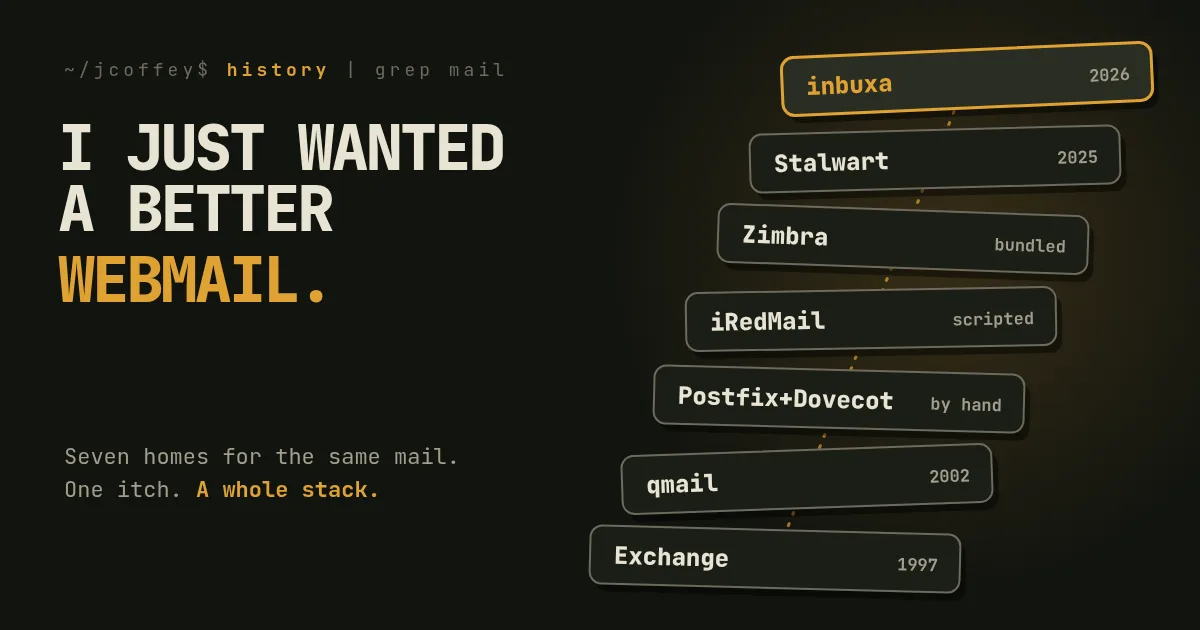
My mail has moved house a few times, and almost every house was one I ran myself. It started on my own Microsoft Exchange server in 1997. In 2002 I moved to qmail, back when that meant reading a lot of documentation and patching things by hand. After qmail came Postfix and Dovecot, hand-rolled: every config file written by me, every piece wired to the next by me.
Then, for a couple of years, I gave up and paid for Gmail. I hated it. It felt like paying for the honor of feeding Google my email for their analytics. So I went back to running it myself, on iRedMail, which is the same Postfix, Dovecot and friends, stitched together by a script instead of by me. Then Zimbra, which bundled everything into one big suite. Then, in the fall of 2025, it went to Stalwart, which did mail, calendars, contacts and files from one binary and spoke JMAP natively, which almost nothing does.
Each move was the same lesson in a different shape: the more pieces you glue together yourself, the more of your evenings belong to the glue. And the one time I stopped gluing and handed it to someone else, I paid for it and still ended up as the product.
Stalwart was the first time it felt like one program instead of a pile. Then I needed a webmail, so I installed Roundcube, like everyone does.
Roundcube worked fine. But I'd just moved to a server that spoke a modern protocol end to end, and my browser was still talking to it the old way. It bugged me. I looked for a JMAP webmail I could run, didn't find one, and started writing my own. It was for me, on my own server. Audience of one.
The first version went down the wrong road, so I deleted it and started over. The only thing that survived was the name, ihasmail, because I'd already paid for the joke domain. I wrote about that first year in September, so I won't do it again here. The short version: it stayed private for ten months, then went public in August as a JMAP webmail for Stalwart.
That should have been the end of it.
Wall one: you need a server first
The first thing people told me was that they didn't run Stalwart yet. Everything I'd written assumed you already had a mail server, and "install and configure a mail server" isn't one step. It's a weekend and a bad mood.
So I wrote ihasmail-oneshot: one command on a Docker host, and you had the server, the webmail in front of it, certificates, your first mailbox and the list of DNS records to add.
At about the same time, my own Stalwart needed a 0.15 to 0.16 upgrade. That's a real upgrade with real changes underneath it, and doing it by hand on a server with live mail on it is not a relaxing afternoon. So I wrote stalwart-migrator to do it properly.
Two tools now, and neither of them was a webmail. That should have been my first warning.
Wall two: the server itself
The webmail grew an administration section: accounts, groups, mailing lists, roles, tenants and domains, each shown only if your account really held the permission. The more of the server I could reach from a browser, the more I had to understand what the server would and wouldn't do.
And I kept running into the same line. The features you need the moment you host mail for other people, like multi-tenancy, directory integration, audit and undelete, sat behind a license key. I made the full argument in inbuxa Is Here and I'm not going to remake it. The short version is that I think those features belong to everyone who runs a mail server, and a webmail can't fix that. Only a server can.
There was a second reason. The normal setup puts the web interface on the same machine as everyone's mail, and that's the most attacked surface in the whole stack. I wanted the mail host to do mail and nothing else, with the console and the webmail somewhere else, talking to it over JMAP like any other client would.
You can't patch your way to either of those. So on September 18 I forked the server, and two days later inbuxa was public: a mail server, its console and its webmail, built as one suite. inbuxa started as a fork of Stalwart. The webmail is ihasmail's code, so that part was mine all along.
That was the moment a webmail project became a mail server project. I didn't really notice at the time.
Wall three: getting in, and staying up
A mail server nobody can move to is a hobby. So the next month was mostly about the doors.
Getting your mail in. Ten days after launch, inbuxa-migrate shipped. It reads JMAP, IMAP, Maildir, Google Takeout and both kinds of Exchange, and it works in two passes, so people keep using the old server until cutover.
Getting it installed. The launch post said the installer was "specified and not yet built". By October 12 it was built: one Go binary that puts the server, the console and the webmail where you choose, on one machine or several.
Keeping it up. My own mail, and the mail of the people I host, moved onto a three-node inbuxa cluster on September 25. Every release since has rolled out one node at a time while the others carried the mail. The first time I watched two nodes reboot half an hour apart in the middle of a release and nobody's mail stopped, I'll admit I grinned at the screen.
And then the part How Email Got Hard talks about, the legal side of running mail for others: audit logs, locked accounts, legal holds, data loss prevention and journaling. Nobody builds a webmail and expects to end up writing litigation holds. Here we are.
Wall four: owning it
For the first five weeks, inbuxa still took upstream releases. I'd strip each one, check it and merge it in. In late October I decided to stop. Release 0.16.27 was the last one inbuxa will take. Since then, inbuxa writes its own security fixes and publishes its own advisories, and from 27.1 it owns its own storage format.
That was the biggest decision of the whole year, and it's the one that changed the job the most. A fork that tracks upstream can lean on upstream. A project that doesn't has to stand up on its own: its own tests, its own release schedule, its own security work. inbuxa 27.1 is in release candidates now and ships in January 2027. After that it's two release series a year.
It also meant being honest about leaving. If inbuxa owns the format, people need a way out that doesn't depend on me, so I wrote down a layout for a whole mail account, and inbuxa-migrate reads and writes it. A Stalwart store can still come in. Your data can always go out.
Wall five: the edges
Once you own the whole stack, you start finding the parts of mail nobody has written down properly.
The edge. A lot of people can't open mail ports on the network where their server lives. So inbuxa now has a relay: a small appliance that sits at the edge, takes mail in and out for one server behind it, and gets managed from that server's console. It's in the 27.1 release candidates, and people on the forum are already running it.
The specs. Three of them, published at coffeylabs.org: /.well-known/source, for finding the source code of the version a server is running; account export, for taking a whole account with you; and a journal report format for mail journaling.
The IETF. In October I submitted a draft for JMAP undelete, so a client can find and restore things that were deleted. It was folded into the working group's object history draft, and I'm a co-author. That's the one I'm proudest of. inbuxa should give something back to the protocols it's built on, not just use them.
So how did we get here?
Exchange, qmail, Postfix and Dovecot, iRedMail, Zimbra, Stalwart, inbuxa. Seven homes I ran myself in twenty-nine years, one paid detour through Gmail, and the last home is mine to look after.
Looking back, I never once decided to build a mail stack. Each step was a ladder to get over a wall. The webmail needed a server, so I made one easy to install. Upgrading the server needed a tool, so I wrote one. The server had lines in it I didn't believe in, so I forked it. A fork needs a way in, a way to install it and a way to keep it running. Owning the format means owning the way out. Each ladder turned out to be the next floor.
Two things didn't change the whole way up.
The first is a rule from the webmail's first year: your mail server is the only source of truth about your mail. The webmail keeps no database of its own. Settings, filters, signatures and calendars live on the server. inbuxa took that further: the console and the webmail are separate programs that sign in like any other client. That's why you can put them wherever you want. It's also why none of this collapsed as it grew.
The second is the "we" in the title of this section. It was "I" for most of the first year. Now there's a forum where someone reports a bug at night and wakes up to a release with the fix in it, and where people who left Zentyal and Zimbra and hosted mail tell me what's still hard. inbuxa doesn't do telemetry, so I mostly find out who's running it when they show up and say hello. Every one of those hellos has made the software better.
What I'd tell the guy installing Roundcube
Your itch is a better spec than any roadmap. Scratch it properly and it'll show you the next one.
And maybe budget more than a weekend.
- inbuxa: inbuxa.org, with a demo you can open without installing anything
- The source: git.coffeylabs.org/inbuxa
- The forum: community.coffeylabs.org
- Me: @jcoffey@linuxexpert.org, or the feed
inbuxa is not affiliated with or endorsed by Stalwart Labs. Stalwart is a trademark of Stalwart Labs LLC.