Last month, for a few days in June, Nvidia was the most valuable company in the world. Not Apple, not Microsoft. A company that designs graphics chips and owns no factories to make them.
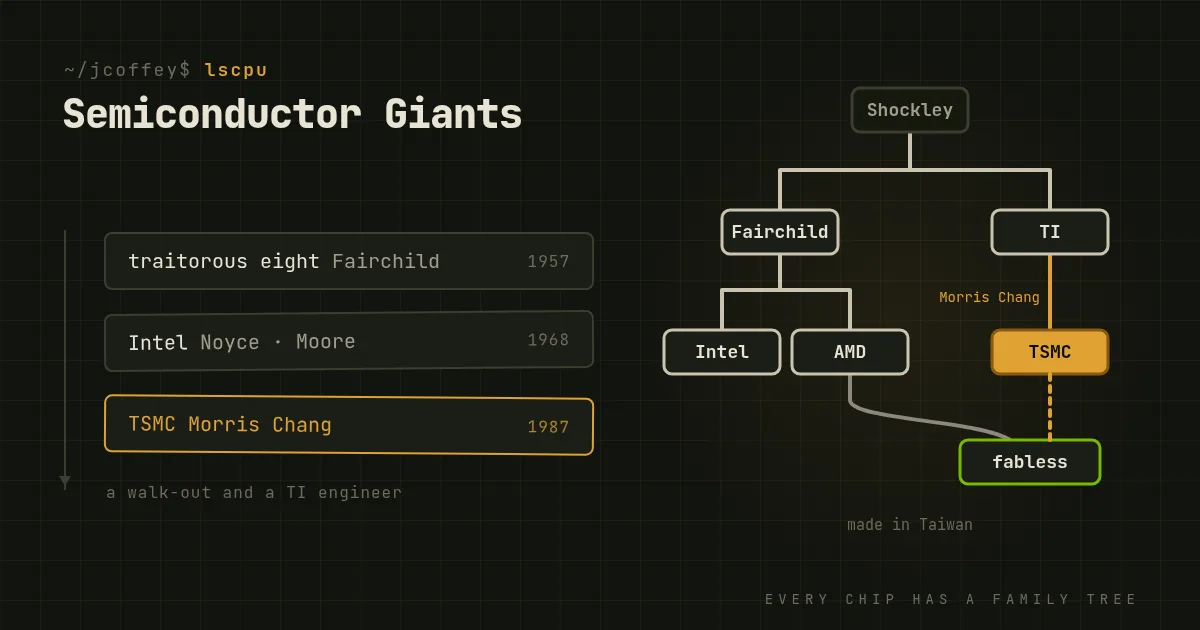
To understand how that happened, you have to go back to a family tree that starts with a walk-out in 1957 and a Texas oil-exploration company, and runs through almost every chip in your life.
Shockley and the traitorous eight
William Shockley shared the 1956 Nobel Prize in Physics for co-inventing the transistor at Bell Labs. He moved to California to start his own company, recruited brilliant young scientists, and then managed them so badly that eight of them quit together in 1957. Shockley called them the "traitorous eight."
With backing from Fairchild Camera and Instrument, the eight founded Fairchild Semiconductor in Mountain View. Among them were Robert Noyce and Gordon Moore. Fairchild's engineers developed the planar process, Jean Hoerni's method of building transistors flat on a silicon wafer with a protective oxide layer, and Noyce used it in 1959 to make a practical integrated circuit. Most chips in the world are still made with descendants of that process.
Fairchild's real legacy was its alumni. So many companies were started by people who left it, known as the "Fairchildren," that the region around it got a new name: Silicon Valley.
Texas Instruments
Meanwhile in Dallas, Texas Instruments had grown out of a company that used seismic technology to find oil. TI shipped the first commercial silicon transistor in 1954. Then in the summer of 1958, a newly hired engineer named Jack Kilby, working alone while most of his colleagues were on vacation, built the first integrated circuit: several components on a single piece of germanium.
Kilby and Noyce invented the integrated circuit independently, months apart, and it took years of patent fights before the companies agreed to cross-license. Kilby received the Nobel Prize in 2000. Noyce had died in 1990, and the prize isn't awarded posthumously.
TI went on to make the first handheld calculators, the Speak & Spell and a huge range of signal processors and analog chips. It also employed a young engineer named Morris Chang for twenty-five years. Remember him.
Intel
In 1968 Noyce and Moore left Fairchild to found Intel, with Andy Grove as their first hire. They started by making memory chips.
Three years later, a Japanese calculator company asked Intel to design a set of custom chips. Intel's engineers, led by Ted Hoff, Federico Faggin and Stan Mazor, put the processor on a single general-purpose chip instead. The 4004, in 1971, was the first commercial microprocessor. Its descendants took over the world after IBM picked the 8088 for its PC, which I covered in the history of x86.
Gordon Moore also gave the industry its metronome. In 1965 he observed that the number of components on a chip was doubling every year, and in 1975 he revised that to every two years. Moore's Law was never a law of physics. It was a prediction the industry made come true by treating it as a schedule.
AMD
Advanced Micro Devices was founded in 1969 by Jerry Sanders and seven others, mostly from Fairchild. Sanders was a salesman, flamboyant where Intel was engineering-led, and AMD started out as a second source, making licensed copies of other companies' chips.
In 1982 IBM required a second source for the processor in its PC, so Intel licensed x86 to AMD. When Intel tried to end that arrangement, the companies spent years in court. AMD has spent the forty years since alternating between Intel's shadow and Intel's nightmare. Its Athlon beat Intel to 1 GHz in 2000. It designed the 64-bit extension that every x86 chip now uses, which has its own article. Then it nearly went broke in the 2010s, before the Zen architecture in 2017 brought it roaring back.
In 2009 AMD did something that turned out to matter most of all: it spun off its factories into a separate company, GlobalFoundries, and became fabless. It would design chips and pay someone else to make them.
TSMC
That someone is usually Taiwan Semiconductor Manufacturing Company, founded in 1987 by Morris Chang, the same engineer who'd spent twenty-five years at TI.
Chang's idea was radical. Chip companies all made their own chips, but building a leading-edge factory costs billions of dollars. TSMC would be a pure-play foundry: it would make chips for anyone and design none of its own, so it would never compete with its customers. That made it possible for a company with good engineers and no factory to compete with Intel.
The fabless companies it enabled are now the industry: Apple's iPhone and Mac chips, AMD's processors, Qualcomm's phone chips and Nvidia's GPUs are all made by TSMC. And over the past decade TSMC passed Intel in manufacturing technology. The most advanced chips in the world are made in Taiwan.
Where things stand in 2024
- Nvidia is riding demand for AI training chips, made by TSMC, to a valuation that briefly topped $3 trillion.
- Intel is trying to become a foundry for other companies while catching up on its own manufacturing, and its stock reflects how hard that is.
- TSMC makes most of the world's advanced chips on one island a hundred miles from China, which makes it one of the most important companies in geopolitics.
- Governments have noticed. The US CHIPS Act is handing out tens of billions of dollars in grants: this spring Intel was awarded up to $8.5 billion, TSMC $6.6 billion for its Arizona factories and Samsung $6.4 billion.
All of it traces back to eight people who couldn't stand working for William Shockley, and one TI engineer who thought chip factories should work for everyone.
Since then
Added October 2026. Intel's troubles deepened. Pat Gelsinger retired as CEO in December 2024, the US government took a roughly 10 percent stake in the company in August 2025, and in September 2025 Nvidia announced a $5 billion investment in Intel to build chips together. Nearly seventy years after the traitorous eight walked out, the industry's map is being redrawn again.