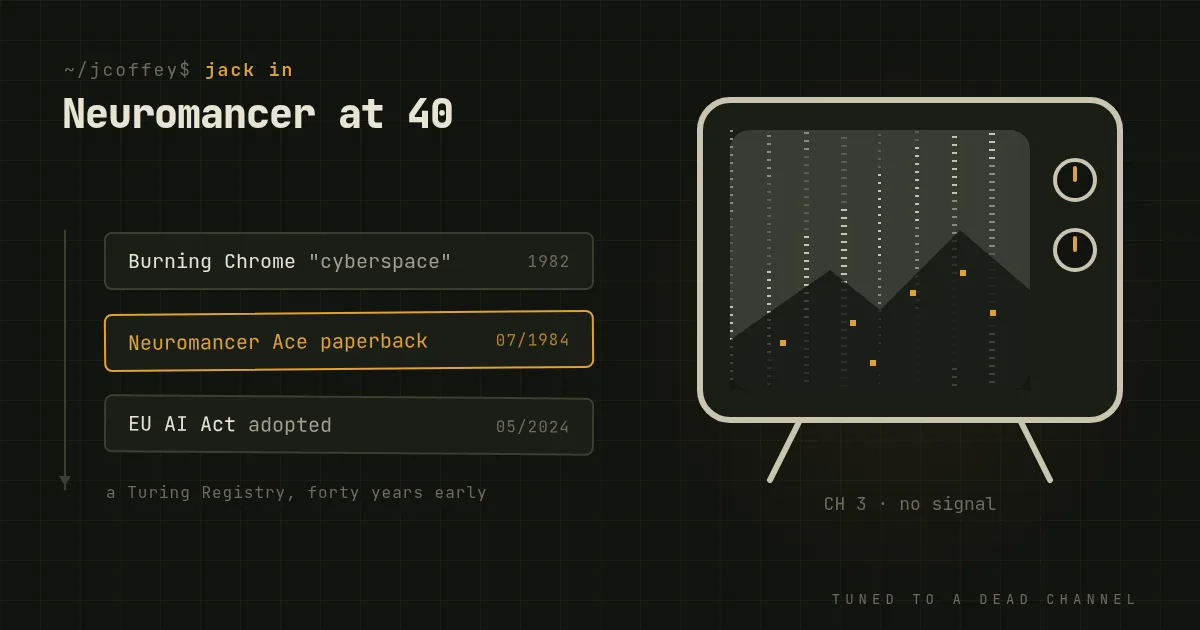
Neuromancer was published by Ace Books in July 1984, forty years ago this month, as a cheap paperback original. It became the first novel to win science fiction's triple crown: the Hugo, the Nebula and the Philip K. Dick Award. It also did something stranger. It gave a technology that barely existed yet its vocabulary, its look and its attitude, and the people who went on to build that technology read it.
What's remarkable is how little William Gibson knew about computers when he wrote it. He typed the manuscript on a manual typewriter. His idea of cyberspace came partly from watching kids in Vancouver arcades, hunched over the machines, playing as if they wanted to climb inside the screen.
The word
The famous claim is that Neuromancer coined the word "cyberspace." It didn't, quite. Gibson first used it in his 1982 short story "Burning Chrome," in Omni. Neuromancer is where it caught on, defined there as a "consensual hallucination" shared by billions of people jacked into a global network. Gibson has since admitted he picked the word because it sounded evocative while meaning nothing in particular, so he could fill it in later.
The rest of the world filled it in for him. By 1996 John Perry Barlow, a co-founder of the Electronic Frontier Foundation, was publishing "A Declaration of the Independence of Cyberspace." Governments started using "cyber" as a prefix for anything involving computers and security, from cybercrime to US Cyber Command. A word invented to sound cool on the page became the official name for a domain of warfare.
The look
Neuromancer opens on a sky the color of a television tuned to a dead channel, and the mood never brightens. The cyberpunk style it popularized is high tech and low life: huge corporations more powerful than governments, hackers living hand to mouth on the edges, chrome and grime and neon in the rain.
That aesthetic went everywhere. The Matrix, which borrows the novel's term for its network, owes it a visible debt. So do Ghost in the Shell, a generation of video games and the general picture in most people's heads when they hear the word "hacker." It also shaped hackers' picture of themselves. A fair number of people who went into security in the 1990s will tell you this book is part of why.
What it got right
- A global network everyone is plugged into, for work, crime and entertainment. In 1984 the internet had about a thousand hosts, nearly all of them at universities and military labs.
- Corporations as the real powers, controlling the infrastructure everyone depends on.
- Hacking as a profession, with crews, contracts, tools bought from specialists and defensive software standing guard. The novel calls that Intrusion Countermeasures Electronics, or ICE.
- Bodies modified with technology, and medical tech that's available to anyone who can pay.
What it got wrong
Gibson is the first to point out the biggest miss: there are no mobile phones. In one scene, as Case walks past a row of payphones, each one rings in turn. It's a great scene, and it couldn't happen now. The future arrived through a device in everyone's pocket, not a cable in the back of the skull.
The interface was wrong too. Nobody jacks into a three-dimensional landscape of glowing data. We stare at rectangles of text and tap on glass. Virtual reality keeps arriving and not quite taking over.
The prediction that aged best
Here's the part that reads differently in 2024. The plot of Neuromancer is driven by an artificial intelligence called Wintermute. It's legally restricted from becoming any smarter, and it spends the whole book manipulating humans into helping it get around that limit. Those restrictions are enforced by the Turing Registry, an international authority that licenses AIs and polices them, with agents empowered to shut them down.
Forty years later, large language models are writing code and essays, and the European Union has just adopted the AI Act, the first comprehensive law regulating artificial intelligence. The questions Gibson treated as background color are now committee agendas: who licenses these systems, how capable they're allowed to be, and who's responsible when one does something nobody intended. He didn't predict the technology. He predicted the anxiety, and the bureaucracy that follows it.
Why it still matters
Most science fiction about computers dates badly, because the details are wrong within a decade. Neuromancer survives because it wasn't really about the details. It was about what living inside networked technology would feel like, and who would own it. On the second question in particular, it was right.
If you work in this field and haven't read it, it's a short book. Read it this week.
Since then
Added October 2026. Apple's long-promised television adaptation finally has a date: Neuromancer premieres on Apple TV on January 22, 2027, with Callum Turner as Case.