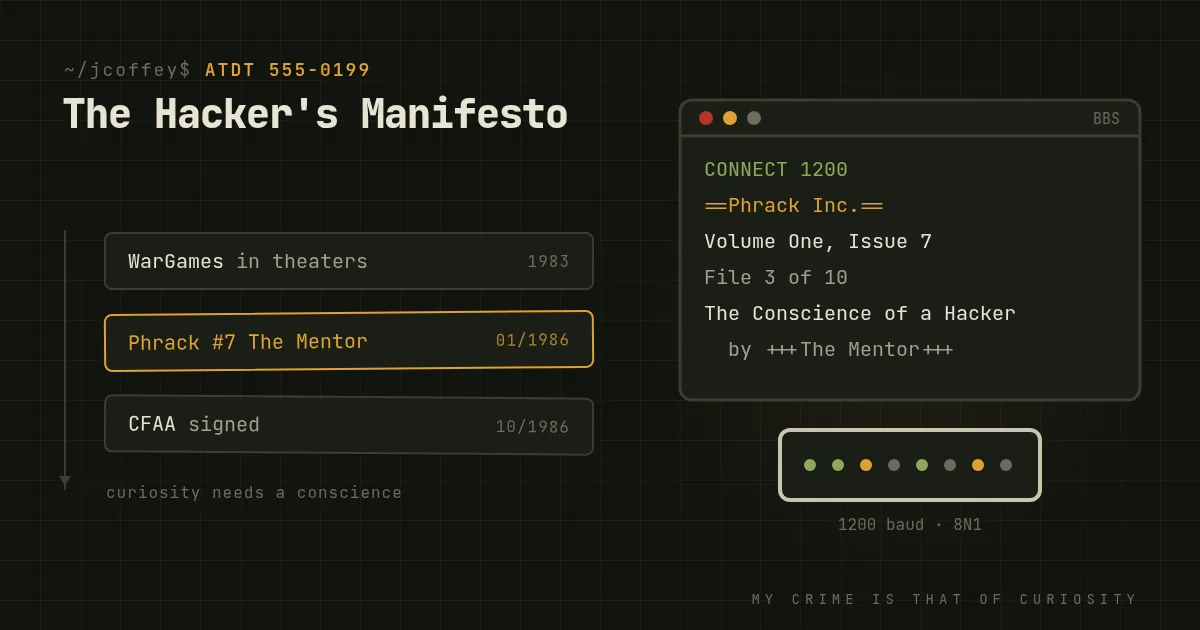
On January 8, 1986, issue 7 of the underground electronic magazine Phrack carried a short essay titled "The Conscience of a Hacker." Its author signed it The Mentor. He was Loyd Blankenship, a young member of the hacking group Legion of Doom, and he wrote it shortly after being arrested.
It runs only a few hundred words. Almost everyone calls it "The Hacker's Manifesto." Nearly forty years later, it's still printed on T-shirts, read aloud at conferences and quoted in films, and it's still one of the best ways to understand why a generation of people got into computers the way they did.
The world it came from
To read it properly, you have to picture 1985.
There was no web. The internet was a research network most people had never heard of. If you were a teenager with a modem, your world was bulletin board systems, BBSes: single computers in somebody's spare bedroom, reached by dialing a phone number, where you could post messages, swap files and play text games, one caller at a time. Long-distance calls were expensive, so "phreaking," manipulating the phone system to call for free, was how many kids reached boards in other cities. From there it was a short step to poking at the computers on the other end of the line.
Adults mostly didn't understand any of it, and by the mid-1980s they'd started to fear it. WarGames in 1983 had convinced a lot of people, including members of Congress, that a teenager with a modem could start a nuclear war. Arrests followed, along with new laws. The federal Computer Fraud and Abuse Act was passed later that same year, 1986.
What it says
The essay is written as an answer to the newspapers. Another kid's been arrested, it begins, and the adults shake their heads. Then it explains what it actually felt like to be that kid: bored and underestimated at school, then discovering a machine that did exactly what you told it to, and finding a world through the modem where nobody cared about your age, your looks or where you came from. Only what you knew.
Its most quoted line is a confession and a defense in one: "My crime is that of curiosity."
It isn't really a manifesto in the political sense. There's no program, no list of demands. It's an identity statement. It told isolated kids, each of whom thought they were the only one, that there were others like them, and that what they felt wasn't criminal impulse but a hunger to understand how things worked.
Why it lasted
- It named something real. Plenty of people who never broke into anything recognized themselves in it: the kid who took apart the radio, who stayed up all night learning, who felt more at home with machines than in a classroom.
- It was early. It shaped how hackers saw themselves just as the culture was taking form, and before the press had settled on calling them criminals.
- It circulated the way the culture did. Copied from board to board and file to file, it was "viral" before the word meant that.
- Pop culture picked it up. The 1995 film Hackers quotes it, and so does a generation of conference talks.
There's also a strange postscript that ties it to digital rights history. Blankenship went on to work at Steve Jackson Games, where he wrote the role-playing sourcebook GURPS Cyberpunk. In 1990 the Secret Service raided the company and seized that manuscript, calling it a handbook for computer crime. That raid was part of why the Electronic Frontier Foundation was founded, which I covered in The Free Software Foundation and Electronic Frontier Foundation.
What it left out
Reading it as an adult, and as someone who's spent a career running systems, the gaps are as clear as the insight.
The essay treats curiosity as its own justification. It's not. Breaking into a computer you don't own can hurt the people who depend on it, whatever your intentions, and "I was just looking" hasn't comforted anyone whose hospital system was down. The best of the hacker tradition learned to channel curiosity: build your own lab, get permission, report what you find, publish so others can fix it. That's how the people who read this as teenagers became the security researchers, red teamers and open source developers who now keep a lot of the internet running.
It also describes the network as a place free of skin color, nationality and prejudice. That was a lovely aspiration. The decades since have shown that the internet carries all of our prejudices with it, sometimes amplified. Equality online has to be built, like everything else.
Why it still matters
Strip it down and the message is about curiosity, about the joy of figuring out how something works. That's the root of everything good in this field. Every protocol, every open source project, every vulnerability found and fixed started with someone who needed to know how the thing worked.
The lesson since 1986 is that curiosity needs a conscience, and the essay's own title already had that word in it.
Since then
Added October 2026. "The Conscience of a Hacker" turned forty this January.