Ask a room of people whether they use Linux and a few hands go up: the developers, the sysadmins, the one person with a sticker on their laptop. Ask whether they've used it today and the honest answer is nearly every hand, nearly every time.
The Linux kernel doesn't need you to know it's there. Here's an ordinary day, from the moment the alarm goes off.
In your pocket
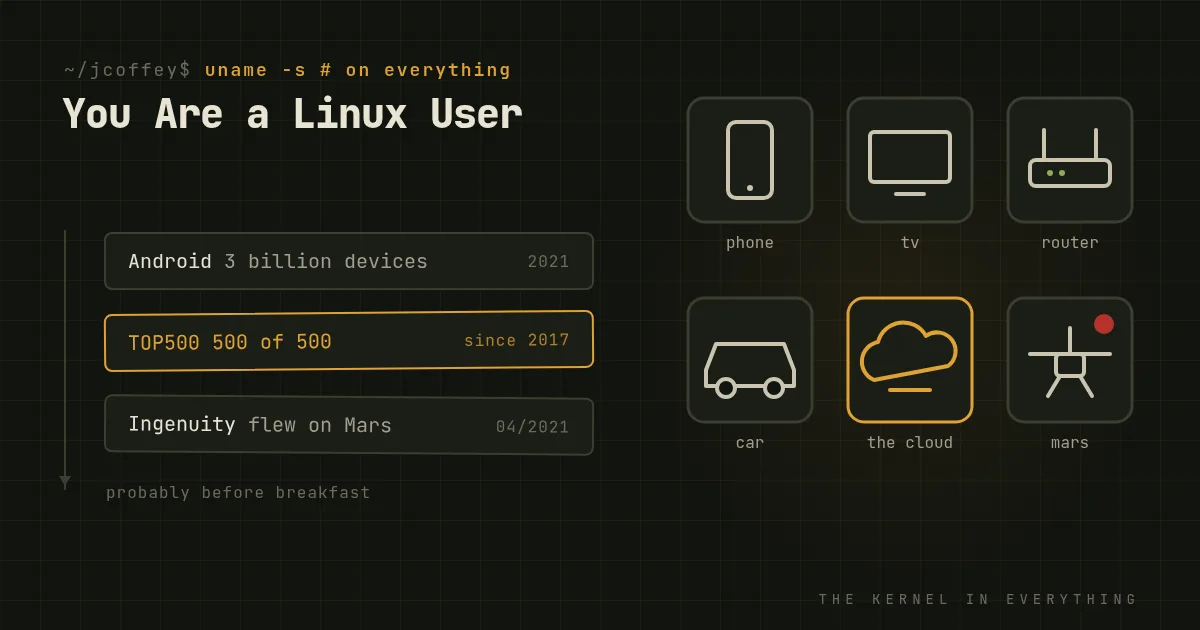
If your phone runs Android, it runs Linux. Android is the Linux kernel with Google's software on top: its own user space, its own app runtime, and none of the GNU tools a desktop Linux has. But the kernel underneath is Linux, maintained with the same mailing-list process as the server in a data center. Google counted more than three billion active Android devices a few years ago. That alone makes Linux the most widely used operating system kernel in history.
If you have an iPhone, you're off the hook for this one. iOS is built on Darwin, which descends from BSD Unix and the Mach kernel. A cousin, not a sibling.
In your home
- Your TV. Samsung's smart TVs run Tizen and LG's run webOS, and both are Linux-based. Google TV and Android TV boxes run Android, which is Linux again. The streaming stick behind your TV almost certainly does too.
- Your router. The great majority of home routers, mesh Wi-Fi systems and cable modems run embedded Linux. Projects like OpenWrt exist precisely because so many of them do.
- Your smart speaker, thermostat, doorbell camera and e-reader. Amazon's Echo and Kindle devices run Linux-based operating systems, as do a large share of the cameras and hubs on the market. So do plenty of washing machines and refrigerators, if you bought the fancy kind.
- Your games. Valve's Steam Deck runs SteamOS, an Arch-based Linux distribution, with Proton translating Windows games on the fly. The PlayStation and Nintendo Switch, for the record, don't: Sony's consoles use a FreeBSD-derived system and Nintendo built its own.
On the road
- Your car. Many infotainment systems run Linux. Tesla's does. Toyota, Subaru and others use Automotive Grade Linux, a Linux Foundation project building a shared automotive platform. If your dashboard plays Android Auto, your phone is running the show in Linux anyway.
- Planes and trains. In-flight entertainment systems are a famous source of photos of a Linux boot screen, typically posted when one crashes mid-flight.
Everything you do online
This is the big one. Almost every website, app backend and cloud service you touch runs on Linux servers.
- The cloud. Most virtual machines on AWS, Google Cloud and Azure run Linux. Microsoft has said that more than half of the cores in Azure run Linux.
- The services. Google search, Gmail, Facebook, Amazon and Wikipedia all run on Linux in their data centers.
- Streaming. Netflix's application servers run Linux on AWS. One twist: the Open Connect appliances that actually stream the video to you run FreeBSD, Linux's BSD cousin. Unix-like either way.
When you text, pay with a card, check the weather or order dinner, a Linux machine is almost certainly somewhere in the path.
Beyond Earth, and beyond fast
- Supercomputers. All 500 of the world's fastest supercomputers run Linux, and have since November 2017. Not most of them. All of them.
- Space. The laptops on the International Space Station moved to Debian in 2013. SpaceX has said its rockets' flight computers and Starlink run Linux. And NASA's Ingenuity helicopter, which made the first powered flight on another planet in April 2021, ran Linux on Mars.
Why it ended up everywhere
None of this happened because anyone ordered it. It happened because Linux is free to use and modify, runs on almost any processor, and can be stripped down to fit a cheap device or scaled up to run a supercomputer. A device maker can take the kernel, add drivers for its hardware and ship, with no license fee per unit and no vendor that can change the terms. Multiply that decision across thousands of companies and you get a kernel in everything.
So the next time someone says they've never used Linux, ask them what phone they have and what they watched last night. They probably used it before breakfast.
Since then
Added October 2026. I told a longer version of this story for Linux's 35th birthday in Just a Hobby, including what the world might look like without it.