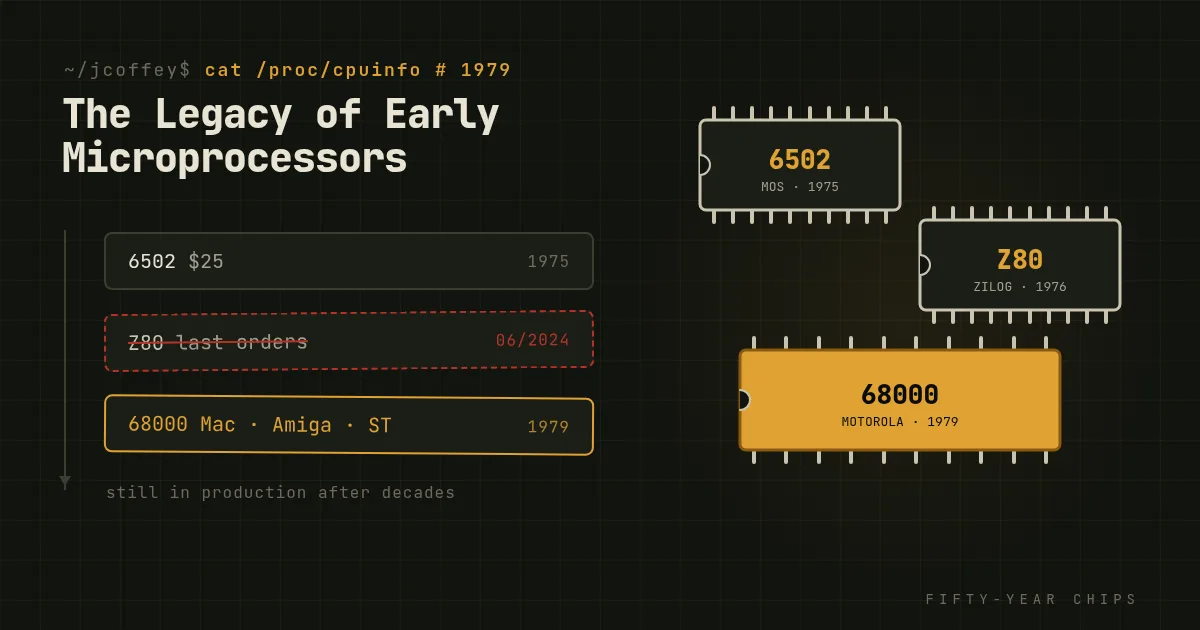
On June 14, Zilog stopped taking orders for its standalone Z80 processor. Its foundry partner was retiring the manufacturing process, and after nearly forty-eight years the Z84C00 family, the descendants of a chip first sold in 1976, reached end of life.
Forty-eight years is an extraordinary run for any electronic part, and the Z80 isn't alone. A small group of microprocessors designed in the mid-to-late 1970s built the personal computer industry, and several of them, or their direct descendants, are still being manufactured. Their stories explain a lot about why some technology lasts.
The MOS 6502 (1975): cheap enough to start a revolution
In 1975 Chuck Peddle and a group of engineers who had left Motorola built the 6502 at MOS Technology and sold it for $25, when Intel's and Motorola's comparable chips cost well over a hundred dollars. That price is the whole story. It was cheap enough for hobbyists and small companies to build computers around it.
They did: the Apple I and Apple II, the Commodore PET, VIC-20 and Commodore 64, the BBC Micro, the Atari 2600 and 8-bit computers, and the Nintendo Entertainment System. A generation learned to program in BASIC or assembly on a 6502.
It's still in production. The Western Design Center, founded by Bill Mensch, one of the 6502's original designers, makes the W65C02 and W65C816 today. The W65C02 still ends up in embedded products, including medical devices and industrial controllers, where a simple, well-understood processor is a feature.
The Zilog Z80 (1976): CP/M and a million embedded things
Federico Faggin, who had led the Intel 4004 and 8080 design, left Intel to found Zilog, and with Masatoshi Shima designed the Z80: compatible with the 8080's software, but faster, with more registers and built-in DRAM refresh that made computers cheaper to build.
It became the processor of the first generation of business microcomputers running the CP/M operating system, and of the TRS-80, the Sinclair ZX80, ZX81 and ZX Spectrum, the MSX standard, the Osborne 1 and the original Game Boy's processor, a close Sharp-made cousin. Texas Instruments' graphing calculators, like the TI-83 and TI-84, still run on Z80-family processors.
That's why it lasted until this year. The Z80 ended up inside an enormous number of industrial controllers, terminals and appliances designed decades ago that are still being manufactured, and redesigning those around a new processor costs more than buying old chips. Zilog's newer eZ80 cores carry on, and distributors' stock will last a long time.
The Intel 8086 and 8088 (1978–1979): the accidental standard
Intel's 8086 wasn't the first 16-bit microprocessor. Texas Instruments and National Semiconductor both got there earlier. But it became the most important one, through its cheaper variant, the 8088, which used an 8-bit external bus so it could pair with cheaper support chips. IBM chose the 8088 for its Personal Computer in 1981, and the rest is the history of x86: every PC and most servers since run an instruction set descended from it.
The 8086 and 8088 also had long lives as embedded and military parts, with licensed second-source versions made by AMD, Harris and others, and radiation-hardened versions flying in space hardware long after desktop PCs moved on.
The Motorola 68000 (1979): the elegant one
Motorola's 68000, designed by a team led by Tom Gunter, was everything the 8086 wasn't: a clean 32-bit internal architecture with sixteen general registers and a flat address space, wrapped in a 16-bit external bus. Programmers loved it. Its instruction set was regular and orthogonal, a pleasure to write assembly for.
It powered the machines that defined the graphical era: the Apple Lisa and original Macintosh, the Amiga, the Atari ST, early Sun workstations, and the Sega Genesis. Later 68k-family chips ran Macs until 1994, when Apple moved to PowerPC, and Palm's early handhelds.
It lasted too. TI's TI-89 and TI-92 graphing calculators run on a 68000. Motorola, and later Freescale and NXP, carried 68000-derived cores into embedded controllers and the ColdFire family for decades.
Why these lasted
Some patterns run through all four:
- They were simple enough to understand completely. An engineer could hold the whole processor in their head, and when you're building a medical device or an industrial controller that has to be certified, simple and fully documented beats fast.
- Software was the moat. Once CP/M ran on the Z80 and DOS on the 8088, the processors were carried along by the software written for them. The same force keeps x86 alive today.
- Embedded products live for decades. A consumer PC lasts five years. A factory controller, a cash register or an avionics box can be manufactured unchanged for twenty-five years, and it needs the same chip throughout.
- Second sources and licenses. Many of these designs were licensed to multiple manufacturers, which made engineers confident they'd still be able to buy them.
The 1970s chips taught the industry that a processor's real lifetime is set by the software and products built around it, not by its age. Most of today's processors will be lucky to be on the market for five years. Some of these went for fifty.
Since then
Added October 2026. The Z80 turned fifty this July, and there's already a replacement: the FOSS Z80 project has an open source, pin-compatible Z80 running on real silicon, aimed at the people who still need to keep those old machines and products alive.