A disclosure first, the same one I gave in my piece on the Linux Foundation: I've helped write three of the Linux Foundation's certification exams and still sit on the advisory council for one of them. So I'm not neutral. I'll try to be useful anyway, and I won't share anything about exam content beyond what's public.
How the exams work
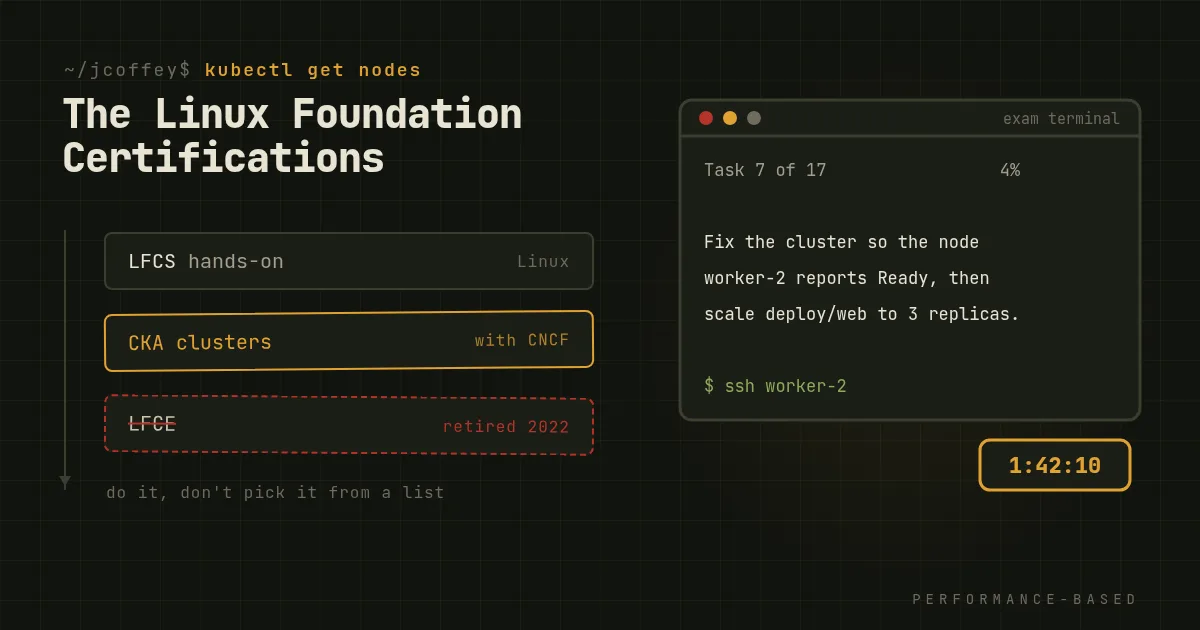
The flagship Linux Foundation certifications are performance-based. You don't pick answers from a list. You're given remote access to live systems and a set of tasks, and you have a couple of hours to get them done. Configure this service. Fix this broken boot. Create this Kubernetes deployment so it survives a node failure. Your work is checked by examining the final state of the systems.
You can use the official documentation during the exam, as you would at work. What you can't do is guess. You either know how to do the task or you don't.
Exams are taken online, proctored remotely, and come with one free retake.
What's on offer in mid-2024
Linux
- LFCS, Linux Foundation Certified System Administrator. The core Linux exam: system operation, users and permissions, storage, networking, services and essential command-line work. It's distribution-independent and the best single Linux certification in the Linux Foundation's catalog.
- LFCA, Linux Foundation Certified IT Associate, a multiple-choice entry-level exam for people starting out in IT.
- The old LFCE, Linux Foundation Certified Engineer, was retired in 2022. You'll still see it on résumés and in older articles, but you can't take it.
Kubernetes and cloud native, run with the CNCF:
- CKA, Certified Kubernetes Administrator, for running and troubleshooting clusters. Probably the most sought-after certification in the catalog.
- CKAD, Certified Kubernetes Application Developer, for building and deploying applications on Kubernetes.
- CKS, Certified Kubernetes Security Specialist, for securing clusters and workloads. It requires a current CKA.
- KCNA and KCSA, multiple-choice associate exams for Kubernetes and cloud native fundamentals and security.
Specific projects, mostly associate-level: Prometheus (PCA), Istio (ICA), GitOps with Argo and Flux (CGOA), Cilium (CCA) and others, with new ones added regularly.
How they compare
- Red Hat's RHCSA and RHCE are also hands-on, highly respected and the obvious choice if you work in RHEL shops. They're tied to Red Hat's tools, and the RHCE is now essentially an Ansible exam.
- CompTIA Linux+ is vendor-neutral and mostly multiple choice, with some simulated tasks. It's widely recognized in government and enterprise HR systems, which sometimes require CompTIA certifications by name.
- LPI's LPIC series is vendor-neutral, mostly multiple choice, and popular in Europe and Latin America.
- Cloud provider certifications from AWS, Azure and Google test knowledge of their own platforms and are largely multiple choice.
The performance-based format is the Linux Foundation's and Red Hat's real advantage. A multiple-choice exam tests whether you recognize the right answer. A hands-on exam tests whether you can produce it under time pressure, which is closer to the job.
Are they worth it?
It depends on where you are:
- Early in your career, yes. A certification gets your résumé past filters and gives you a structured syllabus, and passing a hands-on exam is a real signal that you can do the work.
- Changing specialties, for instance from traditional sysadmin work to Kubernetes, the CKA is one of the most direct ways to show you've made the move.
- Already experienced, less so. Your track record speaks louder. But some employers, consultancies and government contracts require specific certifications, so check what your market asks for.
The exams cost a few hundred dollars, and the Linux Foundation runs frequent discounts, particularly around events and holidays, often bundled with a training course. Many employers will pay.
How to prepare
- Practice on real systems. Build a lab with a few virtual machines or a local Kubernetes cluster, break things and fix them. Reading isn't enough for a hands-on exam.
- Learn the documentation. You're allowed to use the official docs during the exam. Knowing where things are in them, and how to search them quickly, is a skill in itself.
- Get fast at the command line. Time is the real enemy. Aliases,
kubectlimperative commands,vimfluency and tab completion all save minutes. - Use the practice environment. The CKA, CKAD and CKS include access to a simulator with harder-than-real practice questions. Take it seriously.
- Read the candidate handbook. Knowing the rules, the environment and the check-in process avoids nasty surprises on the day.
A certification won't make you an engineer. But preparing for a good one, the kind where you have to do the work rather than recognize it, will make you a better one.