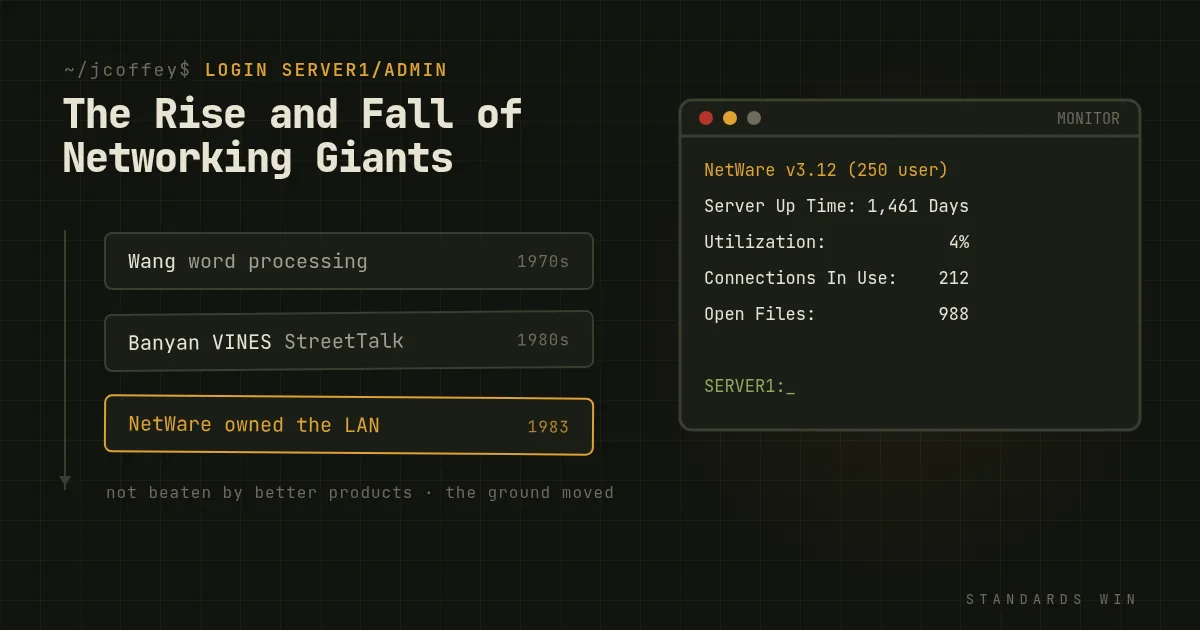
I came up on NetWare and Windows NT 3.51. If you started in IT in that era, you'll remember when "the network" meant a NetWare server in a closet, logging in meant a NetWare login script, and the most important skill in the building was knowing how to fix a print queue.
That world is almost entirely gone, along with several of the companies that built it. Wang, Banyan and Novell were each, for a while, the dominant force in a part of office computing. Their stories are worth knowing, because the pattern of how they fell keeps repeating.
Wang Laboratories: the office computer
An Wang, a Chinese-born physicist at Harvard, founded Wang Laboratories in 1951 and made his first fortune from magnetic core memory, the main form of computer memory before chips. The company went on to calculators and then, in the 1970s, to the product that made it famous: dedicated word processing systems.
Before PCs, Wang's word processors were how offices produced documents. A central minicomputer served a room of terminals, and secretaries used them instead of typewriters. The Wang 2200 small computer of 1973 and the VS minicomputer line from 1977 sold to businesses, banks and governments by the tens of thousands. At its peak in the mid-1980s Wang had over 30,000 employees and billions in revenue.
Why it fell: the IBM PC and its clones running WordPerfect and later Microsoft Word did word processing on a cheap desk machine anyone could buy. Wang's systems were proprietary and expensive, and they didn't interoperate with the growing PC world. Wang was slow to accept that the PC wasn't a toy. It filed for bankruptcy in 1992.
Banyan Systems: the directory that was ahead of its time
Banyan, founded in 1983 in Massachusetts, sold VINES, a network operating system that ran on top of Unix and used its own protocol stack, derived from Xerox's XNS. Its great strength was StreetTalk, one of the first enterprise directory services. Every user, printer and server in a large, spread-out organization had a single global name, and you could find anything from anywhere.
Big, geographically dispersed organizations like the US military, government agencies and large corporations loved it. StreetTalk did in the 1980s what enterprises would wait another decade to get from Novell and Microsoft.
Why it fell: two things it couldn't control. The internet made TCP/IP the protocol everyone ran, and VINES' own protocols became a liability. Then Microsoft shipped Windows NT with networking built in, and in 2000 Active Directory, essentially the directory idea Banyan had pioneered, bundled with the operating system everyone already had. Banyan renamed itself ePresence in 1999 and left the networking business.
Novell: the king of the LAN
Novell shipped NetWare in 1983 and, by the late 1980s, it owned PC networking. At its height, a large majority of networked PCs in businesses connected to NetWare servers. NetWare was fast, very stable for its time, and could serve files and printers to hundreds of users from modest hardware. Novell Directory Services, introduced with NetWare 4 in 1993, brought a proper enterprise directory to the mainstream.
NetWare's protocol, IPX/SPX, was everywhere, and so were Certified NetWare Engineers. If you managed a network in 1992, you almost certainly managed NetWare.
Why it fell:
- Windows NT in 1993 put file and print sharing into a general-purpose server operating system that could also run applications, managed with the same tools as the desktops. NetWare did one thing very well. NT did everything adequately, and it came from the company that made the desktops.
- TCP/IP won. NetWare added it, but late.
- Strategy. Novell bought WordPerfect in 1994 to fight Microsoft Office and lost badly. The years of distraction cost it the server war.
- Active Directory in Windows 2000 matched NDS closely enough, and came bundled.
Novell's later chapters were more interesting than many remember. It bought the desktop Linux company Ximian in 2003 and then SUSE, completed early in 2004, becoming one of the major Linux companies. In 2011 Novell itself was acquired by Attachmate, later part of Micro Focus, and its name disappeared. SUSE was eventually sold off and lives on today as its own company.
What they have in common
None of the three lost because their products were bad. NetWare was a better file server than NT for years. StreetTalk was a better directory than anything Microsoft had for a decade. Wang's word processors were superb.
They lost because the ground moved:
- Standards beat proprietary protocols. Once everyone ran TCP/IP, a proprietary network stack became a cost, not a feature.
- "Good enough and included" beats "better and separate." Bundling networking into the operating system, and the directory into the server, beat best-of-breed products that had to be bought and managed separately.
- They defended the old platform instead of moving to the new one in time.
Why it matters now
The same pattern is playing out today. Proprietary platforms that look unassailable, in virtualization, cloud services and business software, are one standards shift or one pricing decision away from being the next NetWare. The organizations that came through those transitions well were the ones whose data and skills weren't locked into a single vendor's protocol when the ground moved. Open standards and open source are the best insurance against becoming someone's museum exhibit.
And if you still have a NetWare server somewhere, unplugged in a closet with its uptime counter frozen at four years, you're not alone.