Every VMware renewal meeting this year seems to include someone asking about OpenStack. Broadcom's pricing has sent a lot of organizations looking for alternatives, and OpenStack is the biggest open source name in private infrastructure.
But comparing OpenStack and vSphere directly is a bit like comparing a car to a taxi company. One is a very good machine. The other is a system for running a fleet of machines as a service to others. Which you need depends on what you're actually trying to do.
What vSphere is
VMware vSphere is server virtualization done extremely well. ESXi is the hypervisor on each host, and vCenter manages them as a cluster, with live migration (vMotion), automatic restart on host failure (HA), load balancing (DRS), and a polished interface that a single administrator can run.
The model is an administrator managing virtual machines. Someone requests a VM, an admin builds it from a template, and it lives for years. vSphere was designed for that, and for that it's the benchmark everyone else is measured against. Add vSAN for storage, NSX for networking and VMware's automation products, and you can build something cloud-like on top, at a cost.
I compared vSphere with a closer like-for-like alternative in VMware vs Proxmox.
What OpenStack is
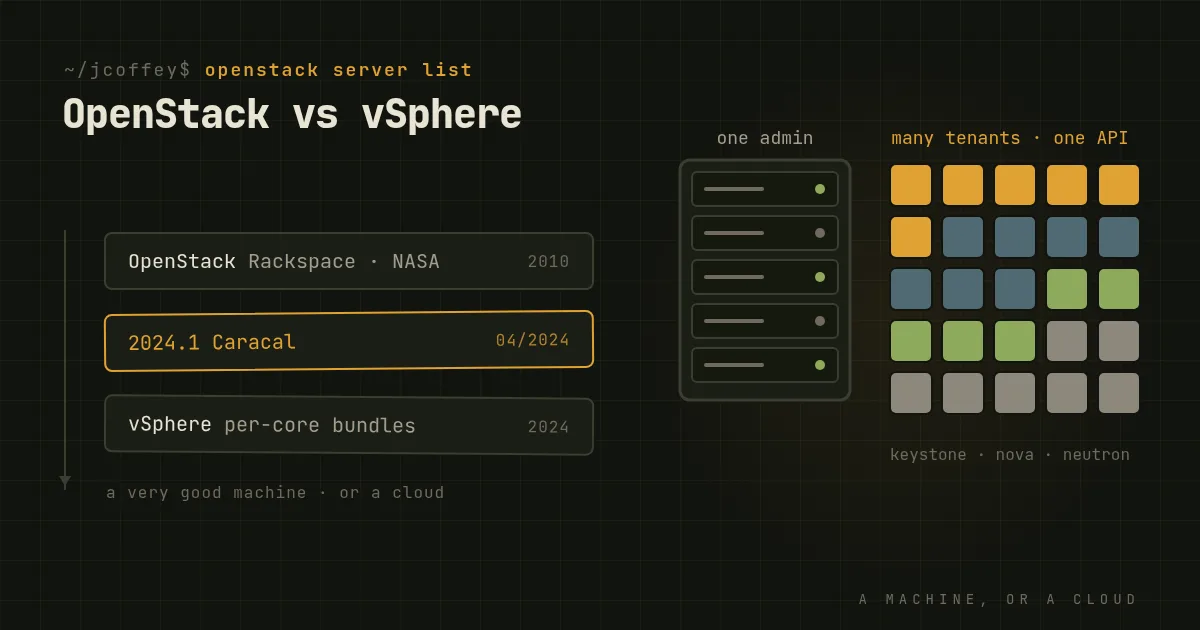
OpenStack is software for building an infrastructure-as-a-service cloud, the kind of thing AWS's EC2 is. Rackspace and NASA launched it together in 2010, and it's now a collection of cooperating services, released every six months under the Open Infrastructure Foundation. The latest, 2024.1 "Caracal," came out in April.
The core services:
- Keystone for identity, projects and quotas.
- Nova for compute, usually with KVM underneath.
- Neutron for software-defined networking: tenant networks, routers, floating IPs and security groups.
- Cinder for block storage, and Swift for object storage.
- Glance for VM images, and Horizon, the web dashboard.
- Optional extras for load balancers (Octavia), Kubernetes clusters (Magnum), bare-metal provisioning (Ironic) and much more.
The model is self-service for many tenants. Teams or customers get their own projects with quotas, and they create, network and destroy their own instances through an API, without filing a ticket. Everything is automatable, which is why OpenStack works well under OpenTofu, Ansible and CI pipelines.
Who runs OpenStack
Not small shops. OpenStack's users tend to be organizations that need to be a cloud:
- Research institutions. CERN runs one of the largest OpenStack clouds in the world for physics computing.
- Telecom carriers, for network functions and 5G infrastructure.
- Public cloud providers. OVHcloud's public cloud and many regional providers are built on it.
- Large enterprises offering internal clouds to hundreds of development teams.
The comparison that matters
| vSphere | OpenStack | |
|---|---|---|
| What it is | Virtualization platform | Cloud platform |
| Typical user | IT admins managing VMs | Many teams self-serving through APIs |
| Multi-tenancy | Limited without extra products | Built in |
| Day-one complexity | Low | High |
| Licensing | Commercial subscription, now per core | Free, open source (Apache 2.0) |
| Support | One vendor | Distributions and consultancies |
| Talent | Easy to hire | Scarce and expensive |
The honest catch with OpenStack is operations. It's a distributed system of many services, each with its own database tables, message queues and configuration, and upgrades every six months. Deploying it has gotten much easier, with Kolla-Ansible, OpenStack-Ansible and Canonical's and Red Hat's distributions, but running it well still takes a dedicated team that understands Linux networking, storage and Python services deeply. Organizations that tried to run it with two part-time admins in the early 2010s mostly have stories they don't tell at parties.
The honest catch with vSphere is now the bill and the terms, which Broadcom can change.
How to decide
- You have a few hundred VMs and an IT team that manages them: you don't need OpenStack. Look at Proxmox VE, or another KVM platform, or keep vSphere and negotiate.
- You need to offer self-service infrastructure to many teams or customers, with quotas, an API and tenant isolation, at a scale of thousands of instances: OpenStack is designed for exactly that, and it costs nothing to license.
- You want a private cloud but don't have the team to run OpenStack: buy it as a supported distribution, or a managed private cloud, rather than building it from upstream.
- What your developers really want is Kubernetes: consider giving them Kubernetes on bare metal or a simpler virtualization layer, rather than a full IaaS platform underneath it.
OpenStack is the right answer to a big question. vSphere is a great answer to a smaller one. Most of the trouble comes from mixing them up.
Since then
Added October 2026. In March 2025 the Open Infrastructure Foundation announced it would join the Linux Foundation, and the move closed later that year. OpenStack now sits under the same umbrella as Kubernetes, which ends a rivalry that never made much sense.