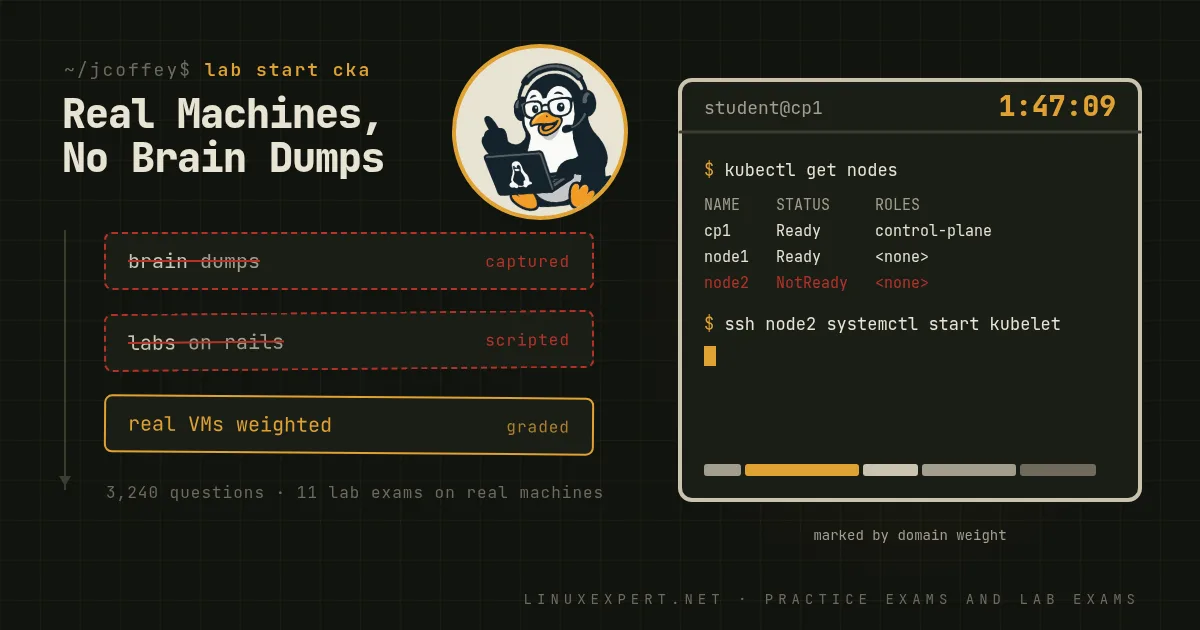
I've been writing the LINUXexpert study guides since 2018. When I brought them back this month, it was because you asked. This time I didn't want to stop at the guides. I wanted practice that actually gets you ready for the exam, and that isn't what most exam prep sells.
Most of what's out there is one of two things. It's either a brain dump, real exam questions captured by people who sat the test and typed up what they remembered, or it's a lab that holds your hand down a single track and calls that practice. I didn't want to build either of those, so I built the parts myself.
The problem with brain dumps
Every vendor whose exams we cover makes you agree not to share exam content before you sit: the Linux Foundation, the CNCF, Red Hat, Canonical and LPI all do it. A dump is that agreement broken, sold back to the next candidate. Get caught studying from one and the vendor can pull your certification, and a cert that can be pulled isn't worth much on a resume.
Even setting the rules aside, dumps don't work the way people think. They're frozen at whatever version of the exam someone remembered, half the answers are guesses, and the objectives move under them. Worst of all, they teach you to recognize a question, not to do the job. Then you're three months into the role and the cluster is on fire, and no one is handing you four choices.
None of the questions on LINUXexpert.net came from anyone's memory of an exam. They're written from each exam's published domains and competencies and from the upstream docs. While the guides were being written, the commands in them were run on real systems: Debian, Ubuntu, Fedora and AlmaLinux machines, and live Kubernetes clusters. Plenty of things we "knew" turned out to have changed. Defaults move, flags get deprecated, a distribution swaps one tool for another. You only find that out by running it.
Our own exam engine, and a big pool
The multiple-choice practice exams run on an engine I wrote for this site. It isn't a quiz plugin. It works like this:
- A pool, not a fixed paper. Every exam has a bank of 180 questions, three times the length of a paper. There are eighteen practice exams today, so that's 3,240 questions in all. Each sitting draws a fresh paper, so you can't memorize your way through by the third try.
- The real weights. Each paper is split across the exam's domains by the same weights as the real test. KCNA weighs its four domains 44, 28, 16 and 12 percent, so a 60-question KCNA paper comes out 26, 17, 10 and 7.
- The real length and the real clock. Same number of questions and the same time limit as the exam you'll sit. The timer runs on the server, so closing the tab doesn't pause it.
- No answers in the page. Your browser only ever gets the questions. The answers stay on the server until you end the exam.
When you finish, you see how you did in each domain, and every question comes with the right answer, an explanation and a link to the chapter that covers it. None of the practice questions repeat a chapter quiz, so a good score means you know the material, not that you've seen the question before.
Labs on real machines, not on rails
This is the part I'm proudest of, and the part almost nobody else does properly.
A lot of "hands-on" prep is a guided exercise. It tells you what to type, checks that you typed it, and moves you to the next step. Some of it is a fake shell in the browser that only understands the commands the script expects. That's a tutorial. It isn't an exam.
The hands-on exams (LFCS, CKA, CKAD, CKS, RHCSA and the rest) give you a terminal, a list of tasks and a clock, and they grade whether the system ends up right. So that's what we built:
- Your own real machines. Every sitting gets fresh virtual machines, built from our own images, on their own private network. Nobody else is on them, and they're deleted when you're done. The CKA lab is a three-node kubeadm cluster. The Ansible lab (EX294) is a control node and three managed hosts. The Ubuntu Desktop lab joins a real Samba Active Directory domain.
- A real terminal. A full shell in the browser, over SSH, on the actual machine. Use whatever tools you'd use at work. If your connection drops, you come back to the same shell, right where you left it.
- Things are broken on purpose. Troubleshooting is a big part of these exams, so the labs come with real faults to find: a node whose kubelet won't come up, a DNS zone with the wrong name, a Service that doesn't reach its Pods.
- Graded on the result, not your keystrokes. When you finish, every machine is restarted and then checked as root. Only changes that survive a reboot count, the way Red Hat grades its exams. We check the end state, not how you got there, so any reasonable way of doing a task passes.
- Weighted like the real test. Every task carries marks, and the marks add up by domain to the exam's published weights. The CKA lab gives 30% of its marks to troubleshooting and 25% to cluster architecture, because that's how the CKA is weighted. Red Hat doesn't publish weights, so for RHCSA and EX294 we don't invent any.
- Tested before anyone sees it. Before a lab goes live, a reference answer has to score 100% on fresh machines, and an untouched session has to score zero. If either one is off, the lab doesn't ship.
The clock doesn't start until the machines are ready and you press Start. Setup takes a few minutes, and so does marking, because a real cluster takes real time to reboot.
There are eleven lab exams live right now: LFCS, CKA, CKAD, CKS, Istio (ICA), CNPE, RHCSA, Ansible (EX294), and Canonical's Linux Terminal, Ubuntu Server and Ubuntu Desktop. OpenShift (EX280) is being built now.
I did look at faking it. There are clever ways to run Linux inside a browser tab, and they'd cost almost nothing to run. None of them is the environment you'll be tested in: wrong architecture, no systemd, no real kernel, and the grader would be running on your machine. So the labs stay on real VMs.
What it costs
Real machines cost real money every time someone starts a lab, so this is the one part that needs a subscription. The plan is $12 a month or $100 a year, and it comes with four lab exams a month plus more practice papers.
The study guides and the multiple-choice practice exams are free with an account, one paper a day. The account is there to keep AI scrapers from hoovering up everything. The first chapter of every guide is open to anyone who wants a look first.
One rule we enforce
The same agreement that makes dumps a bad idea applies on our side too. In the LINUXexpert forum and anywhere members talk about their exams, talk about how you prepared, how the time went and what the environment felt like. Never the questions. Posts that share exam content get deleted, fast.
If there's an exam you want that isn't on the site yet, email me. That's how most of this got built.
TEST YOUR MIGHT. Happy learning, nerds.