The Linux Foundation has published its 2025 State of Tech Talent Report, released on June 23 at Open Source Summit North America. It's based on a survey of more than 500 hiring and training leaders around the world. Here's what stood out.
AI is changing the work, not just the headlines
- 94% expect AI to add significant value to their operations.
- Two-thirds say AI has already significantly changed how their teams work.
- Half are expanding their AI-specific workforce.
The organizations creating new AI roles most often named AI/ML operations engineering leads (64%) and AI product managers (36%). The picture is less "AI replaces the team" and more "the team needs new skills, and some new people."
The gaps are real
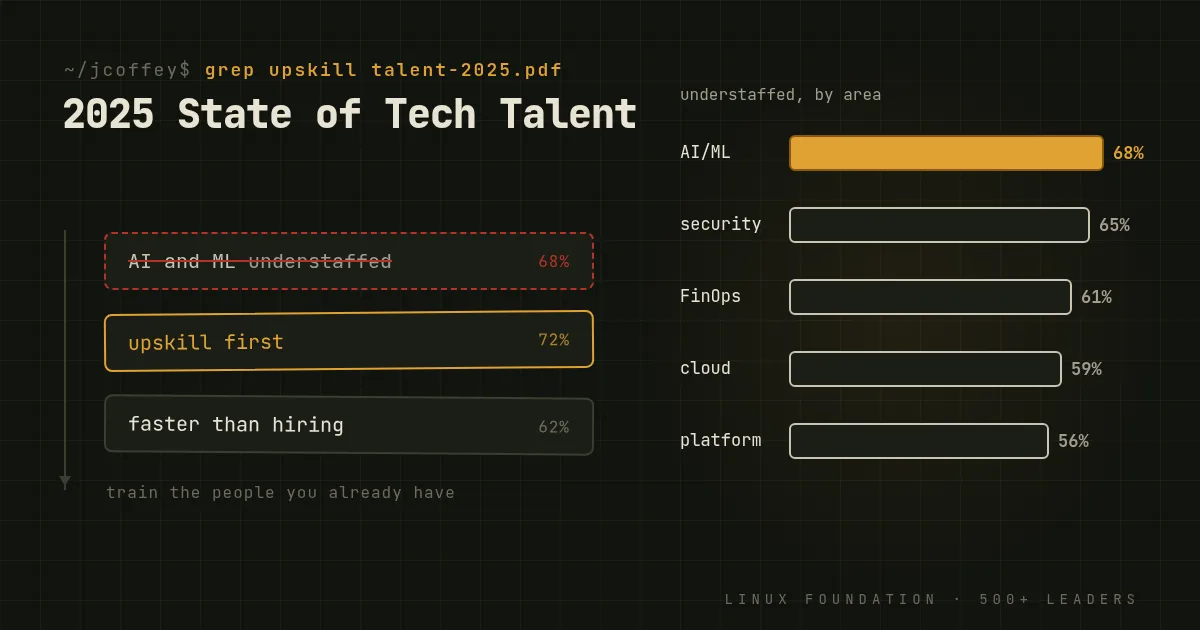
The share of organizations short of staff in each area:
| Area | Understaffed |
|---|---|
| AI and machine learning | 68% |
| Cybersecurity and compliance | 65% |
| FinOps and cost optimization | 61% |
| Cloud computing | 59% |
| Platform engineering | 56% |
And 44% say a shortage of skilled workers is a major barrier to adopting new technology. The skills problem isn't only an HR problem. It's slowing projects down.
Training beats hiring
This is the clearest finding in the report:
- 72% now prioritize upskilling their existing staff, up from 48% in 2024.
- Upskilling is 62% faster than hiring new talent.
- 56% rely on upskilling, rather than hiring or contracting, to fill AI and ML skill needs.
- 91% say technical training is an effective way to keep people.
It makes sense. Your own people already understand the business, its systems and its customers. Teaching them a new skill is quicker than teaching a new hire everything else.
Certifications and open source count
- 71% consider certifications important when hiring, as a way to confirm what someone can actually do.
- 84% say an open source culture improves retention.
- 40% use open source frameworks, models and tools to speed up their AI work.
What to take from it
If you lead a team: invest in training before you open a requisition. It's faster, and the people you train are more likely to stay. Give them room to work in the open source projects you depend on.
If you work in HR: build training paths that end in something people can show, such as a certification or a real project. Use your open source involvement when recruiting. It matters to candidates.
If you're building a career: learn how AI fits into your work, and get stronger in cloud and security, where the gaps are widest. Contribute to open source. Those are skills you can prove in public.
The full report, with its methodology and data, is free from the Linux Foundation and published under a Creative Commons license.