Companies succeed or fail on their people. Yet in tech, healthcare, finance and almost everywhere else, plenty of firms make the same set of mistakes. They overlook the people they already have. They don't pay them fairly. Then they try to fix the result with outside hires and trendy perks.
It doesn't work, and it costs more than doing it right.
Passing over your own people
When a company keeps filling senior roles from outside, its own staff notice. The message they hear is that there's no way up here. The ambitious ones, the people you most want to keep, take that message seriously and leave.
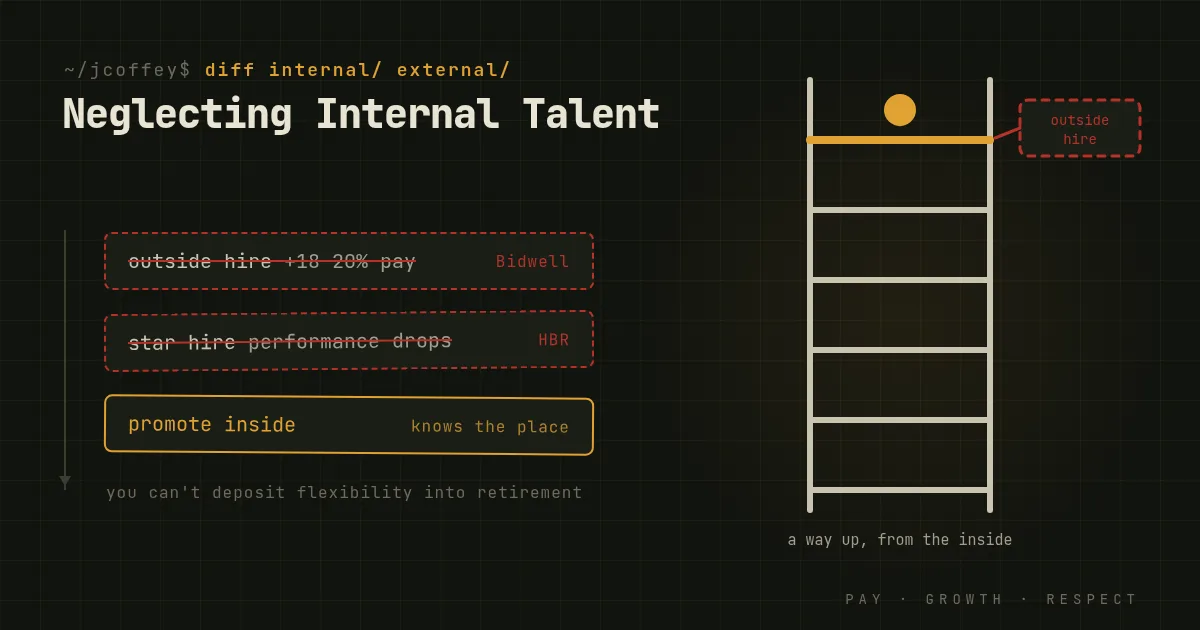
The outside hire isn't a bargain either. Matthew Bidwell at Wharton studied seven years of data from a US financial services firm, published in 2011 as Paying More to Get Less. External hires were paid about 18 to 20% more than internal staff promoted into similar jobs. Yet they got lower performance reviews for their first two years and were more likely to leave.
The reasons aren't mysterious. An internal candidate already knows the systems, the customers, the history and who to ask. An outside hire has to learn all of that while being paid more than the colleagues teaching them, which doesn't help anyone's morale.
Outside hires have their place: a skill nobody inside has, or a team that needs a fresh view. But as a habit, it spends more and gets less.
Pay is a message
Pay isn't just a number. It tells people what the company thinks they're worth. When it falls behind what they contribute, or behind the cost of living, they hear that message clearly, and the best of them can get paid more elsewhere.
When companies finally act, it's often because people started leaving. In 2021, junior analysts at Goldman Sachs put together a presentation about 95-hour work weeks that leaked and spread widely. Within months, the big Wall Street banks raised first-year analyst pay sharply, to around $100,000 and more. They could have done that before the burnout made the news.
Reviewing pay against the market regularly, before people start resigning, is cheaper than replacing them.
Hiring a star won't fix the system
It's tempting to believe one brilliant outsider can turn a struggling team around. The research disagrees. Boris Groysberg, Ashish Nanda and Nitin Nohria followed more than a thousand star Wall Street analysts who changed firms, writing it up for Harvard Business Review in 2004. After moving, their performance typically dropped and stayed lower for years. Much of what made them stars came from their old firm's people, systems and support, and it didn't move with them.
The same goes for filling gaps with contractors and consultants while ignoring the full-time staff. It can plug a hole for a while. But if the real problem is the culture, the workload or the pay, nobody brought in from outside can fix that. The full-time staff who are left end up supporting the contractors, and feel even less valued.
There's no shortcut for a systemic problem. It has to be fixed from the inside.
The illusion of flexibility
Unlimited PTO sounds generous. In practice it often means fewer days off. Without a set number, nobody knows what's acceptable, so people take less than they would have, especially when they're worried about how it looks. And when someone leaves, there's no unused balance to pay out. Several HR data firms have reported that people on unlimited plans take the same or fewer days than people with a fixed allowance.
Flexible schedules are genuinely valuable. Plenty of people found during the pandemic that they work better remotely or on their own hours. But without clear boundaries, "work whenever" quickly becomes "work all the time," with messages at night and on weekends and nobody ever quite off.
None of these perks is bad on its own. The problem is using them instead of fair pay and a reasonable workload. You can't deposit flexibility into your retirement account.
The long-term bill
The bill for all this comes in three forms:
- Lost knowledge. Every experienced person who leaves takes years of understanding with them. Some of it was never written down.
- Lower morale. The people who stay pick up the work of those who left, and see what the company really values.
- A worse reputation. Former employees write reviews, talk to friends and post online. Candidates read all of it.
Companies that invest in their people build the opposite: experience that stays, people who train the next generation, and a reputation that recruits for them.
What to do instead
- Look inside first. Post roles internally, and give your own people a real shot at them.
- Build ways up. Mentoring, training and clear paths to the next role, so growing doesn't mean leaving.
- Pay fairly, and check regularly. Compare pay with the market every year, and fix gaps before they become resignations.
- Make flexibility real. If time off is unlimited, set a minimum and have leaders take it visibly. Set clear hours when people are expected to be reachable, and when they aren't.
- Fix causes, not symptoms. If good people keep leaving, find out why before hiring anyone.
Retention isn't about free coffee or unlimited vacation. It's about trust, opportunity and fairness. Pay people well, treat them with respect and give them room to grow, and they'll put their energy into the company's future. Neglect them, and they'll take that energy somewhere else.